Compare Money Transfer Rates: Find Cheapest Apps & Promo Codes


TL;DR:
- The most cost-effective way to send money from the U.S. is to compare providers based on the recipient amount after fees and markups. Many banks charge higher exchange-rate markups, making specialist providers cheaper despite similar advertised fees. Using live comparison tools like Idealremit ensures you see real-time, corridor-specific quotes and get the most money to your recipient.
The cheapest way to send money from the U.S. is to compare providers by the amount your recipient actually receives, not the advertised fee, and apply corridor-specific promo codes only when they push that number higher. Run a live comparison on Idealremit for your exact corridor and amount before every transfer.
Here is why that matters immediately: the mid-market exchange rate is the real benchmark, and most providers charge noticeably above it. Banks like Chase and HSBC generally cost considerably more than specialist digital providers due to hidden exchange-rate markup, resulting in a substantial difference in what your recipient ultimately receives. Promo codes are often first-transfer-only and capped at a fixed dollar credit, so they can beat the regular best provider for a single send but rarely change the math for recurring remittances.
Table of Contents
- What really determines which provider is cheapest?
- How do you compare money transfer providers correctly?
- How do promo codes and exclusive offers actually work?
- Which apps and comparison tools give you live quotes?
- Does transfer size change which provider wins?
- How do you verify a provider is safe for U.S. senders?
- How does Idealremit calculate "best rate" and estimate savings?
- Key Takeaways
- The gap between "cheapest" and "actually cheapest"
- Idealremit makes the comparison straightforward
- Useful sources
- FAQ
What really determines which provider is cheapest?
Most people look at the transfer fee. That is the wrong number.
The true cost of any international transfer has five components, and only one of them is usually visible upfront.
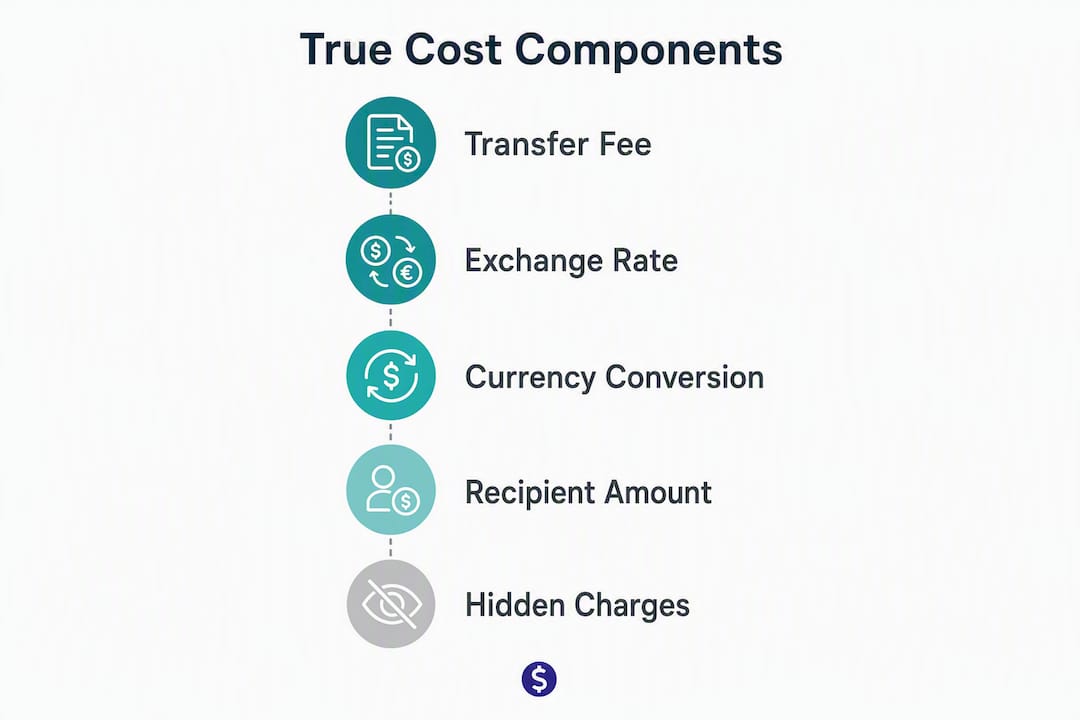
| Cost Component | What It Is | Typical Range |
|---|---|---|
| Transfer fee | Fixed or percentage fee shown at checkout | varies |
| Exchange-rate markup | Gap between mid-market rate and provider rate | varies, often higher for banks than specialists |
| Receiving bank fee | Fee charged by the recipient's bank on arrival | varies |
| Card/issuer surcharge | Extra charge when funding with a credit or debit card | often applies |
| Weekend/holiday spread | Wider markup applied outside market hours | varies |
The exchange-rate markup is where providers hide most of their profit. A provider advertising a "$5 fee" but marking up the exchange rate by 3% actually costs $35 on a $1,000 transfer: the $5 fee plus $30 buried in the rate. A transparent provider charging a 0.5% fee with no markup costs $5. Same advertised fee structure, $30 difference in what your recipient gets.
The only reliable metric is the recipient amount. Compare what lands in your recipient's account after every fee and markup is applied - not what the provider advertises on its homepage.
Pro Tip: Always use the "recipient gets" field in any comparison tool, not the "send amount" field, as your primary decision metric. Two providers with identical advertised fees can deliver amounts that differ by $40 or more on a $1,000 transfer.
For a deeper look at why exchange-rate markups matter more than fees, Idealremit's blog breaks down the mechanics clearly.
How do you compare money transfer providers correctly?
Follow this checklist every time you send. The steps are the same whether you are sending $200 to Mexico or $5,000 to the Philippines.
- Enter your exact send amount. Pricing tiers shift at specific thresholds; a quote for $999 may differ from one for $1,001.
- Select your source and destination currencies. The best provider is highly corridor-specific - rates competitive for USD→INR may be expensive for USD→NGN.
- Choose your payment method. Bank debit (ACH) is almost always cheaper than a debit or credit card. Card funding adds 1.5-3% in most cases.
- Select your payout method. Bank deposit, mobile wallet, and cash pickup carry different fees and speeds.
- Enter any promo code in the designated field before reading the final recipient amount.
- Compare transfer speed. A provider that is $8 cheaper but takes 4 days may not suit an urgent send.
- Check the timestamp. Mid-market rates update every 5-60 minutes depending on the provider; a quote from 2 hours ago is stale.
A worked example at $1,000
Say you are sending $1,000 USD to India. Provider A advertises a $0 fee but applies a 2.5% exchange-rate markup. Provider B charges a $4.99 fee and uses the mid-market rate with a 0.5% markup. On a $1,000 send:
- Provider A: $1,000 × (1 - 0.025) = $975 equivalent delivered, minus nothing in fees = $975 net
- Provider B: ($1,000 - $4.99) × (1 - 0.005) = $995.01 × 0.995 = ~$990 net
Provider B delivers roughly $15 more despite charging a visible fee. That gap scales with amount.
Red flags to watch: "Zero fee" with no mid-market disclosure; card funding without a surcharge warning; no timestamp on the quoted rate; transfer limits that change pricing at higher amounts; weekend rates that are not flagged as wider than weekday rates.
According to best practices for choosing a remittance service, verifying these details before committing to a provider is the single step most senders skip.
How do promo codes and exclusive offers actually work?
Promo codes come in three formats: a percentage off the transfer fee, a fixed-dollar credit applied to the fee, and a first-transfer bonus (sometimes a fee waiver or a boosted exchange rate for the first send). All three have limits.

Most codes are first-time-only and corridor-restricted. A code that waives a $5 fee on your first transfer to Morocco does nothing for your second transfer, and nothing at all for a transfer to Colombia. Some codes are capped at a maximum benefit, so a "10% off fees" code on a $5,000 transfer might be capped at $15 savings.
Promotional rates can temporarily beat market leaders but may not offer the best value for subsequent, non-promotional transfers. For anyone sending money monthly, a provider that consistently delivers $10 more per transfer beats a one-time promo that saves $20 once.
Where to find legitimate promo codes:
- The provider's own app or website (often displayed at signup or in push notifications)
- Comparison platforms like Idealremit, which surface corridor-specific offers alongside live quotes
- Email newsletters from providers you have registered with
- Fintech deal aggregators (verify the code is current before applying)
Verification checklist before using a code:
- Confirm the expiry date
- Check corridor eligibility
- Read the cap on maximum benefit
- Verify the code applies to your payment method (some codes exclude card payments)
- Compare the final recipient amount against the best non-promo provider
Which apps and comparison tools give you live quotes?
The feature that separates a useful comparison app from a useless one is whether it shows you the recipient amount in real time, not a cached rate from yesterday.
Features that matter in a comparison tool:
- Live quote refresh (ideally every 2-15 minutes, not daily)
- Recipient-amount calculation that factors in both the fee and the FX markup
- A promo-code entry field that recalculates the recipient amount instantly
- Rate alerts that notify you when a corridor rate improves
- Corridor depth (coverage of your specific send/receive country pair)
- Clean mobile UX that does not bury the recipient amount below the fold
Idealremit aggregates live quotes, supports rate alerts, and computes recipient amount automatically across 100+ countries, making it the recommended starting point for U.S. senders. The US comparison page shows corridor-specific quotes with fees and FX markup broken out separately, so you see exactly where the cost is coming from.
Platforms like user-reviewed remittance apps highlight that UX quality varies significantly across tools, and apps that bury the recipient amount or require account creation before showing quotes add friction that costs senders real money.
Pro Tip: The most useful screen in any comparison app is the quote view that shows recipient amount, transfer fee, and exchange-rate margin side by side. If an app only shows the exchange rate without the fee, or only the fee without the rate, it is hiding part of the cost.
Does transfer size change which provider wins?
Yes, and the shift is more dramatic than most senders expect.

| Transfer Band | Dominant Cost Driver | Which Model Usually Wins |
|---|---|---|
| Under $500 | Fixed transfer fee | Low or zero fixed fee, even with moderate FX markup |
| $500-$5,000 | Exchange-rate markup | Mid-market rate + transparent fee (0.3-0.7%) |
| Over $10,000 | Both, plus relationship pricing | Specialist FX desks or providers with large-transfer tiers |
For transfers above roughly $500, providers matching the mid-market rate with a transparent fee of 0.3-0.7% are usually cheaper than providers hiding profit in the FX rate. Below $500, a $0-fee provider with a 1.5% markup may still beat a $4.99-fee provider with a 0.4% markup simply because the absolute dollar difference on a small amount is small.
On a typical $1,000 transfer, switching from a major bank to a low-markup provider can save a meaningful amount per transfer. For senders making monthly transfers, these savings can add up significantly over the course of a year.
For large transfers above $10,000, the math changes again. High-volume transfers often unlock distinct pricing, and senders should explicitly check large-transfer pricing tiers or call provider sales desks for better bulk rates. Some providers offer dedicated FX desks for amounts above $50,000 with rates closer to the interbank mid-market.
Timing matters too. Mid-market rates change continuously; provider rates update every 5-60 minutes. Avoid sending on weekends or public holidays when spreads widen. Set a rate alert on Idealremit for your corridor, and check the live quote immediately before you execute, not the day before.
Pro Tip: For transfers above $10,000, call the provider's sales desk directly and ask for their large-transfer rate. The published rate on the website is often not their best offer at that volume.
How do you verify a provider is safe for U.S. senders?
A cheap rate from an unregistered provider is not a deal. It is a risk.
Trust signals to check before sending:
- FinCEN registration: U.S. money transmitters must register with the Financial Crimes Enforcement Network. Check the FinCEN MSB registrant search before using any unfamiliar service.
- State licensing: Most states require separate money transmitter licenses. A provider registered federally but unlicensed in your state may still be operating illegally.
- Encryption and security: Look for TLS/SSL on all pages, two-factor authentication at login, and a clear privacy policy.
- KYC procedures: Legitimate providers ask for identity verification. If a service sends money without any ID check, that is a red flag, not a convenience.
- Public reviews: Trustpilot ratings and volume of reviews give a signal on reliability and customer service quality. A provider with 50,000 reviews and a 4.2-star rating is more verifiable than one with 12 reviews and a 5-star score.
- Dispute resolution: Check that the provider has a visible complaints process and a customer support channel that responds within 24-48 hours.
For a detailed breakdown of what separates trusted remittance providers from risky ones, Idealremit's blog covers the key criteria. Separately, the guide to transferring money securely walks through common scams and how to avoid them.
How does Idealremit calculate "best rate" and estimate savings?
Idealremit pulls live quotes from provider APIs, computes the FX markup as the percentage gap between the mid-market reference rate and the provider's quoted rate, and then calculates the recipient amount using the formula: recipient amount = (send amount - transfer fee) × provider exchange rate.
| Input | Example Value |
|---|---|
| Send amount | $1,000 USD |
| Transfer fee | $4.99 |
| Recipient amount | ($1,000 - $4.99) × 83.10 = 82,768 INR |
| Quote timestamp | Refreshed within last 15 minutes |
Comparison tools compute the FX markup as the percentage gap between mid-market and provider quote and show total all-in cost refreshed from live provider APIs. Idealremit timestamps each quote so you know exactly how fresh the data is.
Limitations to know: Some providers do not expose real-time rates via API; their quotes may refresh less frequently. Card-funded transfers on certain corridors may not be available through the comparison tool. Always confirm the final rate on the provider's own site immediately before completing a transfer, since rates update every 5-60 minutes and the comparison quote is a snapshot, not a lock.
Key Takeaways
The single most reliable way to find the cheapest international transfer is to compare the recipient amount across live quotes, not the advertised fee, and use promo codes only when they demonstrably increase that amount.
| Point | Details |
|---|---|
| Recipient amount is the metric | Compare what lands in your recipient's account, not the advertised transfer fee. |
| Banks cost 3-5% more | Hidden exchange-rate markup at major banks adds $30-$50 on a $1,000 transfer versus specialist providers. |
| Promo codes have limits | Most codes are first-transfer-only and corridor-restricted; test them against the best non-promo provider before applying. |
| Transfer size shifts the math | Above $500, mid-market rate plus a 0.3-0.7% fee usually wins; below $500, a zero-fee provider may still come out ahead. |
| Use Idealremit for live comparisons | Idealremit computes recipient amount automatically across 100+ countries and surfaces corridor-specific promo codes alongside live quotes. |
The gap between "cheapest" and "actually cheapest"
Most senders focus on the wrong number. The advertised fee is the number providers want you to see. The exchange-rate markup is the number that actually determines what your recipient gets. After years of watching this play out across hundreds of corridors, the pattern is consistent: the provider with the lowest advertised fee is rarely the cheapest all-in option.
What surprises people is how much the corridor matters. A provider that is genuinely competitive for USD→MXN can be 2% more expensive than the best option for USD→PHP. No single provider wins every corridor, which is exactly why running a live comparison at execution time, rather than trusting a review from six months ago, is the only approach that holds up. Promo codes are real savings when they apply, but they are a one-time event. The habit of comparing recipient amounts on every transfer is where the consistent money is.
Idealremit makes the comparison straightforward
If you are sending money from the U.S. and want to know which provider delivers the most to your recipient right now, the fastest path is a live comparison on Idealremit. The platform pulls real-time quotes, breaks out the transfer fee and FX markup separately, and shows you the recipient amount for your exact corridor and send amount.

To use a promo code, enter it in the promo field on the comparison results page before clicking through to the provider. The recipient amount recalculates instantly so you can see whether the code actually improves the outcome versus the next-best option. Rate alerts let you set a target rate for your corridor and get notified when a provider hits it, so you are not checking manually every day.
Run a live comparison for your corridor now and see which provider delivers the most to your recipient today.
Useful sources
- Idealremit US comparison tool: Live quotes for U.S. senders with recipient-amount calculation and rate alerts.
- Idealremit blog: banks vs. remittance companies: Explains why banks cost more and when specialist providers win.
- Idealremit blog: low-cost provider list: Guidance on building a long-term low-cost sending strategy.
- FinCEN MSB registrant search: Verify that any U.S. money transmitter is federally registered before sending.
- TransferFees.io: Fee calculator covering 50+ services with fixed fees, percentages, and exchange-rate markup in one view.
This article is general information, not financial or legal advice. Verify current rates, fees, and provider licensing directly with the provider and relevant regulatory bodies before sending.
FAQ
Which money transfer app gives the best exchange rates?
No single app wins every corridor. The best rate for USD→INR may come from a different provider than the best rate for USD→NGN, so run a live corridor-specific comparison on Idealremit immediately before sending.
What is the cheapest way to compare transfer fees?
Use a comparison tool that shows the recipient amount, not just the advertised fee. Tools like Idealremit factor in both the transfer fee and the exchange-rate markup so you see the true all-in cost.
Do promo codes actually save money on international transfers?
Sometimes, but only for a single transfer. Most codes are first-time-only and corridor-restricted; always compare the promo recipient amount against the best non-promo provider before applying a code.
How often do money transfer rates change?
Mid-market rates change continuously, and provider rates update every 5-60 minutes depending on the provider's pricing engine. Always compare immediately before sending, not hours or days in advance.