

TL;DR:
- Use a regulated comparison tool like Idealremit to check live fees and exchange-rate markups before selecting a provider registered with FinCEN and licensed in your state. Verifying regulatory compliance, fee transparency, and payout options ensures safer and more cost-effective international transfers. Running real-time rate comparisons helps U.S. senders find the lowest net cost across multiple licensed providers.
If you're searching for cuex.com alternatives, the short answer is this: use a regulated comparison tool like Idealremit to check live fees and exchange-rate markups, then choose a provider registered with FinCEN and licensed in your state. Independent reviewers have flagged cuex.com for unclear fees and missing regulatory disclosures, which is exactly why the first move is verification, not sign-up.
Three quick checks before you send a dollar anywhere:
- FinCEN registration: Search the provider's legal name at fincen.gov. No listing means no federal money-services registration.
- State money-transmitter license: Most states require a separate license. Your state banking regulator's website has a lookup tool.
- Transparent fee + rate breakdown: The provider must show you the transfer fee AND the exchange-rate markup before you confirm. If either is hidden, stop.
One more thing worth knowing: "CUEX" also appears as a cryptocurrency token with its own price charts and trading pairs. That is a completely different product. If you landed here researching a remittance site, double-check the exact domain and service type before comparing anything.
Table of Contents
- What are the best cuex.com alternatives for U.S. senders?
- How do you choose the right alternative to cuex.com?
- How we evaluated these alternatives
- How do you verify a money transfer provider is legitimate?
- What do typical transfer timelines and costs look like?
- Key Takeaways
- Why a comparison-first approach protects U.S. senders
- Compare live rates now with Idealremit
- Useful sources
- FAQ
What are the best cuex.com alternatives for U.S. senders?
The providers below cover the most common use cases for Americans sending money abroad. Net cost, speed, and payout flexibility vary significantly across them.
| Provider | Total cost (fees + markup) | Speed | Best for | Payment methods | Payout options | Transfer limits | Compliance |
|---|---|---|---|---|---|---|---|
| Wise | Low markup (near mid-market); flat fee | Minutes to 1-2 days | Large bank-to-bank transfers | Bank, debit, credit | Bank deposit | Up to $1M+ (varies by corridor) | FinCEN registered, state licensed |
| Remitly | Low fees; promotional rates for first transfer | Minutes (Express) or 3-5 days (Economy) | Small remittances, mobile wallet delivery | Debit, credit, bank | Bank, mobile wallet, cash pickup | Varies by country | FinCEN registered, state licensed |
| Western Union | Higher fees; wide rate variance | Minutes to 1-2 days | Cash pickup, urgent transfers | Bank, debit, credit, cash | Cash pickup, bank, mobile wallet | Varies by corridor | FinCEN registered, state licensed |
| MoneyGram | Moderate fees; competitive on select corridors | Minutes to 1 day | Cash pickup, agent network | Bank, debit, credit | Cash pickup, bank deposit | Varies by corridor | FinCEN registered, state licensed |
| WorldRemit | Low to moderate fees | Minutes to 1-2 days | Mobile wallet delivery, airtime top-up | Debit, credit, bank | Bank, mobile wallet, cash, airtime | Varies by country | FinCEN registered, state licensed |
| Xoom (PayPal) | Moderate fees; markup varies | Minutes to 1 day | PayPal users, cash delivery | PayPal balance, bank, debit | Bank, cash pickup, home delivery | - | FinCEN registered, state licensed |
| OFX | Low markup; no transfer fee above minimum | 1-2 business days | Large transfers, business payments | Bank transfer (ACH/wire) | Bank deposit | $1,000 minimum | FinCEN registered, state licensed |
| Idealremit | Comparison tool: shows live fees + markups across providers | Real-time data | Finding the lowest net cost for any corridor | N/A (comparison tool) | Depends on chosen provider | N/A | N/A (aggregator, not a sender) |
Pro Tip: Net cost is not the transfer fee alone. Calculate it as: (amount sent × exchange-rate markup %) + flat fee. A provider charging $0 in fees but using a 3% markup on a $1,000 transfer costs you $30 in hidden markup. Always compare the total.
How do you choose the right alternative to cuex.com?
Start with regulation, then work down to cost. Here is the prioritized checklist:
- Regulation first: Confirm FinCEN registration and your state's money-transmitter license. No license disclosure on the provider's website is a hard stop.
- Fee transparency: The provider must show the exact fee before you confirm, not after.
- Exchange-rate source: Ask whether the rate is mid-market-based or includes a markup. A provider that only shows a "guaranteed rate" without disclosing the spread is hiding cost.
- Payment and payout methods: Confirm the recipient can actually receive funds the way they need (bank deposit, cash pickup, mobile wallet).
- Transfer limits: Check both the minimum and maximum for your corridor. OFX, for example, requires a minimum transfer amount, which may rule it out for small remittances.
- Customer support: Look for a phone number or live chat. Email-only support is a red flag for dispute resolution.
Sample net-cost calculation
Use this formula for any transfer:
Net cost = flat fee + (send amount × exchange-rate markup %)
Example 1: moderate size transfer Provider charges a fixed fee and a percentage markup. Net cost is the combination of both components.
Example 2: larger transfer Same provider, same markup. Net cost increases accordingly and is dominated by the percentage markup for large amounts.
At larger amounts, the exchange-rate markup dominates. That is why Wise and OFX tend to win on big transfers while Remitly's flat-fee structure suits smaller amounts.
Questions to ask and red flags to watch
- Is the provider registered with FinCEN? Can you find the registration number?
- What is the exact exchange rate you will receive, and how does it compare to the mid-market rate on Google?
- What is the refund policy if the transfer fails or is delayed?
- How do you file a dispute, and what is the resolution timeline?
Red flags: no regulatory disclosure on the website, a physical address that cannot be verified, requests for payment via gift card or cryptocurrency, and exchange-rate markups above 3-4% with no explanation.
Pro Tip: Run the same $500 transfer quote on three providers simultaneously. Idealremit's live comparison tool pulls real-time rates so you can see the net cost side by side without visiting each site separately.
How we evaluated these alternatives
Every provider in this article was assessed across the same dimensions using publicly available data.
| Evaluation axis | Evidence type |
|---|---|
| Total cost (fees + markup) | Live rate quotes from provider websites; published fee schedules |
| Transfer speed | Provider-stated timelines by payment method and corridor |
| Regulatory compliance | FinCEN MSB registrant search; state regulator license lookups |
| Payout options | Provider help centers and transfer flow screenshots |
| Transfer limits | Published limit tables per corridor |
| Customer support | Published contact channels; user-review signals |
| User reputation | Aggregated review signals from independent platforms |
One important distinction: institutional FX platforms like Curex Group operate under different eligibility and compliance requirements than retail remittance services. They are not substitutes for a U.S. sender moving $500 to a family member abroad. Similarly, crypto swap aggregators focus on token liquidity, not consumer remittance, and carry different regulatory profiles entirely.
Readers should run live rate checks immediately before committing to a transfer. Published rates shift throughout the day.
How do you verify a money transfer provider is legitimate?
Follow these steps in order before sending funds to any new provider:
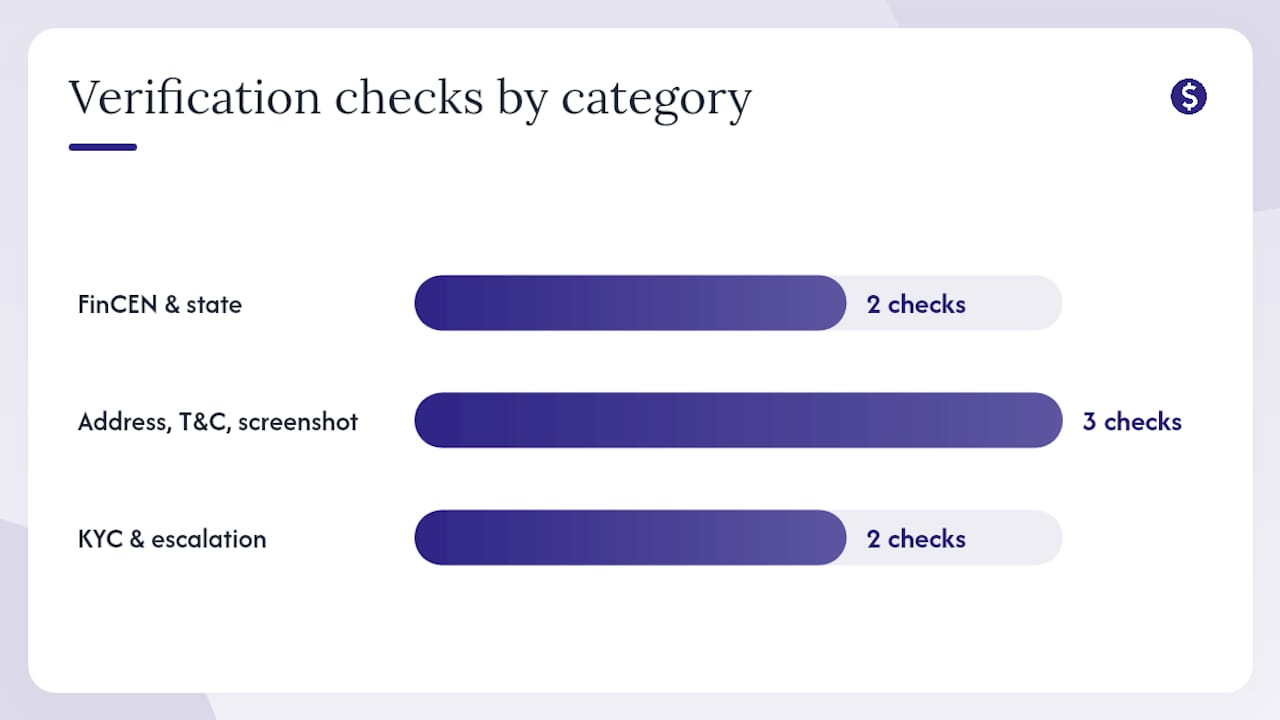
- Search FinCEN's MSB registrant database at fincen.gov using the provider's legal business name.
- Check your state's money-transmitter license list. Most state banking departments publish a searchable registry.
- Verify the company's physical address using a business registry or Google Maps. A virtual-only address with no verifiable office is a warning sign.
- Read the Terms and Conditions for fee disclosure language and the dispute resolution process. Vague language like "rates may vary" with no formula is a red flag.
- Confirm KYC requirements. Legitimate providers ask for government-issued ID. Any provider that skips identity verification is not compliant with U.S. AML/CFT rules.
- Escalate if needed. If a transfer goes wrong, file a complaint with your state banking regulator or submit a tip to FinCEN. You can also initiate a chargeback through your bank or card issuer for card-funded transfers.
Review platforms have flagged cuex.com for missing licensing information and opaque fee language. Those are exactly the failure points this checklist catches.
Pro Tip: Screenshot the published rate and fee before you hit "confirm." If a dispute arises, that screenshot is your evidence that the provider showed you a specific rate at a specific time.
What do typical transfer timelines and costs look like?
Speed and cost depend on the payment method, corridor, and delivery option you choose.
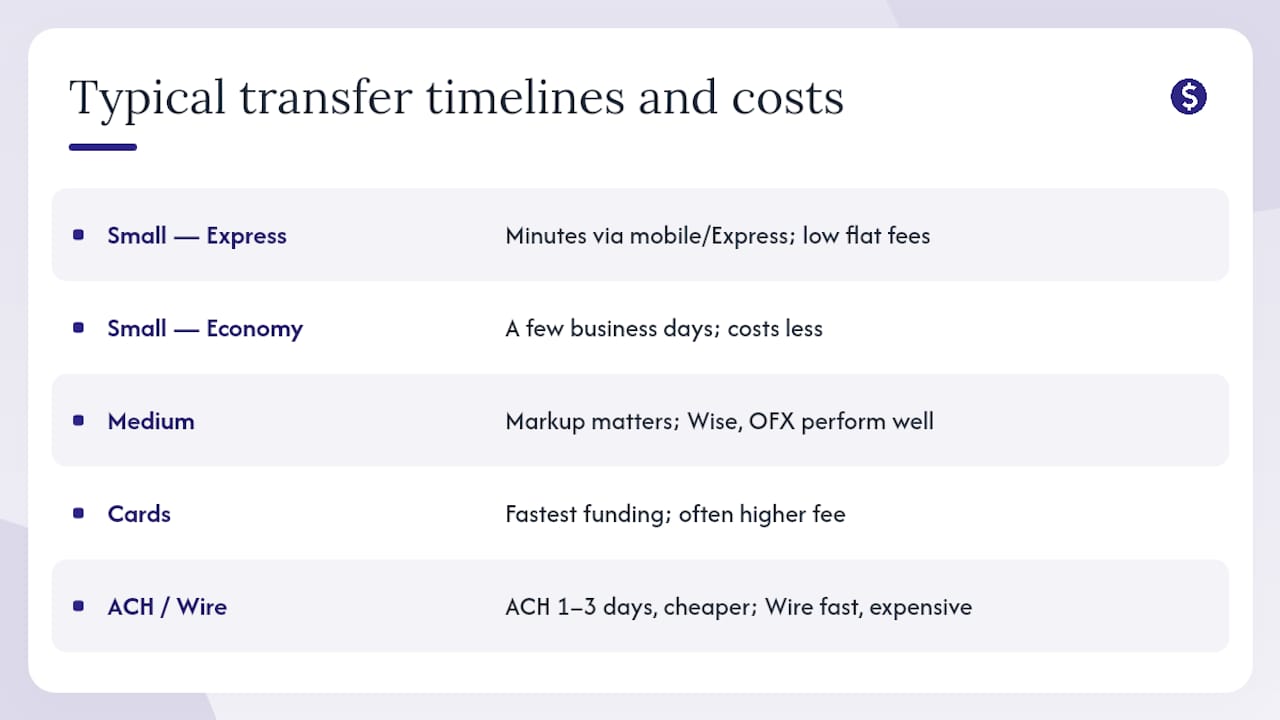
For small transfers, expect to pay low flat fees on competitive platforms like Remitly or WorldRemit, with delivery in minutes via mobile wallet or Express service. Economy options on the same platforms take a few business days but cost less. The exchange-rate markup on this tier is generally low, so the total net cost for typical amounts varies depending on the provider and corridor.
For medium transfers, the markup matters far more than the flat fee. Wise's near-mid-market rate structure and OFX's no-fee model perform well here. Bank-to-bank transfers in this range typically settle in a couple of business days. Cash pickup via Western Union or MoneyGram can be available very quickly, but the exchange-rate spread is usually wider.
Payment method also affects speed. Debit and credit card funding is fastest but often carries a higher fee. ACH bank transfers are slower (1-3 days to fund) but cheaper. Wire transfers are fast and expensive.
Key Takeaways
The safest path to a cost-effective international transfer is to verify regulation first, calculate net cost (fee + exchange-rate markup), and use a live comparison tool before committing.
| Point | Details |
|---|---|
| Verify regulation before anything | Confirm FinCEN registration and state money-transmitter licensing before sending a dollar. |
| Net cost beats headline fees | Calculate fee + exchange-rate markup together; markup often costs more than the flat fee on transfers above $500. |
| Speed vs. cost tradeoff | Card-funded transfers arrive fastest; ACH bank transfers cost less but take 1-3 days to fund. |
| Red flags to pause a transfer | No licensing disclosure, hidden markup language, or requests for gift card/crypto payment mean stop immediately. |
| Use Idealremit to compare live | Idealremit's US comparison tool shows real-time fees and rates across providers so you can find the lowest net cost for your corridor. |
Why a comparison-first approach protects U.S. senders
The conventional advice is to pick a "trusted brand" and send. That works until it doesn't. The providers that dominate name recognition are not always the ones with the lowest net cost for your specific corridor, and brand familiarity has nothing to do with whether a provider is licensed in your state.
What actually protects you is the workflow: check regulation, compute net cost, then send. The reason Idealremit recommends a comparison-first approach is not because any single provider is always cheapest. It's because the spread between the best and worst net cost on a $1,000 transfer can easily exceed $30, and that gap is invisible unless you run the numbers side by side. Transparency in fee and rate disclosures is not a nice feature. It is the only way to know what you are actually paying.
The methodology here reflects that: live-rate sampling, regulator lookups, and published fee schedules. No provider paid for placement. The ranking reflects net cost and compliance, not marketing spend.
Compare live rates now with Idealremit
Sending money internationally from the U.S. means choosing between eight or more regulated providers, each with different fees, markups, and payout options depending on where the money is going. Idealremit cuts through that by showing you the real-time net cost for your exact corridor in one place.

Three things the tool does that matter for this search:
- Live rate comparison: Pulls current fees and exchange-rate markups across providers so you see total cost, not just the headline fee.
- Country coverage: Supports transfers to over 100 countries, with detailed breakdowns for corridors across Africa, Asia, Europe, and the Americas.
- Rate alerts: Set a target rate and get notified when a provider hits it, so you are not refreshing pages manually.
Compare providers now on Idealremit and run a free quote for your corridor before your next transfer.
Useful sources
| Source | Purpose |
|---|---|
| FinCEN MSB Registrant Search | Verify federal money-services business registration for any U.S. remittance provider |
| Traders Union cuex.com review | Independent review flagging fee opacity and regulatory concerns |
| Scamwave cuex.com review | Additional due-diligence flags and red-flag checklist |
| CUEX token price data (BitDegree) | Clarifies the crypto/remittance name confusion for CUEX |
For live rate checks, provider comparisons, and deeper guides on transfer security, visit the Idealremit blog and the US comparison page.
FAQ
What is the safest cuex.com alternative for U.S. senders?
Any provider registered with FinCEN and licensed in your state qualifies as regulated. Wise, Remitly, Western Union, MoneyGram, WorldRemit, Xoom, and OFX all meet that bar and publish transparent fee schedules.
How do I calculate the real cost of an international transfer?
Add the flat transfer fee to the exchange-rate markup: net cost = flat fee + (send amount × markup %).
Is cuex.com a legitimate money transfer service?
Independent reviewers have flagged cuex.com for unclear fees and missing regulatory disclosures. Verify any provider's FinCEN registration and state license before sending funds.
Why does "CUEX" sometimes show up as a cryptocurrency?
CUEX is also the ticker for a cryptocurrency token with its own price charts and trading pairs. If you are researching a remittance site, confirm the exact domain and service type to avoid confusing the two.
How long does an international transfer take from the U.S.?
Express or card-funded transfers through providers like Remitly or Western Union can arrive in minutes. Bank-funded (ACH) transfers typically take 1-3 business days to fund, with delivery in 1-5 business days depending on the corridor and payout method.