
TL;DR:
- Compliance in remittance involves adhering to legal standards to prevent money laundering and protect consumers. It requires providers to implement AML programs, verify identities through KYC, and monitor transactions in real-time while screening for sanctions. Following these rules ensures legal operation, fair consumer protections, and access to international payment corridors.
Compliance in remittance is defined as the full set of legal and regulatory obligations that govern international money transfers to prevent money laundering, terrorist financing, and fraud while protecting consumers. Regulatory bodies like the Financial Action Task Force (FATF) and the Financial Crimes Enforcement Network (FinCEN) set the standards that remittance providers must follow. AML programs, Know Your Customer (KYC) procedures, sanctions screening, and transaction monitoring form the backbone of what is compliance in remittance. Understanding these requirements protects you as a sender and keeps the providers you rely on operating legally.
What are the key compliance requirements in remittance operations?
Remittance compliance policies center on four core pillars: Anti-Money Laundering (AML) programs, KYC verification, real-time transaction monitoring, and sanctions screening. Each one addresses a specific risk in the money transfer chain.

AML programs require providers to build written policies, designate a compliance officer, train staff regularly, and submit to annual independent audits. AML compliance programs must be dynamic and demonstrable, not static documents filed away and forgotten. The audit requirement alone forces providers to update their controls as criminal methods evolve.
KYC procedures verify the identity of every sender and recipient before a transfer is processed. Providers collect government-issued ID, proof of address, and sometimes the source of funds for larger transactions. This step is the first line of defense against fraudulent transfers and identity theft.
Real-time transaction monitoring and sanctions screening are mandatory elements in AML compliance programs. Mandatory real-time monitoring means every transaction is checked against sanctions lists, Politically Exposed Persons (PEP) databases, and behavioral thresholds before funds move. A transaction that triggers a flag generates a Suspicious Activity Report (SAR), which goes directly to FinCEN.
- AML program with written policies and a designated compliance officer
- KYC identity verification for all senders and recipients
- Real-time transaction monitoring with SAR filing obligations
- Sanctions screening against OFAC, UN, and EU lists
- PEP checks to identify high-risk individuals in public office
Pro Tip: If a remittance provider asks for more documentation than you expect, that is a sign of a compliant operation, not an obstacle. Providers with strong KYC programs are far less likely to freeze your funds mid-transfer due to regulatory pressure.
How do remittance regulations affect businesses and consumers?
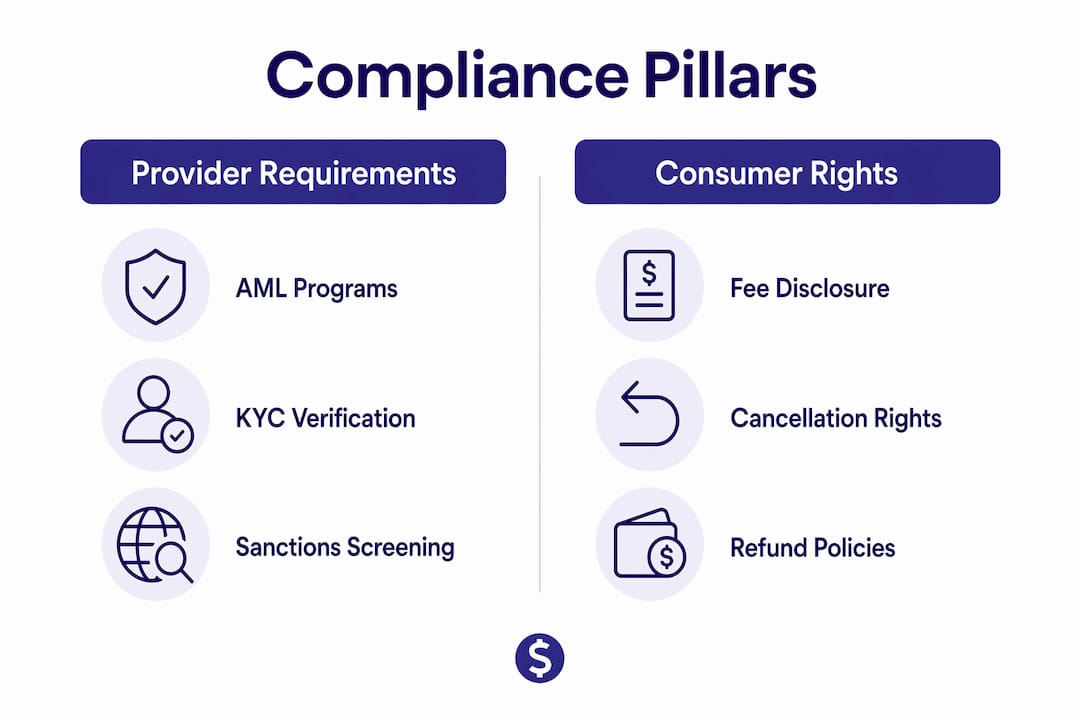
Remittance regulations create specific rights and obligations for both sides of a transfer. The rules differ depending on whether you are an individual sending money home or a business running a money transfer operation.
Consumer protections under the Remittance Transfer Rule
The Remittance Transfer Rule, enforced by the Consumer Financial Protection Bureau (CFPB), gives senders in the United States clear legal protections. Senders can cancel a transfer within 30 minutes if the funds have not yet been collected by the recipient, with refunds processed within 3 business days. That 30-minute window is short, so knowing it exists before you send is the practical takeaway. The rule also requires providers to disclose all fees, the exchange rate, and the exact amount the recipient will receive before the transaction is confirmed.
Business registration and operational deadlines
Money Services Businesses (MSBs) must register with FinCEN within 180 days of starting operations. Missing that deadline exposes a business to significant civil and criminal penalties. The Remittance Transfer Rule applies to any business processing more than 500 remittance transfers per year in the U.S. That threshold is lower than most new operators expect.
The table below summarizes the key compliance requirements for businesses versus the rights they create for consumers.
| Compliance requirement | Who it affects | Practical impact |
|---|---|---|
| MSB registration with FinCEN (180-day deadline) | Businesses | Mandatory before full operations begin |
| AML program with annual independent audit | Businesses | Ongoing operational cost and obligation |
| KYC identity verification | Both | Senders must provide valid ID; providers must verify it |
| Fee and exchange rate disclosure | Businesses | Consumers receive written disclosure before transfer |
| 30-minute cancellation window | Consumers | Right to cancel and receive a refund within 3 business days |
Effective AML compliance safeguards the financial system and protects consumers through transparency and fee disclosure. That dual function is why regulators treat compliance as non-negotiable rather than optional best practice.
What challenges do remittance providers face in maintaining compliance?
Compliance in remittance is operationally complex. Providers operating across multiple countries face a different regulatory framework in each jurisdiction, and those frameworks rarely align perfectly.
Multi-jurisdictional complexity is the most common pain point. A provider sending money from the U.S. to Morocco must satisfy FinCEN requirements in the U.S., Bank Al-Maghrib regulations in Morocco, and potentially FATF recommendations that both countries have adopted. Automated compliance platforms with tailored rulesets for each corridor replace manual processes that cannot scale across dozens of country pairs.
Third-party agent risk is a less visible but equally serious challenge. Agents and third-party partners represent significant compliance risks and require thorough screening and ongoing training. An agent who fails to verify a customer's identity creates liability for the entire provider network. Regular re-verification and documented training sessions are the standard mitigation.
- Multi-jurisdictional rule conflicts between origin and destination countries
- Agent networks that require continuous screening against PEP and sanctions lists
- Balancing strict KYC requirements with a fast, frictionless customer experience
- Keeping AML programs current as criminal typologies evolve
Pro Tip: When evaluating a remittance provider, check whether they publish their compliance certifications or regulatory licenses on their website. Licensed providers are accountable to regulators in ways that unlicensed operators are not.
Compliance programs that build trust with banks and regulators enable access to international payment corridors that non-compliant providers simply cannot reach. That access directly determines which countries a provider can serve and at what cost.
How can individuals and businesses ensure compliance in their remittance practices?
Understanding remittance regulations is not just a provider responsibility. Senders and businesses that use remittance services carry their own obligations and benefit from knowing their rights.
Choosing a compliant provider
The first step is selecting a provider that holds the appropriate licenses in your country. In the U.S., that means FinCEN registration and state-level money transmitter licenses. A trusted remittance provider will display its license numbers and regulatory affiliations clearly. Providers that avoid this transparency are a red flag.
Fulfilling your KYC obligations
KYC is a two-way process. Providers are required to collect your information, and you are required to provide accurate documentation. Submitting false information to pass a KYC check is a criminal offense in most jurisdictions. Keep your ID documents current and be prepared to explain the source of funds for large transfers.
Knowing your cancellation and refund rights
The 30-minute cancellation window under the Remittance Transfer Rule is a right, not a courtesy. If you make an error in a transfer, contact your provider immediately. Providers are legally required to process your refund within 3 business days once a valid cancellation is submitted.
Monitoring transaction alerts
Many providers offer transaction alerts by email or SMS. Enabling these alerts lets you spot unauthorized activity on your account before it becomes a larger problem. Idealremit's rate alert feature also helps you time transfers when exchange rates are most favorable, combining compliance awareness with cost savings.
- Verify your provider's FinCEN registration and state licenses before sending
- Submit accurate, current identity documents for KYC verification
- Enable transaction alerts to monitor your account in real time
- Know your 30-minute cancellation right and act on it immediately if needed
- Review fee disclosures and exchange rates before confirming any transfer
Key takeaways
Remittance compliance is a legal framework built on AML programs, KYC verification, sanctions screening, and consumer protection rules that every provider and sender must understand to transfer money safely and legally.
| Point | Details |
|---|---|
| AML programs are mandatory | Providers must maintain written AML policies, a compliance officer, and annual independent audits. |
| KYC protects both sides | Senders must provide accurate ID; providers are legally required to verify it before processing. |
| Consumer rights are enforceable | The Remittance Transfer Rule gives U.S. senders a 30-minute cancellation window and a 3-business-day refund timeline. |
| MSB registration has a hard deadline | Businesses must register with FinCEN within 180 days of starting operations or face penalties. |
| Technology closes compliance gaps | Automated platforms manage multi-jurisdictional rules more reliably than manual processes. |
Why compliance is the foundation, not the ceiling
Most people treat compliance as a cost center or a bureaucratic hurdle. After years of watching the remittance industry from the inside, I see it differently. Compliance is the reason a small money transfer operator can access the same banking rails as a global institution. Without a demonstrable AML program, banks will not open correspondent accounts, and without correspondent accounts, international transfers simply do not happen.
The risk-based approach to compliance is the insight that most articles miss. A risk-based AML framework tailors controls to specific customer and corridor risks rather than applying the same heavy scrutiny to every transaction. That distinction matters because over-compliance, treating every $200 transfer like a potential money laundering event, drives legitimate customers away and undermines financial inclusion. The best operators calibrate their controls precisely.
Technology is closing the gap between compliance complexity and operational reality. Automated platforms now handle sanctions screening, PEP checks, and SAR filing in milliseconds. That speed means compliance no longer has to slow down the customer experience. The providers who understand this are the ones building durable, scalable operations. The ones who treat compliance as a checkbox exercise are the ones regulators eventually shut down.
- Brahim
Idealremit helps you send money with confidence
Knowing the rules around remittance compliance is one thing. Finding a provider that actually follows them is another challenge entirely.

Idealremit compares trusted, licensed money transfer providers so you can see fees, exchange rates, and transfer speeds side by side before you commit. Every provider listed on the platform holds the regulatory licenses required in their operating markets. You can compare compliant transfer services across more than 100 countries and set up rate alerts to catch the best exchange rates automatically. For anyone sending money internationally, whether for family support, business payments, or personal transfers, Idealremit gives you the transparency the Remittance Transfer Rule requires providers to offer. Check the international transfer security checklist before your next transfer to make sure every step meets compliance standards.
FAQ
What does remittance compliance mean for everyday senders?
Remittance compliance means the provider you use must verify your identity, disclose all fees upfront, and follow anti-money laundering rules before processing your transfer. As a sender, you benefit from legal protections including the right to cancel within 30 minutes and receive a refund within 3 business days.
What is the Remittance Transfer Rule?
The Remittance Transfer Rule is a U.S. regulation enforced by the CFPB that applies to businesses processing more than 500 international transfers per year. It requires fee and exchange rate disclosure before every transfer and gives senders a 30-minute cancellation window.
What is KYC and why does it apply to remittance?
KYC stands for Know Your Customer and refers to the identity verification process every licensed remittance provider must complete before processing a transfer. It protects against fraud, money laundering, and terrorist financing by confirming that senders and recipients are who they claim to be.
How do I know if a remittance provider is compliant?
A compliant provider will display its FinCEN registration number, state money transmitter licenses, and regulatory affiliations on its website. It will also require identity verification before processing your transfer and provide a written fee and exchange rate disclosure.
What happens if a remittance provider fails compliance requirements?
Providers that fail compliance requirements face civil penalties, criminal charges, and loss of banking relationships that make international transfers possible. For consumers, non-compliant providers carry a higher risk of frozen funds, delayed transfers, and no legal recourse if something goes wrong.