
TL;DR:
- Dynamic transfer fees adjust in real time based on currency market or blockchain network conditions.
- Providers disclose these variable costs upfront to ensure transparency and fair charges for users.
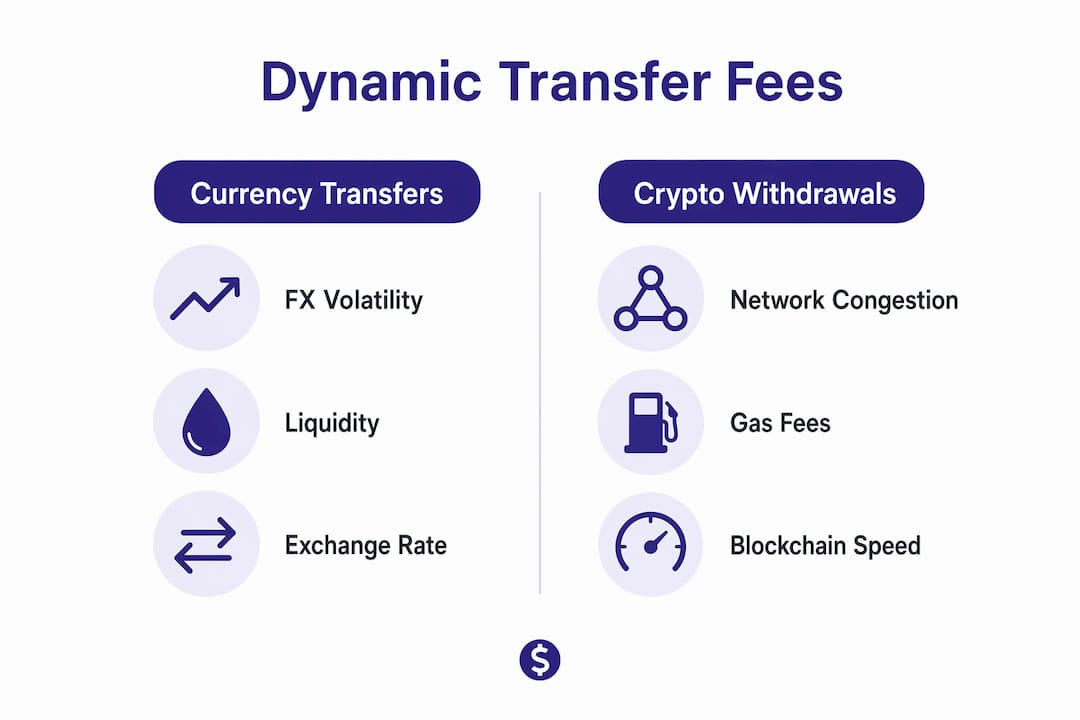
Dynamic transfer fees are variable charges that shift in real time based on live currency exchange costs or blockchain network conditions. Unlike a flat fee that stays the same regardless of when you send money, these charges move with the market. You'll encounter them in two main contexts: foreign currency transfers and crypto withdrawals.
In currency exchange, dynamic charges appear when you're sending a less commonly traded currency or when FX markets are unusually volatile. Wise, for example, shows these charges directly in its calculator before you confirm a payment. On the crypto side, platforms like Gemini and Kraken apply dynamic withdrawal fees that mirror real-time blockchain network costs, commonly called gas fees.
A few things worth knowing upfront:
- Dynamic fees can go up or down depending on market conditions.
- They reflect actual costs the provider is absorbing, not arbitrary markups.
- Reputable providers disclose them before you confirm a transaction.
- They differ from fixed fees, which stay constant regardless of market conditions.
How dynamic transfer fees work in practice
The mechanics differ depending on whether you're sending fiat currency or crypto, but the core logic is the same: the fee tracks a real underlying cost.

For currency transfers, FX market volatility and liquidity drive the charge. When demand for a currency pair spikes or liquidity thins out, the cost of executing that exchange rises. Wise reflects this by adding a dynamic charge on top of its standard fee for currencies where exchange costs shift frequently. The charge appears in the calculator before you initiate the transfer, so you see the full cost upfront.
For crypto withdrawals, the driver is blockchain network congestion. On Ethereum, every transaction requires gas, a computational fee paid to validators who process and secure the network. Gas fees consist of a base fee set by the protocol and an optional priority fee (tip) to speed up processing. When network activity is high, both components rise. Gemini's dynamic withdrawal fees are structured to match these current network fees exactly. Gemini does not pocket any portion of the fee.
Kraken takes a similar approach. Its funding fees can be either static or dynamic, depending on the method, currency, and network conditions. Fees are displayed at the point of transaction confirmation, not buried in fine print.
Pro Tip: Before you initiate any transfer, refresh the fee calculator or confirmation screen. Dynamic fees can change between the moment you start a transaction and the moment you confirm it.
Why providers use dynamic fees, and what they cost you
Providers don't use dynamic pricing arbitrarily. There's a practical reason: when the cost of executing a currency exchange or processing a blockchain transaction spikes, a fixed fee model forces the provider to either absorb the loss or suspend the service entirely.
Wise states this directly. Dynamic charges act as a pricing mechanism to keep transfer services available during volatile market conditions. Without them, providers would often have to halt transactions for less liquid currency pairs. The dynamic model keeps the service running while passing the actual cost to the sender transparently.
On the crypto side, Gemini frames its dynamic fees as a fairness mechanism. A fixed withdrawal fee would either overcharge users during low-congestion periods or undercharge during high-congestion ones. Mirroring network fees exactly means users pay only what the network actually costs.
The CFPB's Consumer Financial Protection Circular 2024-02 makes clear that remittance transfer costs include not just provider fees but also exchange rate spreads and third-party charges. Providers who advertise "no fee" transfers while embedding costs in the exchange rate spread are in violation of federal consumer protection rules.
Under 12 CFR 1005.30, third-party fees, including charges imposed by the recipient's bank, must also be disclosed as part of the total transfer cost. That means the dynamic fee you see quoted may not be the only variable cost in the transaction.
Pro Tip: Ask your provider for a full cost breakdown that includes the exchange rate spread, any third-party fees, and the dynamic charge. Providers regulated under U.S. remittance rules are required to disclose all of these.
How to manage dynamic transfer fees when sending money abroad
The single most effective thing you can do is check fees at the moment of transfer, not hours earlier. Dynamic fees reflect live conditions, so a quote from the morning may not hold by afternoon.
When comparing providers, look at the total transfer cost, not just the headline fee. That means accounting for:
- The dynamic or fixed transfer fee
- The exchange rate spread (the gap between the mid-market rate and what you're offered)
- Any third-party fees charged by the recipient's bank
- Flat service fees that apply regardless of amount
Timing also matters for crypto withdrawals. Ethereum gas fees tend to be lower during off-peak hours, typically late nights and weekends in U.S. time zones, when network activity drops. For currency transfers, extreme market events like central bank announcements or geopolitical news can spike dynamic charges temporarily.
Choosing trusted remittance providers that show fees before confirmation, not after, is the clearest signal of transparency. Cross-border payment infrastructure that uses real-time fee models for currency conversion can also give you a more accurate picture of what you'll actually pay.
Idealremit helps you compare fees before you commit

Sorting through dynamic fees, exchange rate spreads, and third-party charges across multiple providers is genuinely tedious. Idealremit aggregates real-time rates and fee structures from a wide network of remittance providers, so you can see the full cost of a transfer before you start one. The platform covers transfers to over 100 countries, with live exchange rate tracking and personalized rate alerts that notify you when conditions shift in your favor. If you're sending money regularly, compare transfer services on Idealremit before locking in a rate.
FAQ
What is a dynamic transfer fee?
A dynamic transfer fee is a variable charge that adjusts in real time based on live FX market conditions or blockchain network congestion, rather than staying fixed regardless of when you send.
Do dynamic fees always mean higher costs?
Not necessarily. Dynamic charges can go up or down depending on market conditions, and they reflect actual exchange or network costs rather than a fixed markup.
How does Gemini handle dynamic crypto withdrawal fees?
Gemini's dynamic withdrawal fees match current blockchain network fees exactly and are displayed before you confirm a withdrawal, so you're never charged more than the network actually costs.
What does the CFPB say about transfer fee transparency?
CFPB Circular 2024-02 requires providers to disclose all remittance costs, including exchange rate spreads and third-party fees, and prohibits marketing transfers as "free" when costs exist.
How can I minimize dynamic transfer fees?
Check fees immediately before sending, compare the full cost including the exchange rate spread, and use a comparison tool like Idealremit to find the most cost-effective provider for your corridor.
Key Takeaways
Dynamic transfer fees reflect real-time costs in FX markets or blockchain networks, and understanding every component of the total transfer cost is the only way to compare providers accurately.
| Point | Details |
|---|---|
| Fees move with the market | Dynamic charges rise or fall based on live FX volatility or blockchain network congestion. |
| Full cost includes more than the fee | Exchange rate spreads and third-party bank fees add to the total, per CFPB disclosure rules. |
| Timing affects what you pay | Crypto gas fees tend to be lower during off-peak hours; currency fees spike during market events. |
| Transparency is a legal requirement | CFPB Circular 2024-02 prohibits providers from hiding costs in fine print or exchange rate spreads. |
| Idealremit simplifies the comparison | Idealremit aggregates live rates and fees across a wide network of countries, including dynamic charges. |