
TL;DR:
- Actively monitoring remittance costs helps protect your financial health and maximizes the amount your family receives abroad. Tracking fees, exchange rates, and transfer methods reveals hidden costs and enables smarter, cost-effective transfer decisions. Regular reviews and automation tools are essential for sustainable, efficient remittance practices and long-term personal financial stability.
Monitoring remittance savings means actively tracking every fee, exchange rate, and total amount you send abroad so your transfers stay efficient and your money goes further. Remittances represent 3.7% of Mexico's GDP and 3.5% of India's, which tells you just how much is at stake at the household level. When you send money regularly through services like Wise, Remitly, or Western Union, even small cost differences compound into hundreds of dollars lost or saved each year. The importance of remittance tracking goes beyond comparison shopping. It is a discipline that protects your own financial health while maximizing what your family actually receives.
Why monitor remittance savings and what it really costs you
Transaction costs are the single biggest reason to track your transfers closely. The average cost of sending money from the U.S. runs around 5.8%, but a proposed 1% remittance tax raises that to 6.8%, an effective 17% increase in total transaction costs. That is not a rounding error. On a $500 transfer, that difference means $5 less reaching your family every single time.
Hidden fees compound the problem. Most senders focus on the headline transfer fee but miss the exchange rate margin, which is the gap between the mid-market rate and what the provider actually gives you. A provider advertising "zero fees" often recovers its margin entirely through the exchange rate. Understanding how exchange rates work in international transfers is the first step toward recognizing this hidden cost layer.
The channel you use also determines your cost. Here is how typical costs compare across transfer methods:
| Transfer method | Typical cost range | Speed |
|---|---|---|
| Bank wire transfer | 5% to 10% | 1 to 5 business days |
| Digital providers (Wise, Remitly) | 0.5% to 3% | Minutes to 1 day |
| Cash-based (Western Union, MoneyGram) | 3% to 7% | Minutes to 1 day |
| Informal channels (hawala) | 1% to 3% | Variable, unregulated |
Digital providers consistently deliver lower costs, but informal channels carry legal and security risks that make them a poor long-term choice. The impact of remittance savings becomes clear when you multiply even a 2% cost difference across 12 monthly transfers of $500. That is $120 per year staying in your pocket rather than disappearing into fees.
Key cost components to watch every time you send:
- Transfer fee: The flat or percentage fee charged by the provider
- Exchange rate margin: The spread between mid-market and offered rate
- Recipient fees: Charges applied at the receiving end, often invisible to the sender
- Tax deductions: Regulatory levies that vary by corridor and transfer amount
What tools and methods actually work for tracking remittances
The most practical approach to monitoring your transfers depends on how many you send and how much detail you want. Two main options exist: manual spreadsheets and automated digital dashboards.
Manual spreadsheets work for low-frequency senders. You log each transfer with the date, amount sent, fee paid, exchange rate used, and amount received. The problem is that manual entry introduces errors, and most people stop updating the sheet within two months. It requires discipline that most busy senders simply do not sustain.
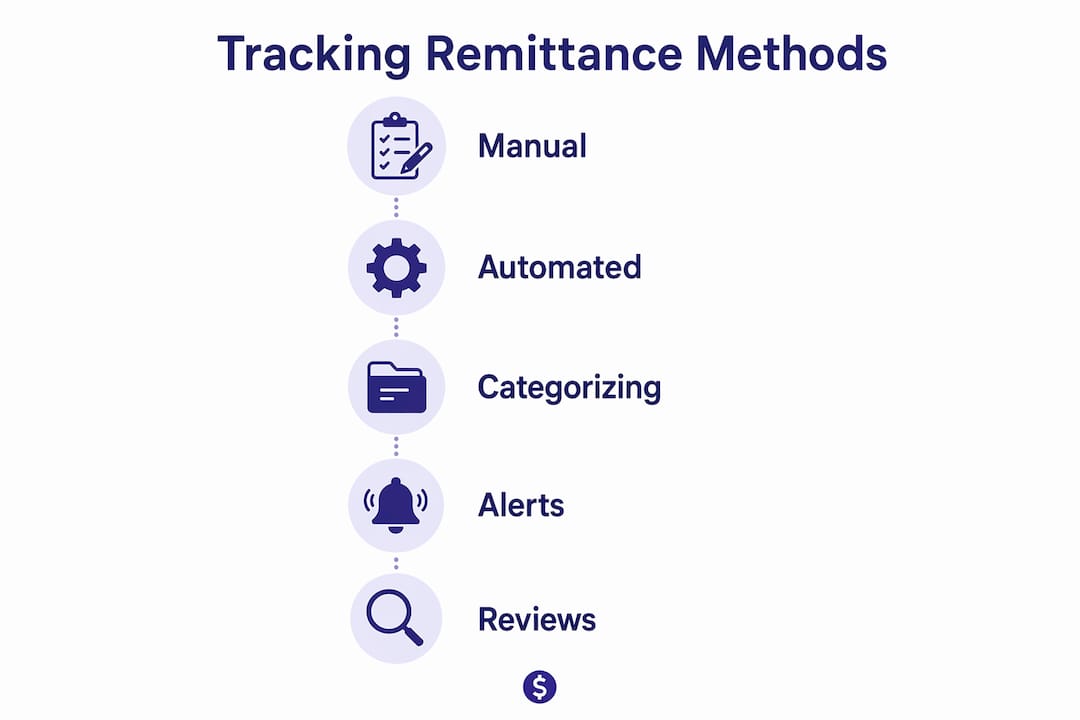
Automated tools solve this directly. Pangea Dashboard reduces manual errors by visualizing remittance flows by date, amount, category, and relationship. You can see at a glance whether your costs are trending up, which provider you used most, and how much your recipient actually received over time. This kind of visibility is what turns passive sending into active financial management.
Here is how the two approaches compare:
| Tracking method | Best for | Main limitation |
|---|---|---|
| Manual spreadsheet | Occasional senders, 1 to 3 transfers/month | Error-prone, time-consuming |
| Automated dashboard | Regular senders, 4+ transfers/month | Requires app setup |
| Bank statement review | Any sender | Lacks fee breakdown detail |
| Comparison platform (Idealremit) | All senders pre-transfer | Snapshot only, not historical |
Beyond the tool itself, categorizing your transfers adds another layer of clarity. Organize each transfer by recipient, purpose (rent, medical, education), and timing. This practice reveals patterns you would never notice otherwise. You might discover that emergency transfers cost 40% more than scheduled ones because you used a cash agent in a rush.
Pro Tip: Set up a dedicated folder or tag in your email for transfer confirmation receipts. Once a month, pull them together and log the total fees paid. This five-minute habit builds a clear annual cost picture without requiring any special software.
Remittance alerts are another underused tool. Setting rate alerts through platforms like Idealremit notifies you when exchange rates hit a favorable level, so you send at the right moment rather than whenever it feels urgent. The role of remittance alerts in reducing costs is well documented, yet most senders never activate them.
Why blending remittance monitoring with personal savings protects your future
Tracking transfers in isolation misses the bigger picture. Prioritizing remittances over retirement or emergency funds leaves immigrant families with minimal accumulated wealth over decades. This is the opportunity cost that rarely gets discussed openly.
The solution is a sequencing principle: save first, then remit from what remains. This is not about sending less. It is about building a financial structure that does not collapse if your income drops for one month.
Here is a practical framework for sustainable sending:
- Set a non-negotiable savings minimum. Commit a fixed amount to your emergency fund or retirement account before calculating what you can send. Even $50 per month invested consistently over 20 years compounds significantly.
- Calculate your remittance ceiling. After savings and living expenses, define the maximum you can send without stress. This number should be reviewed every six months, not every time a family member asks for more.
- Automate both savings and transfers. Automating savings to happen first dramatically improves success rates compared to manual last-minute saving. The same logic applies to remittances. Scheduled, fixed transfers replace emotion-driven sending.
- Review the balance quarterly. Life changes. A raise, a new expense, or a change in family needs should trigger a review of both your savings rate and your remittance amount.
"Effective remittance management requires defining clear boundaries on what can be afforded without sacrificing the sender's own financial security." — The Economics of Remittances
Treating remittances as part of a broader financial system rather than isolated obligations is the mindset shift that separates senders who build wealth from those who stay financially stagnant. Tools like dedicated goal accounts and automated savings apps make this structure easy to maintain without constant willpower.
How regular reviews help you optimize transfers over time
Monitoring is not a one-time setup. It is a recurring practice that pays dividends every time you do it. Monthly or quarterly remittance reviews help identify fee patterns, provider changes, and habits worth adjusting. Most senders who do this consistently find at least one cost-saving opportunity per quarter.

Tax rules and transfer limits add another reason to review regularly. India's Liberalized Remittance Scheme (LRS) carries a ₹10 lakh annual limit, and tracking cumulative thresholds helps you avoid surprise tax deductions and plan your transfer schedule strategically. Similar rules exist in other corridors, and missing them costs money.
Here is a practical monitoring schedule with the triggers that should prompt action:
| Review frequency | What to check | Action trigger |
|---|---|---|
| Monthly | Total fees paid, exchange rates used | Switch provider if cost exceeds 4% |
| Quarterly | Cumulative amounts sent, tax thresholds | Adjust timing if approaching limits |
| Biannually | Provider comparison, new market rates | Re-compare on Idealremit for better rates |
| Annually | Total remittance vs. savings ratio | Rebalance if remittances exceed 20% of income |
Replacing emotion-driven transfers with fixed schedules and amounts builds predictability for both you and your recipient. Your family can plan around a known monthly amount. You avoid the stress of last-minute transfers, which almost always cost more.
Pro Tip: Once a quarter, run your standard transfer amount through Idealremit's comparison tool. Providers adjust their rates and fees frequently, and the cheapest option six months ago may not be the cheapest today. A five-minute check can save you $30 to $50 per transfer.
Key takeaways
Monitoring remittance savings reduces transaction costs, protects your personal financial health, and gives your family a more predictable and larger share of every dollar you send.
| Point | Details |
|---|---|
| Hidden fees add up fast | A 1% tax alone raises total transfer costs by 17%, making fee tracking non-negotiable. |
| Automated tools beat spreadsheets | Dashboards like Pangea Dashboard reduce errors and reveal cost trends over time. |
| Save before you remit | Committing to savings first prevents chronic under-saving for emergencies and retirement. |
| Schedule beats impulse | Fixed transfer schedules reduce costs and build financial stability for sender and recipient. |
| Review quarterly at minimum | Regular comparisons catch provider fee changes and tax threshold risks before they hit. |
The discipline most senders skip but cannot afford to ignore
I have spoken with hundreds of people who send money home every month, and the pattern is almost always the same. They found a provider that worked once, set it up, and never looked again. They assume loyalty equals reliability. It does not equal savings.
The senders who come out ahead financially are not necessarily the ones earning more. They are the ones who treat their remittance habit the way a small business owner treats expenses: with regular review, clear limits, and a willingness to switch when the numbers change. I have seen people cut their annual transfer costs by $400 simply by switching from a bank wire to a digital provider and setting up rate alerts. That is not a minor optimization. That is a month's grocery bill.
What I find most overlooked is the personal savings side. Many senders feel guilty keeping money for themselves when family needs are visible and urgent. But depleting your emergency fund to cover a relative's unexpected expense puts two households at risk instead of one. The most responsible thing you can do for your family abroad is stay financially stable yourself. Monitoring your remittances forces that conversation with yourself every month.
Technology makes all of this easier than it has ever been. Comparison platforms, rate alerts, and automated dashboards remove most of the friction. The only thing left is the decision to use them consistently. That decision is worth making.
— Brahim
Start saving more on every transfer with Idealremit

Idealremit compares live rates and fees from providers including Wise, Remitly, Western Union, and MoneyGram so you always send at the lowest available cost. The platform tracks exchange rates in real time and lets you set personalized alerts, so you transfer when conditions favor you rather than when urgency forces your hand. Users who compare transfer services before sending consistently pay less than those who default to a single provider. Idealremit also maintains a guide to low-cost providers updated for 2026, giving you a starting point for every corridor you send to. Stop leaving money in fees. Use Idealremit to find your best rate today.
FAQ
Why does monitoring remittance savings matter?
Monitoring remittance savings lets you identify hidden fees, compare provider costs, and avoid tax surprises that reduce what your recipient actually receives. Even a 1% difference in fees translates to a 17% increase in total transaction costs on cash-based transfers.
What is the best tool for tracking money transfers?
Automated dashboards like Pangea Dashboard offer the most accurate tracking by logging transfers by date, amount, and category without manual entry errors. Comparison platforms like Idealremit complement this by showing real-time provider rates before each transfer.
How often should I review my remittance costs?
Monthly reviews catch fee changes and provider shifts, while quarterly reviews help you monitor cumulative transfer amounts against tax thresholds like India's LRS limit. An annual review should assess whether your remittance-to-savings ratio remains sustainable.
What hidden fees should I watch for in remittances?
The most common hidden cost is the exchange rate margin, where providers offer a rate below the mid-market rate and keep the difference. Recipient-end fees and regulatory tax deductions are two additional charges that rarely appear in the advertised transfer fee.
How do I balance sending money abroad with saving for myself?
The most effective approach is to automate a fixed savings contribution before calculating your remittance amount. Treating your emergency fund and retirement savings as non-negotiable commitments protects your long-term financial security without requiring you to reduce support for your family.