For most U.S. senders, a mid-market-rate specialist is the best way to send money to Egypt. You get a transparent fee, a near-market exchange rate, and delivery to an Egyptian bank account or mobile wallet, often within minutes. Here is the short version by priority:
- Cheapest for $300+: Use a mid-market-rate specialist (like Wise) funded by ACH/bank transfer. Sample pricing from May 2026 shows roughly EGP 52,378 delivered on a $1,000 transfer with a ~$10.73 fee.
- Fastest to a mobile wallet: Providers with Vodafone Cash or InstaPay-connected bank deposits can credit funds in minutes.
- Best for cash pickup: A retail network with wide Egypt coverage handles recipients who have no bank account.
- Easiest bank deposit: Any provider that accepts a 29-character Egyptian IBAN and deposits directly to a named account.
One immediate exclusion: Zelle is a domestic U.S. payment rail and does not support cross-border transfers to Egypt at all. Stick to licensed international remittance providers. Since Egypt’s pound float in March 2024, formal channels have recaptured the market and informal routes offer no meaningful rate advantage, plus zero consumer protection.
Key Takeaways
The cheapest way to send money to Egypt from the U.S. is a mid-market-rate specialist funded by ACH, which delivered roughly EGP 52,378 on a $1,000 transfer in May 2026 versus EGP 50,200 or less via a bank wire.
| Point | Details |
|---|---|
| Rate margin beats fee | A $0-fee provider with a 3% margin costs more than a $10 fee at near mid-market on transfers above ~$350. |
| Mobile wallet caps | Egyptian wallets cap at roughly EGP 30,000/day; send large amounts to a bank account with a 29-character IBAN. |
| Avoid holds | Always include a clear purpose of payment (e.g., “family support”) and verify the recipient’s IBAN before sending. |
| Fund by ACH | Bank/ACH funding typically costs less than debit or credit card and improves total EGP delivered. |
| Use Idealremit | Idealremit shows live “EGP delivered” across providers and lets you filter by payout method and speed before you send. |
Table of Contents
- What are the best ways to send money to Egypt?
- Provider profiles: what each service actually delivers to Egypt
- How providers actually charge you: fee vs. exchange-rate margin
- How to choose the right provider for your transfer
- Step-by-step guide to sending money from the U.S. to Egypt
- How Idealremit helps you verify live quotes and find the cheapest option
- What most senders get wrong about Egypt transfers
- Idealremit makes comparing your options straightforward
- Sources
- FAQ
What are the best ways to send money to Egypt?
The table below maps each provider category to the metrics that matter most: total cost, speed, payout options, and how you can fund the transfer from the U.S.
| Provider category | Typical sender fee | Exchange-rate margin | Speed | Payout methods in Egypt | U.S. funding methods |
|---|---|---|---|---|---|
| Mid-market-rate specialist | Low fixed fee (~$5–$10.73) | Near 0% | Minutes to 1 day | Bank deposit (IBAN), Vodafone Cash | ACH/bank, debit card |
| Promotional-first option | $0 first transfer | Moderate (1–2%) | Hours to 1 day | Bank deposit, cash pickup | Debit/credit card, bank |
| Cash-pickup retail network | $5–$10.73 | 1–3% markup | Minutes (cash) | Cash pickup, bank deposit | Debit/credit card, bank |
| Bank wire / large-sum service | $25–$50 | 2–4% | 2–5 days | Bank deposit | Bank wire |
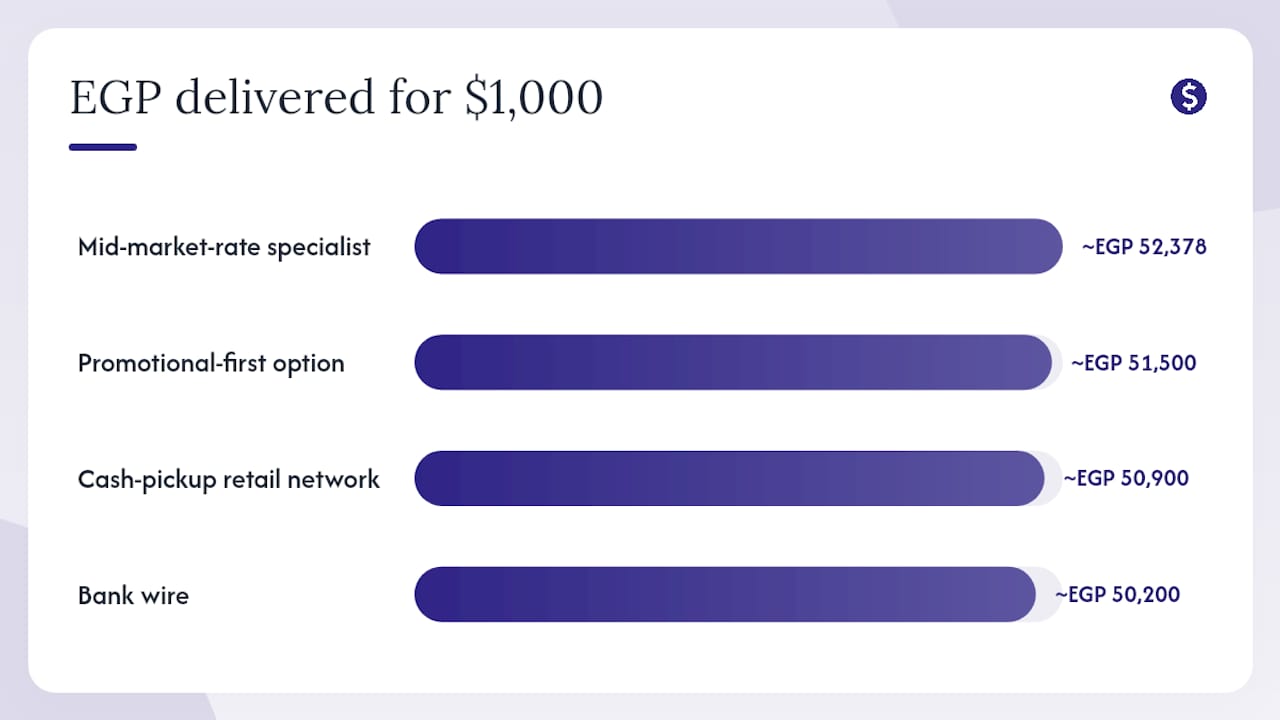
Sample cost estimates (May 2026 indicative figures):
| Send amount | Mid-market specialist | Promotional-first | Cash-pickup network | Bank wire |
|---|---|---|---|---|
| $100 | ~EGP 5,180 | ~EGP 5,050 | ~EGP 5,050 | ~EGP 4,900 |
| $500 | ~EGP 26,100 | ~EGP 25,700 | ~EGP 25,400 | ~EGP 24,600 |
| $1,000 | ~EGP 52,378 | ~EGP 51,500 | ~EGP 50,900 | ~EGP 50,200 |
The gap between the cheapest and most expensive mainstream online providers on a $1,000 transfer runs to roughly EGP 2,150–2,216, or about 4–4.3%. Banks and retail cash operators can push that gap to 6% or more. On a $1,000 transfer, that difference is real money.
How these estimates were calculated: Each figure starts with the mid-market USD/EGP rate at the time of sampling, subtracts the provider’s effective rate margin, then deducts the sender-side fee converted to EGP. The result is EGP delivered to the recipient. Always check a live quote before sending, since rates move daily.
Provider profiles: what each service actually delivers to Egypt
Idealremit
Idealremit is a real-time comparison platform, not a transfer service itself. It aggregates live rates, fees, and provider coverage so you can see “EGP delivered” side by side across multiple services before you commit to one. You can filter by payout method, speed, and coverage to match your recipient’s situation, whether they have a bank account, a Vodafone Cash wallet, or need cash pickup. Rate alerts let you wait for a better USD/EGP window without checking manually every day.
- Pros: Live multi-provider comparison; personalized rate alerts; filters for payout method and speed; no transfer fees of its own.
- Cons: You still complete the transfer on the chosen provider’s platform.
- Best for: Anyone who wants to verify they are getting the best deal before sending, especially for amounts above $300 where the rate margin compounds.
Wise
Wise uses a near mid-market rate and charges a single transparent fee. On a $1,000 transfer in May 2026, it delivered roughly EGP 52,378 with a fee of about $10.73. Bank deposits go to an Egyptian IBAN; Vodafone Cash is also supported on some corridors. Funding by ACH keeps the total cost down. Speed is typically within hours for bank deposits when the recipient’s bank is InstaPay-connected.
- Pros: Near mid-market rate; fully transparent fee shown upfront; strong track record on the USD/EGP corridor.
- Cons: No cash pickup option; card funding adds a surcharge.
- Best for: Senders prioritizing the lowest total cost on transfers of $300 or more.
Remitly
Remitly runs two tiers: Economy (cheaper, 3–5 days) and Express (faster, often same-day or next-day). First-transfer promotions can match mid-market specialists for amounts under $500, but the effective rate on repeat transfers typically reverts higher. Bank deposit and Vodafone Cash are both available for Egypt recipients.
- Pros: Competitive first-transfer promo; mobile-wallet delivery to Vodafone Cash; user-friendly app.
- Cons: Promo rates do not last; Express tier costs more; rate margin on repeat transfers is worth watching.
- Best for: First-time senders under $500 who want a smooth app experience and mobile-wallet delivery.
Western Union
Western Union’s retail network is one of the widest in Egypt, with thousands of agent locations for cash pickup. That reach matters when a recipient has no bank account. The trade-off is cost: the effective rate typically includes a 1–3% markup on top of a sender fee, making it more expensive than mid-market specialists for bank deposits.
- Pros: Extensive cash-pickup network across Egypt; fast cash availability (often minutes); widely recognized brand.
- Cons: Higher effective rate than online specialists; bank-deposit option costs more than dedicated transfer apps.
- Best for: Recipients who need cash in hand and do not have a bank account or mobile wallet.
MoneyGram
MoneyGram sits in a similar position to Western Union: strong retail presence, fast cash pickup, and a higher total cost than mid-market online providers. It also offers bank deposit to Egyptian accounts. For senders who need a physical agent location in the U.S. or a recipient who prefers a familiar cash-pickup brand, it is a workable option.
- Pros: Wide agent network; bank deposit available; competitive on cash-pickup speed.
- Cons: Rate markup makes it costlier than online specialists for bank deposits; fees vary by U.S. state and funding method.
- Best for: Senders who prefer an in-person U.S. agent or whose recipient specifically requests MoneyGram cash pickup.
How providers actually charge you: fee vs. exchange-rate margin
Every international transfer has two cost components. The first is the explicit fee, the dollar amount shown on the send screen. The second is the exchange-rate margin, the gap between the mid-market rate (what you see on Google) and the rate the provider actually applies. The margin is where most of the hidden cost lives.
Here is a simple way to calculate what your recipient actually gets:
| Step | Formula | Example ($1,000 send) |
|---|---|---|
| 1. Find mid-market rate | Check Google or XE.com | 52.94 EGP/USD |
| 2. Find provider’s applied rate | Shown on quote screen | 52.37 EGP/USD |
| 3. Rate margin cost | (52.94 − 52.37) × $1,000 | ~$57 lost to margin |
| 4. Subtract explicit fee | Fee shown upfront | $10.73 |
| 5. EGP delivered | Applied rate × (send amount − fee) | ~EGP 52,378 |
A provider advertising “no fee” often buries the cost in a wider rate margin. Comparison platforms and mid-market providers that show a visible fee and a near-market rate consistently deliver more EGP than banks or zero-fee services with a heavy markup. Understanding why exchange rates matter is the single most useful thing you can do before sending.
Pro Tip: Fund your transfer by ACH/bank account rather than debit or credit card. Card funding typically adds 1–2% to the sender-side cost, which can wipe out the rate advantage of a mid-market specialist entirely.
Always pull a live quote on the day you plan to send. The USD/EGP rate moves, and a quote from yesterday can look very different from today’s.
How to choose the right provider for your transfer
Work through this checklist before you commit:
- Amount: Above $300, the rate margin matters more than the fee. Below $100, a flat fee can dominate, so check total cost, not just the fee line.
- Recipient access: Does your recipient have a bank account with an Egyptian IBAN? A Vodafone Cash wallet? Or do they need cash pickup?
- Urgency: Same-day delivery costs more. If you have 2–3 days, Economy tiers and ACH funding save money.
- Payout cap: Mobile wallets in Egypt carry daily and monthly limits that restrict the amount you can send. For larger amounts, send to a bank account.
- Fee vs. rate sensitivity: If your recipient needs every pound, optimize for total EGP delivered, not the lowest headline fee.
Red flags to avoid:
- No exchange rate shown before you confirm the transfer.
- A provider asking you to send via informal channels or peer-to-peer apps for an “Egypt rate.”
- Unclear documentation requirements that only surface after you fund the transfer.
- No customer support number or live chat when something goes wrong.
Questions to ask when comparing live quotes:
- What is the total EGP my recipient will receive, after all fees and the rate?
- Is there a payout cap on the delivery method my recipient uses?
- What ID or documentation do I need to provide for this amount?
- What triggers a hold, and how long does a review take?
Step-by-step guide to sending money from the U.S. to Egypt
What you need before you start
Collect this information from your recipient before opening any app:
- Full legal name (exactly as it appears on their Egyptian national ID or passport).
- 29-character Egyptian IBAN (format: EG + 2 check digits + 25 digits).
- Bank name and branch, or mobile wallet phone number and provider (Vodafone Cash, Orange Cash, Etisalat Cash).
- A clear purpose of payment (e.g., “family support,” “personal savings”).
Egyptian banks commonly hold transfers when the purpose of payment is missing or the IBAN is incorrect. Getting these details right before you send is the single most effective way to avoid a delay.
The sending process
- Get a live quote. Use Idealremit or go directly to a provider’s site. Enter the send amount and check total EGP delivered, not just the fee.
- Create or log into your account. First-time senders will need to verify identity (government-issued ID, sometimes proof of address).
- Enter recipient details. Full legal name, IBAN or wallet number, bank name, and purpose of payment.
- Choose your funding method. ACH/bank transfer for lowest cost; debit card if you need same-day processing.
- Confirm and save the reference number. Screenshot the confirmation screen. You will need this if anything is delayed.
- Notify your recipient. Tell them the expected arrival time and the reference number so they can follow up with their bank if needed.
If a transfer is held
- Wrong IBAN: Contact the provider immediately. Most can reroute before the funds clear.
- Missing purpose of payment: The receiving bank may request this from the sender’s provider. Have a clear description ready.
- Large-sum AML review: Transfers above certain thresholds trigger compliance checks. Providing source-of-funds documentation speeds resolution. Tracking your transfer through the provider’s app or support line is the fastest way to know where it stands.
Pro Tip: Send 3–5 days before major Egyptian holidays like Eid. Remittance volumes spike sharply in the pre-Eid window, and some bank and retail cut-offs apply. Providers that deposit to InstaPay-connected accounts handle holiday spikes more reliably.
How Idealremit helps you verify live quotes and find the cheapest option
Before you send a dollar, Idealremit’s comparison tool shows you the live “EGP delivered” figure across multiple providers side by side. That single number, not the fee, not the rate in isolation, is what your recipient actually gets. Here is how to use it:
- Go to Idealremit and select the USD to EGP corridor.
- Enter your send amount.
- Filter by payout method (bank deposit, Vodafone Cash, or cash pickup) and by speed if urgency matters.
- Read the “EGP delivered” column. The provider at the top of that column is your cheapest option for that amount and payout method.
- Set a rate alert if today’s rate is not where you want it. Idealremit notifies you when the USD/EGP rate hits your target.
The platform aggregates real-time rates, fees, and provider coverage so you are comparing apples to apples, not a fee from one site against a rate from another. The savings calculator shows you the difference in EGP between the cheapest and most expensive options, which on a $1,000 transfer can run to over EGP 2,000. That is a meaningful amount, not a rounding error.
What most senders get wrong about Egypt transfers
The biggest mistake is fixating on the fee and ignoring the rate. A $0 fee with a 3% rate margin costs more than a $10 fee at near mid-market on any transfer above roughly $350. The math is simple once you run it, but most people never do because the rate is buried in small print.
The second mistake is sending to a mobile wallet for a large amount. Wallet caps of roughly EGP 30,000 per day mean a $600+ transfer can hit a ceiling and sit pending. For anything above that, a bank deposit with a correct IBAN is the cleaner path.
One thing that often gets overlooked: promotional first-transfer rates are genuinely good for small amounts under $500. If you are sending a one-time gift, a promo rate can match or beat a mid-market specialist. But if you are sending regularly, the rate reverts and you need to compare again. Running a live quote on Idealremit before each transfer takes about 90 seconds and can save real money over time.
Idealremit makes comparing your options straightforward
Sorting through fees, rate margins, and payout options across five or more providers takes time you probably do not have. Idealremit cuts that down to a single screen: enter your amount, pick your payout method, and see exactly how many Egyptian pounds each provider delivers right now.
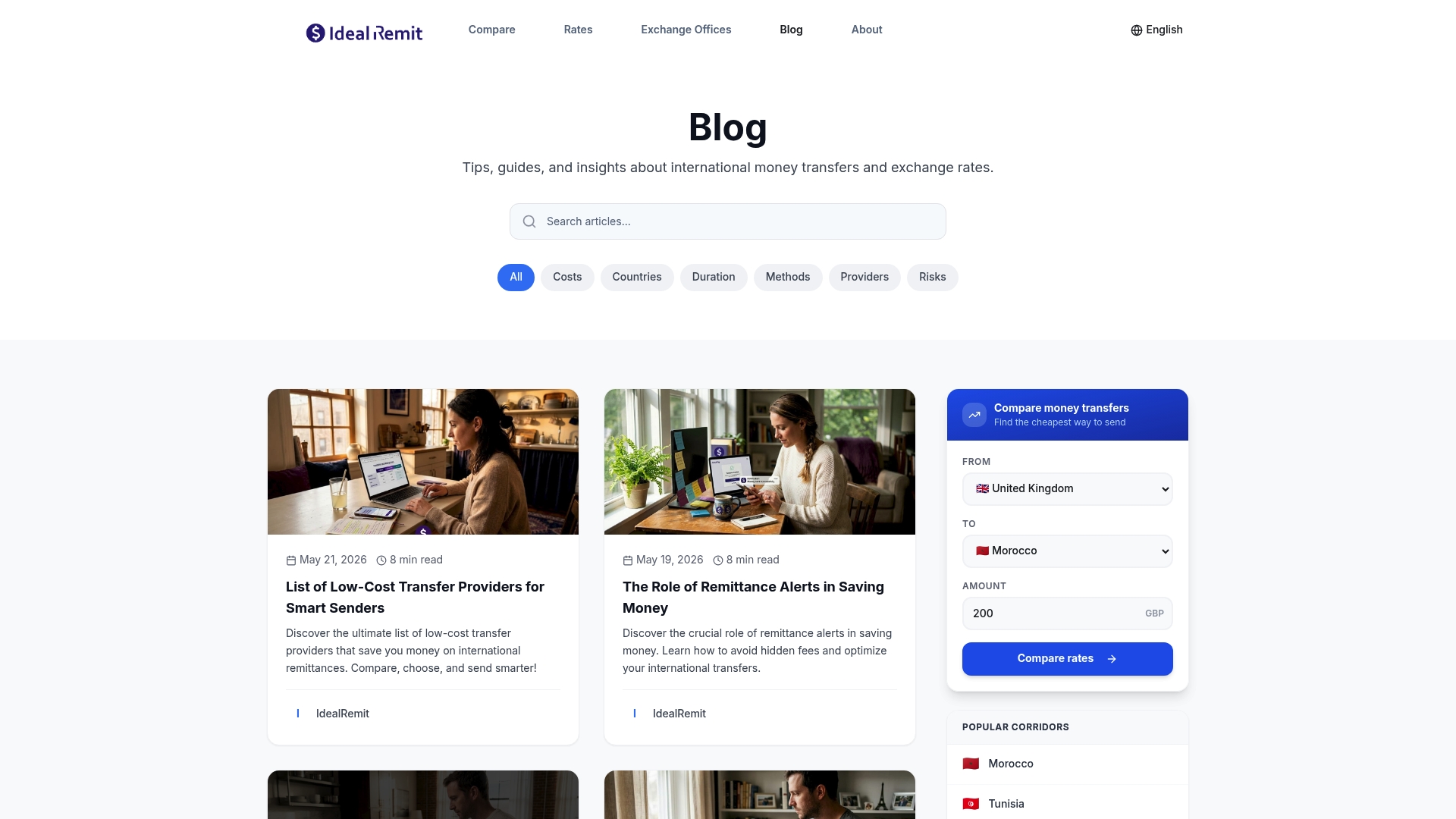
The platform is free to use, covers transfers to over 100 countries, and updates rates in real time so you are never working from a stale quote. Rate alerts mean you can set a target USD/EGP level and get notified when the market hits it, without refreshing a page every morning.
- Transparent total cost: “EGP delivered” is shown upfront, so you compare the number that actually matters.
- Filters that match your recipient’s situation: Bank deposit, Vodafone Cash, or cash pickup, filtered by speed and coverage.
Compare live USD to EGP quotes on Idealremit before your next transfer and see the difference in seconds.
Sources
Check these pages before you send to verify live rates, IBAN rules, and provider details:
Live rates change daily. Pull a fresh quote on the day you send, not the day you research.
FAQ
What is the best way to send money from the USA to Egypt?
A mid-market-rate specialist funded by ACH bank transfer delivers the most EGP for amounts above $300. Sample pricing from May 2026 shows roughly EGP 52,378 delivered on a $1,000 transfer, compared to EGP 50,200 or less via a bank wire.
Can you use Zelle to send money to Egypt?
No. Zelle is a domestic U.S. payment network and does not support international transfers to Egypt or any other country. Use a licensed international remittance provider instead.
How much is $100 USD in Egyptian pounds?
After typical fees and rate margins, a recipient can expect between about EGP 5,050 and EGP 5,180 on a $100 transfer depending on the provider.
How do I send money to a friend in Egypt without a bank account?
Use a cash-pickup network like Western Union or MoneyGram, which have wide agent coverage across Egypt. Your friend collects cash at a local agent location with their ID. Alternatively, if they have a Vodafone Cash wallet, several online providers support direct mobile-wallet delivery.
How long does a transfer to Egypt take?
Speed depends on the provider and payout method. Mid-market specialists depositing to an InstaPay-connected Egyptian bank account can credit funds in minutes. Cash pickup through retail networks is also typically available within minutes of confirmation. Bank wires via a traditional U.S. bank take 2–5 business days.