
TL;DR:
- International money transfers must adhere to strict compliance rules, including reporting thresholds, sanctions screening, and detailed recordkeeping, to avoid fines or criminal charges. Proper verification of recipient details, using licensed providers, and maintaining thorough documentation are essential for legal and operational security. Choosing compliant platforms like Idealremit simplifies adherence, reducing delays, risks, and ensuring smooth cross-border transactions.
Sending money across borders sounds straightforward until a transaction gets flagged, frozen, or fined. The compliance tips for money transfers that protect you are not always visible, but the consequences of ignoring them are. Regulations for international transfers span federal reporting rules, sanctions screening, identity verification, and documentation requirements that trip up individuals and small business owners alike. Non-compliance risks include civil fines, revoked operating licenses, and criminal charges. This guide gives you the specific, practical steps to stay on the right side of the law every time you send money abroad.
Table of Contents
- Key takeaways
- 1. Understand the core compliance tips for money transfers
- 2. Screen for sanctions before every transfer
- 3. Verify recipient and transaction details precisely
- 4. Keep thorough documentation for every transfer
- 5. Manage large cross-border transfers with extra care
- 6. Know your rights as a sender
- 7. Choose licensed and compliant transfer providers
- My honest take on compliance as a business advantage
- Why Idealremit makes staying compliant easier
- FAQ
Key takeaways
| Point | Details |
|---|---|
| Know your reporting thresholds | SAR filings are required at $2,000 and the Travel Rule kicks in at $3,000. |
| Verify every detail before sending | Incorrect SWIFT codes and mismatched names cause delays and compliance flags. |
| Keep records for at least five years | Regulators require documentation including timestamps, exchange rates, and purpose of payment. |
| Add buffer time for large transfers | Cross-border settlements need extra processing days beyond the booking date. |
| Use licensed, screened providers | Reputable platforms automate OFAC checks and reduce your compliance exposure. |
1. Understand the core compliance tips for money transfers
Before you send a single dollar abroad, you need to know what rules apply to you. In the US, the Bank Secrecy Act (BSA) is the backbone of financial compliance for remittances. It requires financial institutions and money service businesses to detect and report suspicious activity. When a transaction hits $2,000 or more and involves suspected fraud or money laundering, a Suspicious Activity Report (SAR) must be filed.
The FinCEN Travel Rule adds another layer. Under this rule, institutions must pass along sender and recipient information for any funds transmittal of $3,000 or more that moves between multiple financial institutions. This is not optional, and it applies whether you are wiring money to a supplier overseas or sending support to family abroad.
You also need to understand Know Your Customer (KYC) requirements. Providers collect identity documents from you before processing transfers. That is not bureaucracy. It is a legal obligation tied to customer due diligence standards that protect everyone in the transaction chain.
2. Screen for sanctions before every transfer
One of the most overlooked money transfer compliance guidelines is sanctions screening. The US Office of Foreign Assets Control (OFAC) maintains a Specially Designated Nationals (SDN) list of individuals, entities, and countries that are prohibited from receiving US funds. Providers must screen against OFAC's SDN list and block any prohibited transactions, reporting them within 10 business days.

If you are a small business owner paying contractors or suppliers in regions with active sanctions, this is your responsibility to understand, not just your provider's. Even sending money to a non-sanctioned country can trigger a flag if the recipient's name appears on the SDN list. Always check OFAC's website directly when you are uncertain about a recipient or destination country.
3. Verify recipient and transaction details precisely
Bad data kills compliant transfers. The name on your transfer must match the recipient's official bank account name exactly. Even a minor spelling variation can cause a rejection or hold. This is one of the most common pain points in international transfers, and it is entirely preventable.
For wire transfers, using the correct SWIFT code length matters more than most people realize. An 8-character SWIFT code routes to the bank's head office, while an 11-character code routes to a specific branch. Using the wrong format causes avoidable processing delays. Always confirm which version your recipient's bank requires.
Here is what to verify before every transfer:
- Full legal name of the recipient exactly as it appears on their bank account
- IBAN or account number confirmed directly with the recipient
- Correct SWIFT/BIC code format (8 or 11 characters depending on the branch)
- Purpose of payment code where required, especially for countries with capital controls like India, China, or the UAE
- Transfer currency confirmed with the recipient to avoid automatic conversion at unfavorable rates
Pro Tip: Ask your recipient to send you a screenshot of their bank account details rather than typing them from memory. This eliminates transcription errors that cause the most common transfer failures.
4. Keep thorough documentation for every transfer
Good recordkeeping is where most individuals and small business owners fall short. Maintaining detailed documentation including exchange rates, timestamps, and fee breakdowns is not optional if you want to stay audit-ready. Tax authorities and compliance regulators can request records at any time, and a missing receipt can turn a routine audit into a serious problem.
The documents you need to retain for each transfer include:
- Transfer confirmation or receipt showing the date, amount, and destination
- Beneficiary information including name, address, and account details
- Source of funds documentation for large transfers (bank statements, invoices, or contracts)
- Purpose of payment records, especially for business transfers
- Exchange rate at the time of the transaction and any fees charged
Regulators generally require a five-year retention period for money transfer records under BSA rules. Set up a dedicated folder on your cloud storage, organized by year and recipient, so you can pull any record in under two minutes.
Pro Tip: Screenshot your transfer confirmation immediately after submitting and save it with a date-stamped filename. Do not rely on email threads alone. Inboxes get deleted; organized folders do not.
5. Manage large cross-border transfers with extra care
Large transfers attract more scrutiny, and they deserve more preparation. The best practices for fund transfers above a certain threshold go beyond the standard steps.
Cross-border settlements need buffer time due to time zone differences and intermediary bank checks, regardless of when you book the transfer. A payment booked on a Friday afternoon might not clear until Tuesday. Plan around that reality, especially when a business obligation has a hard deadline.
Here is a practical framework for large transfers:
- Prepare a compliance documentation pack including beneficiary details, source-of-funds evidence, and purpose of payment at least 48 hours before initiating the transfer.
- Decide on a fixed vs. floating exchange rate. Fixing the rate removes uncertainty in volatile markets and reduces financial risk on large sums. Idealremit's blog covers exchange rate strategy in detail if you want to understand the trade-offs.
- Build in at least one full business day of buffer beyond the provider's stated delivery time.
- Confirm enhanced due diligence requirements with your provider in advance. Some destinations require additional beneficiary verification for transfers above specific thresholds.
- Track the transfer actively. Do not send and forget. Use your provider's tracking tool and follow up within 24 hours if the funds have not moved.
| Transfer size | Key action | Why it matters |
|---|---|---|
| Under $3,000 | Verify recipient details | Avoid name mismatch holds |
| $3,000 to $10,000 | Comply with Travel Rule disclosures | Required by FinCEN for multi-institution transfers |
| Over $10,000 | Prepare source-of-funds documentation | BSA and bank requirements trigger enhanced review |
| Any business transfer | Include purpose of payment code | Capital control countries require this for clearing |
6. Know your rights as a sender
Most people do not realize they have legally protected rights when sending money internationally. Under Consumer Financial Protection Bureau (CFPB) rules, remittance providers must give you a written disclosure of fees, exchange rates, and the amount the recipient will receive before you confirm. You have rights to error investigation, and providers must respond within 90 days of notification when you report a problem.
This matters because knowing your rights is part of how to comply with transfer laws. If a provider refuses to give you a pre-transfer disclosure, that is a red flag. If a transfer goes wrong, file your dispute in writing immediately. The 90-day window starts from the date you notify them, so document every communication.
7. Choose licensed and compliant transfer providers
Using a licensed provider is not just a convenience. It is a compliance decision. Licensed money transmitters are required to carry insurance, maintain reserves, and submit to regulatory audits. An unlicensed operator might offer better rates, but they expose you to serious legal and financial risk. The savings are not worth it.
When evaluating providers, look for these signals:
- State-level money transmitter licenses in all states where they operate
- OFAC sanctions screening built into their transaction processing
- Transparent fee disclosure before you confirm the transfer
- Regulatory compliance disclosures on their website
Exchange rate markups often exceed upfront fees, so the total cost comparison must include exchange rate spreads, not just the listed transfer fee. A provider showing a zero-fee transfer might be recouping the cost through a 3% exchange rate margin. You can compare the true cost of transfers across providers at Idealremit's international transfer security resource before committing.
For virtual asset transfers, note that crypto Travel Rule compliance requires verified identities. Off-chain compliance solutions are emerging to handle this, but unverified wallet transactions remain a compliance gap that regulators are actively closing.
My honest take on compliance as a business advantage
I've watched people treat compliance like a tax. They do the minimum, resent the paperwork, and then get blindsided when a transfer gets frozen right before a critical supplier payment is due. That approach costs more in the long run, financially and operationally.
What I've found is that the small business owners who take money transfer compliance guidelines seriously actually move money faster over time. They have documentation ready. Their providers trust them. Their transfers clear without holds because their profiles are clean and consistent. Compliance builds a track record, and that track record has real practical value.
The uncomfortable truth is that most compliance failures I've seen were not caused by people trying to break the rules. They were caused by people who didn't know the rules existed. Not knowing the Travel Rule threshold. Not understanding that a mismatched name could freeze a $50,000 payment. These are not exotic edge cases. They happen to real individuals and real businesses every week.
Treat compliance as an investment in operational reliability, not just legal protection. Every minute you spend building a clean documentation habit saves you hours of recovery time when something goes wrong.
— Brahim
Why Idealremit makes staying compliant easier
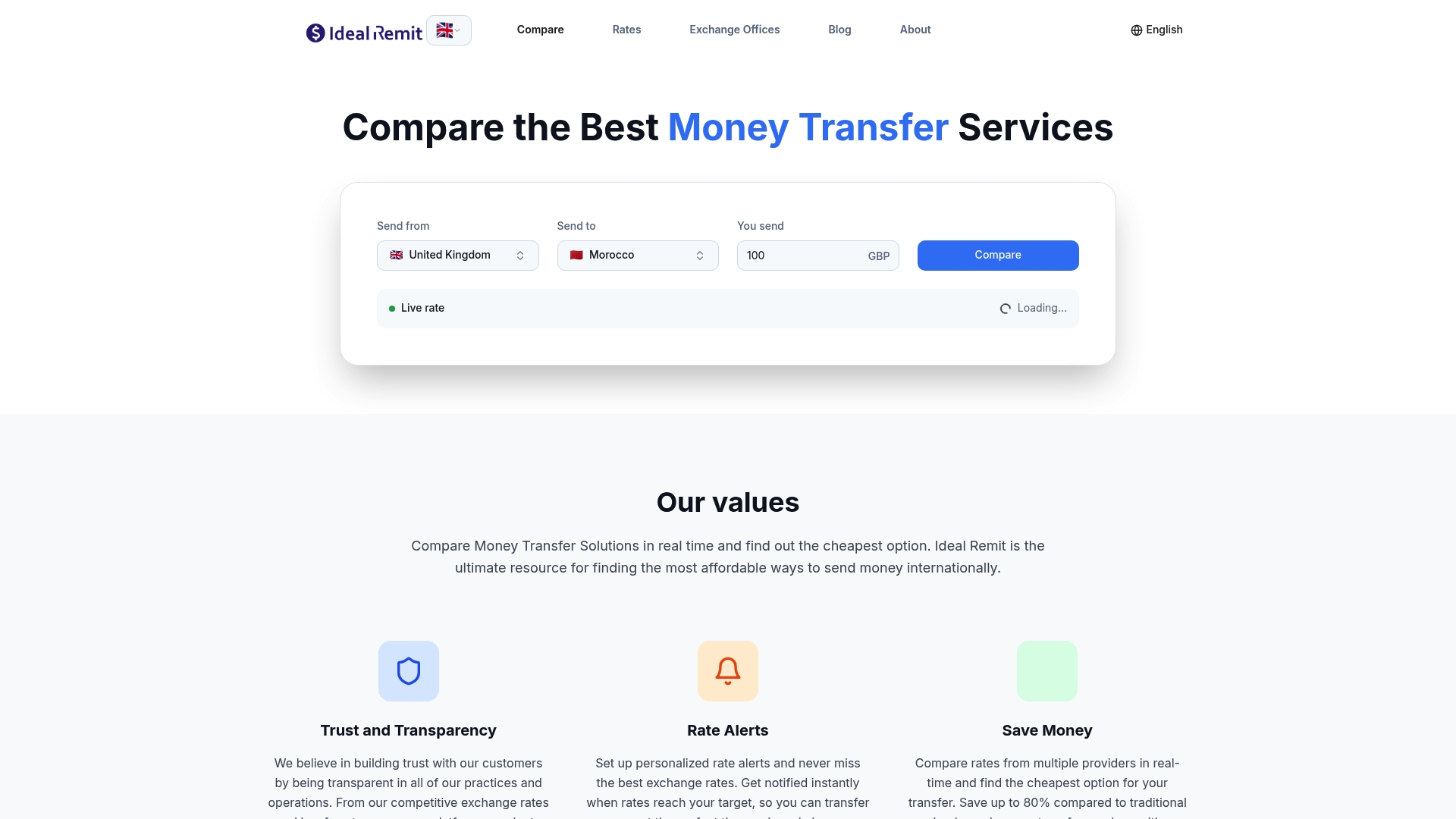
Staying compliant with regulations for international transfers is a lot more manageable when you are working with the right platform. Idealremit aggregates licensed, vetted transfer providers with built-in compliance infrastructure, including OFAC screening, transparent fee disclosures, and pre-transfer exchange rate breakdowns. You can compare compliant providers side by side in real time, including full cost breakdowns that factor in both fees and exchange rate spreads. For US-based senders, that means fewer surprises and transfers that actually clear. Idealremit also offers live rate alerts and savings calculators so you can move money at the right time, with the right provider, at a cost that makes sense. Start with the best transfer options available to you today.
FAQ
What is the SAR filing threshold for money transfers?
A Suspicious Activity Report must be filed for transactions of $2,000 or more that involve suspected fraud or money laundering, under US Bank Secrecy Act requirements.
What does the FinCEN Travel Rule require?
The Travel Rule requires financial institutions to pass sender and recipient information along with any funds transmittal of $3,000 or more that moves between multiple financial institutions.
How long should I keep money transfer records?
US regulators require a minimum five-year retention period for money transfer records under the Bank Secrecy Act. Keep transfer confirmations, beneficiary details, and source-of-funds documentation for at least that long.
What rights do I have if a transfer goes wrong?
Under CFPB rules, you have the right to dispute errors with your remittance provider, who must investigate and respond within 90 days of being notified. Always submit disputes in writing to start the clock.
How do I know if a transfer provider is compliant?
Look for state-level money transmitter licenses, OFAC sanctions screening, and pre-transfer fee and exchange rate disclosures. Avoid any provider that cannot clearly document its regulatory standing.