3%-5% Cash Advance Fees Add $30-$50 to U.S. Credit Card Transfers
Fund an international transfer with a credit card and most issuers will code it as a cash advance, not a purchase. That typically means a 3%-5% cash-advance fee charged immediately, plus interest that starts accruing the same day, with no grace period. Stack that on top of the remittance provider's own transfer fee and FX margin, and card funding is almost always the most expensive way to send money abroad. World Bank pricing data and tools like Idealremit's comparison engine make it easy to see the gap before you commit.
TL;DR:
- Funding international transfers with a credit card often incurs a 3%-5% cash-advance fee and immediate interest, making it very costly.
- Card issuers treat transactions as cash advances if they resemble cash-like activities, leading to higher fees, interest, and no rewards points.
- The total transfer cost includes provider fees, FX margin, cash-advance fees, and accrued interest, which can significantly exceed the advertised rates.
- Using a linked bank account or debit card usually avoids cash-advance coding, reducing total costs, though ACH transfers take longer to process.
- Comparing total costs with tools like Idealremit before sending can help identify the cheapest option and prevent unnecessary expenses.
Table of Contents
- What Makes Up Your Total Credit Card Transfer Fees
- Why Some Card Issuers Treat Transfers as Cash Advances
- How to Calculate the True Cost of Your Transfer
- How to Avoid or Reduce Credit Card Transfer Fees
- When a Credit Card Transfer Might Be Worth the Extra Cost
- Where Senders Go Wrong (And How to Fix It)
- Check Your Exact Corridor Before You Send
- Sources
- FAQ
What Makes Up Your Total Credit Card Transfer Fees
Three separate charges stack on top of each other every time you fund a transfer with plastic, and providers rarely show you all three in one place.
The remittance provider's transaction fee is the number advertised on the homepage, usually a flat amount or a small percentage. It's real, but it's often the smallest piece of the puzzle. The FX margin is the gap between the exchange rate you get and the mid-market rate you'd find on Google or Reuters. A service can advertise "$0 fees" and still make money by marking up the exchange rate 2% or 3% below market. That's the trick behind a lot of "free transfer" marketing.
Then there's the issuer's cash-advance fee, which is separate from both of those and has nothing to do with the remittance company. If your card treats the transaction as a cash advance, you're typically looking at 3%-5% of the amount sent, plus interest starting immediately, since cash advances carry no grace period. This is distinct from a foreign-transaction fee, which some cards also charge on purchases made in another currency; a cash advance can trigger both at once.
To find these numbers yourself:
- Check the provider's fee page and rate quote screen for the transaction fee and quoted exchange rate.
- Compare that rate against the mid-market rate to calculate the real FX margin.
- Pull up your credit card agreement or call the issuer to confirm how transfers are classified and what the cash-advance APR is.
Why Some Card Issuers Treat Transfers as Cash Advances
Card issuers classify a transaction as "cash-like" when it functions as a substitute for cash, even though no ATM is involved. Common triggers include wire transfers, money order purchases, certain prepaid card loads, and some peer-to-peer payment flows. Experian lists these as classic examples, and issuer policies have been expanding this category, according to discussions on FICO Forums.
Once a transaction gets coded this way, the consequences show up fast:
- A cash-advance fee, typically 3%-5% of the amount.
- A higher APR than your standard purchase rate, often applied from day one.
- No grace period, meaning interest starts the moment the transaction posts.
- No rewards points or cash back, since cash advances are excluded from most rewards programs.
The frustrating part is that classification isn't always consistent. The same remittance provider might process as a purchase on one card and a cash advance on another, depending on how the issuer's system reads the merchant category code.
Pro Tip: Call your card issuer before sending a large amount and ask directly: "Will a transfer to [provider name] be coded as a purchase or a cash advance?" Get the answer in writing through chat or email if you can, since phone reps sometimes get this wrong.
How to Calculate the True Cost of Your Transfer
Comparing two funding methods honestly means adding up every charge, not just the headline fee. Here's the checklist:
- Provider transaction fee - the flat or percentage fee shown at checkout.
- FX margin - the difference between the quoted rate and the mid-market rate, multiplied by your transfer amount.
- Cash-advance fee - 3%-5% of the amount, if your card codes it that way.
- Cash-advance interest - calculated from day one at your card's cash-advance APR, not your purchase APR.
Cash-advance fees typically run 3%-5% of the transferred amount - on a $1,000 transfer, that's $30 to $50 before a single day of interest accrues.
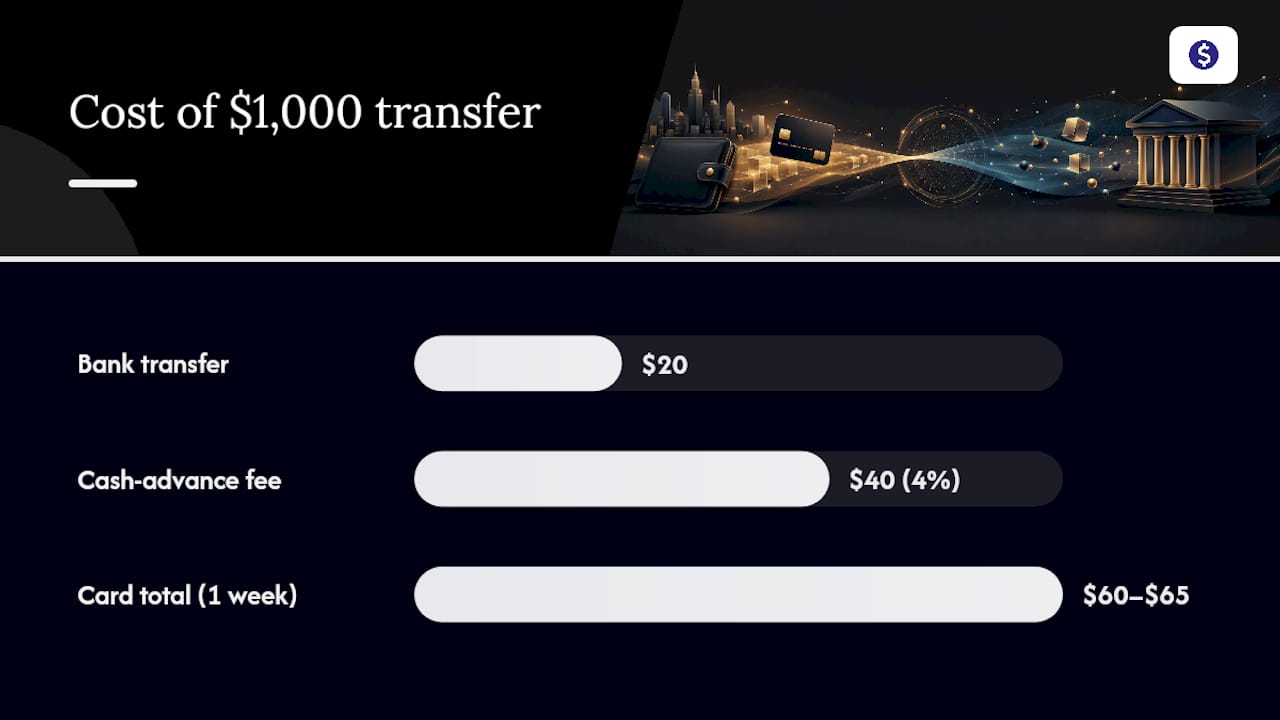
Here's how that plays out on a $1,000 transfer. Say a provider charges a $4.99 transaction fee and offers a rate 1.5% below the mid-market rate, an FX cost of roughly $15. Funded through a linked bank account, your total cost is about $20, and the recipient gets close to $980 worth of value.
Fund that same $1,000 transfer with a credit card coded as a cash advance, and add a 4% cash-advance fee ($40) plus interest at a cash-advance APR (often 25%-30%) accruing from day one. Even if you pay it off within a week, you've added $40 to $45 in extra cost on top of the $20 you'd have paid with a bank transfer. That's the difference between a transfer that costs 2% and one that costs closer to 6%.
How to Avoid or Reduce Credit Card Transfer Fees
The cheapest fix is also the simplest: fund transfers from a linked bank account (ACH) or debit card instead of a credit card. Both typically avoid cash-advance coding entirely, though ACH transfers can take a day or two longer to clear, a real tradeoff if you need money to arrive same day.
If you're not sure how your card will be treated, a few small moves protect you:
- Call your issuer and ask them to confirm the transaction coding before you send a large amount.
- Ask to set your cash-advance limit to $0, which causes a cash-advance transaction to decline instead of quietly posting with fees attached, a tactic detailed by Doctor of Credit.
- Send a small test transfer, like $10 or $20, before committing to a large amount.
- Run the total cost, fee plus FX margin plus any card charges, through a comparison tool like Idealremit before choosing a provider.
Pro Tip: If a card is genuinely your only option, keep the amount as small as possible and pay off the balance the moment it posts. Every extra day at a cash-advance APR compounds the mistake.
When a Credit Card Transfer Might Be Worth the Extra Cost
There are legitimate cases where paying more makes sense.
A few scenarios where card funding can be defensible:
- A true emergency where delay carries a real cost, medically or financially.
- A small, one-off transfer where the absolute dollar cost of the fee is limited, even if the percentage looks high.
- A short-term cash-flow gap where you know you can pay off the balance immediately and avoid ongoing interest.
Outside those situations, card funding is rarely the right default. It's a tool for speed, not a habit for regular transfers.
Where Senders Go Wrong (And How to Fix It)
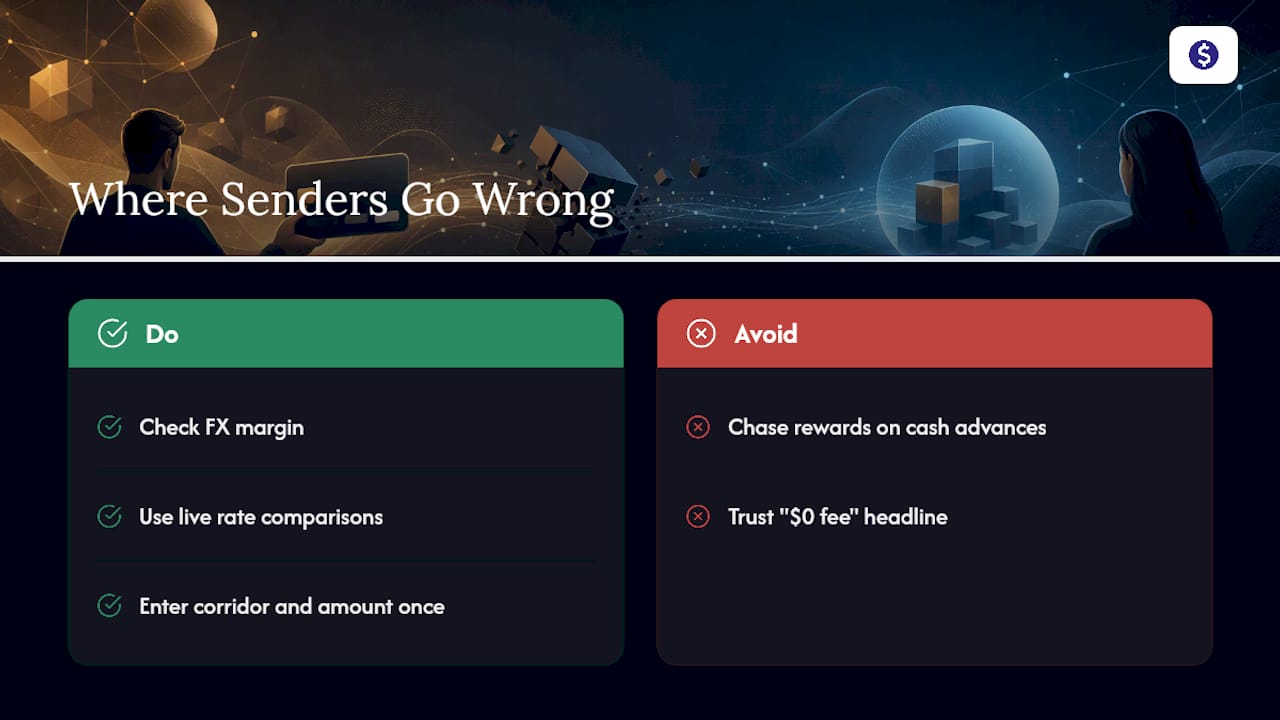
The mistake we see most often is chasing credit card rewards points on a transfer that's coded as a cash advance, which earns zero points and adds a fee on top. A close second: trusting a "$0 fee" headline without checking the FX margin, which is where most of the real cost hides.
Idealremit's live rate comparisons and fee breakdowns exist to expose that gap. Enter your corridor and amount once, and you see the total cost side by side, not just the advertised number.
- Brahim
Check Your Exact Corridor Before You Send
Idealremit is the alternative to guessing at fee pages and FX rates one provider at a time. Enter your transfer amount and destination once, and see the total recipient amount across providers side by side, fee, FX margin, and all, instead of hunting through fine print on five different websites.

Set up a rate alert for your corridor and Idealremit will flag it when pricing shifts in your favor, useful if you're weighing whether to wait a day or send now. If you're deciding between a bank transfer, debit funding, or a card as a last resort, comparing providers by total cost first can save you the 3%-5% a cash advance would add. For readers exploring other fast-funding options, this rundown of alternatives to bank transfers is worth a look too. Start by entering your amount and corridor on Idealremit to see your real total cost before you pick a funding method.
Sources
This article draws on the World Bank's Remittance Prices Worldwide report, NerdWallet's explainer on cash-like transactions, Experian's guide to cash-advance triggers, and Doctor of Credit's mitigation tactics. Readers weighing broader financial service costs may also find this overview of affordable financial services useful.
This article is general information, not a substitute for advice from a qualified financial advisor. Consult a qualified financial professional about your own circumstances before acting on anything here.
- World Bank - Remittance Prices Worldwide Q2 2024 (report and annex)
- FICO Forums - discussion and examples of issuer 'cash-like' transaction changes
- Experian - What purchases are considered cash advances on a credit card?
- Doctor of Credit - How to avoid cash advance fees
FAQ
Is a credit card transfer always coded as a cash advance?
Not always, but many issuers treat international money transfers and P2P payment funding as cash-like transactions, especially wire transfers and money orders, per Experian.
Does a credit card transfer earn rewards points?
No. Transactions coded as cash advances are excluded from most rewards and cash-back programs, even on cards that otherwise earn points on every purchase.
What's the cheapest way to fund an international transfer?
A linked bank account (ACH) or debit card is usually cheapest, since it avoids cash-advance coding entirely; comparing total cost across providers on a tool like Idealremit shows the real difference.
Can I stop my card from being charged a cash-advance fee?
Setting your cash-advance limit to $0 with your issuer causes the transaction to decline rather than post with fees, a tactic outlined by Doctor of Credit.