How to transfer money securely and save up to 80% safely

TL;DR:
- Digital money transfer providers charge an average of 3.55%, compared to 14.55% for traditional banks — a cost gap of roughly 75% on most corridors, with savings reaching 80% on some routes.
- Authorized push payment (APP) scams cost consumers an estimated $442 billion globally in 2025, making provider regulation, two-factor authentication, and recipient verification non-negotiable.
- The cheapest transfer is only the safest one when the provider is licensed, the funding method is secure, and the recipient details are verified through a separate channel before you authorize.
Saving up to 80% on an international transfer sounds like marketing — until you look at the World Bank's own data. Digital money transfer operators charge an average of 3.55% on cross-border transfers, while banks still average 14.55%. The math is real, but so is the risk: as faster, cheaper transfers became mainstream, fraud followed, with APP scams alone driving an estimated $442 billion in global consumer losses in 2025. This guide breaks down exactly how to capture the savings without becoming a statistic — covering provider regulation, transfer-time fraud prevention, the funding-and-payout combinations that drive cost down, and the verification steps most senders skip until something goes wrong.
Table of Contents
- Why secure transfers and low fees go together
- The real cost gap: where the 80% savings come from
- How to verify a money transfer provider is safe
- Step-by-step: sending money securely and cheaply
- Common scams targeting senders and how to spot them
- Save more with IdealRemit's live comparison
- Frequently asked questions
Key Takeaways
| Point | Details |
|---|---|
| Licensing first | Use providers regulated by the FCA (UK), FinCEN (US), or equivalent authority before comparing rates. |
| Where the savings live | Digital MTOs average 3.55% vs banks at 14.55%, per Q1 2025 World Bank data. |
| Payout method matters | Mobile wallet payouts average 5.10% globally, cheaper than bank disbursement at 7.99%. |
| Fraud is authorized, not stolen | Most modern losses come from victim-authorized payments, not hacks — verification is your defense. |
| Verify out-of-band | Always confirm recipient details on a separate channel before sending, never via the same message that requested the money. |
Why secure transfers and low fees go together
Security and savings are not separate problems with separate solutions. They share the same root cause: how the provider is built. Banks charge more partly because their cross-border infrastructure is old and partly because they pass on compliance costs that licensed digital providers handle more efficiently. The same digital infrastructure that drops fees from 14.55% to 3.55% also enables real-time fraud monitoring, tokenization, and biometric authentication that legacy systems struggle to match.
That does not mean any cheap provider is safe. The opposite is closer to the truth: unregulated platforms can quote the lowest rate precisely because they skip the compliance investments that protect you. The right framing is that licensed, digital-first providers tend to win on both fees and security simultaneously. Skipping the licensing check to chase a rate is where senders get into trouble.
According to the World Bank, the global average remittance cost in Q1 2025 was 6.49%, more than double the UN's 3% Sustainable Development Goal target. Within that average, the spread between provider types is enormous, and it is the spread — not the average — that creates the 80% savings opportunity for any given sender.
Here is what a secure, low-cost transfer actually requires:
- Provider licensing in both the sending and receiving country
- Strong customer authentication (2FA, biometric, or PIN-based)
- End-to-end encryption for the funding and confirmation flow
- Transparent pre-authorization disclosure of fees and the exchange rate
- Tracking and dispute resolution with a defined customer support channel
- Recipient verification through a channel separate from the transfer request
For a wider look at how digital wallet rails change the cost equation specifically, see the mobile money for global transfers guide on IdealRemit.
Key insight: A "cheap" transfer from an unlicensed provider is not cheap — the expected cost includes the probability of losing the entire principal. Licensing is the floor, not a bonus feature.
The real cost gap: where the 80% savings come from
The 80% figure is not a marketing flourish. It is the arithmetic gap between the most expensive and least expensive provider categories tracked by the World Bank's Remittance Prices Worldwide database, the gold-standard public dataset on transfer costs.
According to Q1 2025 RPW data, digital-only MTOs charge an average of 3.55%, compared with 14.55% for banks. That is a 75% reduction on the average bank route, and on specific corridors where bank pricing runs above the average and digital pricing runs below it, the gap stretches past 80%. On a $1,000 transfer, the difference between 14.55% and 3.55% is roughly $110 — money that either reaches your recipient or doesn't.

The savings break down across three independent levers:
| Cost driver | Bank average | Digital MTO average | Where the saving lives |
|---|---|---|---|
| Provider type | 14.55% | 3.55% | Choosing a digital MTO over a high-street bank |
| Payout method (global) | 7.99% (bank account) | 5.10% (mobile wallet) | Sending to a wallet instead of a bank account |
| Cash pickup | — | 5.70% | Useful when the recipient has no bank or wallet |
| SmaRT services (cheapest three) | — | 3.29% | Picking the cheapest qualifying service in your corridor |
The World Bank's SmaRT indicator — the average of the three cheapest qualifying services in each corridor — sat at 3.29% in Q1 2025, below the UN's 3% target on many routes. The implication is that the lowest legitimate prices are already below the SDG target; senders just have to find them.
Pro Tip: The 80% figure assumes you are comparing your worst current option (typically a bank-to-bank wire) against your best available option (typically a digital MTO with wallet payout). Compare your actual setup before claiming the full saving.
A few less obvious factors drive the remaining cost variation:
- Exchange rate margin, often the largest hidden cost, not always shown next to the headline fee
- Funding method — bank debit is usually cheapest, credit cards add 1-3%, wire transfers add bank fees on top
- Corridor competition — high-volume routes like US-Mexico and UK-India have more providers and lower prices
- Transfer size — flat fees favor larger amounts, percentage fees favor smaller ones, and the break-even point varies by provider
To see live rates for your specific corridor across dozens of providers, the IdealRemit comparison tool aggregates fees and exchange rate markups in real time so the cheapest-and-licensed option is the one you see first.
How to verify a money transfer provider is safe
Before any savings math matters, the provider has to be legitimate. This is not optional, and the check takes under two minutes.
Start with the regulator. In the UK, every licensed money transfer business is listed on the FCA Financial Services Register. In the US, money services businesses must register with FinCEN, and most also hold state-level money transmitter licenses you can verify through state banking departments. In the EU, providers operate under PSD2 (soon PSD3) and are listed by their national competent authority. If a provider claims a license, the regulator's public register either confirms it or doesn't.
The second check is technical. The website URL must begin with https://, the company should publish a verifiable physical address, and the customer support channels should include a phone number that actually connects to a human. A provider that cannot be contacted is a provider that cannot resolve a dispute.
Here is the minimum verification checklist before you fund a transfer:
- Confirm the license on the regulator's public register in the sending country
- Check the URL for
https://and the exact domain spelling (typosquatting is common) - Read the fee disclosure — fees and the exchange rate must be shown before authorization, not buried in fine print
- Verify customer support exists — try the chat or phone number before sending real money
- Look for reimbursement policy terms in the case of unauthorized transactions
- Check independent reviews on Trustpilot or similar, focusing on resolution of complaints rather than star averages
Worth noting: The UK Payment Systems Regulator's mandatory reimbursement rules, in force since October 2024, require licensed payment firms to reimburse APP fraud victims up to £85,000 per claim. That protection only applies to licensed providers — another reason the licensing check matters more than the headline rate.
For a deeper look at how to sequence these checks alongside the cost comparison, see the secure transfer guide on IdealRemit, which walks through the full pre-transfer workflow.
Step-by-step: sending money securely and cheaply
Once the provider is verified, the actual transfer is straightforward. The order of the steps matters more than most people realize — verifying the recipient after funding is one of the most common ways money ends up in the wrong account.
- Confirm the recipient's details out-of-band. Call or video-call the recipient directly to confirm the account number, wallet ID, or pickup name. Never rely on details sent in the same email or message that requested the money.
- Log in to the provider on a private network. Avoid public Wi-Fi for any transfer over $100. If you must use mobile data, ensure 2FA is active.
- Enter the transfer amount and destination. The screen should immediately display the total fee, the exchange rate, the markup against mid-market, and the amount the recipient receives.
- Compare the receive amount across providers. This is the single most useful comparison — it bundles fee and FX margin into one number. A 5-second check on IdealRemit often reveals a $20-50 swing on a $1,000 transfer.
- Choose the funding method. Bank debit is usually cheapest. Credit cards are faster but add 1-3%. Wire transfers add bank-side fees that often erase the digital provider's savings.
- Select the payout method. Mobile wallet is cheapest globally at 5.10%, cash pickup at 5.70%, bank deposit at 7.99%. Match this to what the recipient can actually access.
- Authorize with strong authentication. Use biometric or 2FA confirmation. If the provider does not require it, that is a red flag.
- Save the confirmation reference. The tracking number is what you need if anything goes wrong. Screenshot it; do not rely on email alone.
- Notify the recipient through the same channel you used to verify. Tell them the reference number and expected arrival time so they can flag any discrepancy.
The single most overlooked step is step 1 — verifying recipient details on a separate channel from the one that requested the money. Authorized push payment fraud works precisely because the request and the payment details come through the same compromised channel (a hacked email, a spoofed SMS, a fake WhatsApp account). Breaking that loop is what protects most senders.
Pro Tip: For recurring transfers to the same person, save the recipient profile inside the provider's app and update it only after an out-of-band confirmation. Most successful scams targeting regular senders involve a fraudster prompting an "update" to the saved account details.
Common scams targeting senders and how to spot them
Cheap transfers are not what creates fraud risk — fast transfers are. The same speed that makes a digital wallet payout arrive in minutes also means there is little time to reverse a fraudulent transfer. APP fraud, where the victim themselves authorizes the payment under false pretenses, now dominates global remittance fraud statistics.
According to the Global Anti-Scam Alliance, consumers worldwide lost an estimated $442 billion to APP fraud and scams in 2025. The pattern is consistent across regions: fraudsters do not break into accounts, they convince the account holder to send the money themselves.
The most common scam types targeting international transfer senders:
- Impersonation scams — fraudster poses as a bank investigator, government agent, or tech support, creating urgency around a "compromised" account and instructing the victim to move funds to a "safe" account
- Romance scams — long-running emotional manipulation culminating in a request for money, often framed as a medical emergency or travel expense
- Investment scams — promises of guaranteed high returns on crypto, forex, or property, often involving a professional-looking platform; UK Finance reports £98 million in losses to investment scams in the first half of 2025 alone
- Invoice redirection — fraudster intercepts a legitimate supplier or family member's communication and sends "updated" bank details, redirecting the next payment
- Purchase scams — payment for goods or services that never arrive, particularly on marketplaces that lack buyer protection
- Advance-fee scams — request for a small upfront payment to "unlock" a larger amount (inheritance, loan, prize)
Two red flags are present in almost every case: urgency ("you need to act in the next hour") and isolation ("don't tell your bank, they're part of the problem"). A legitimate provider, family member, or institution will never object to you taking time to verify through a separate channel.
Worth noting: Once an APP fraud payment is authorized and the funds reach the recipient account, recovery is statistically unlikely. Most jurisdictions outside the UK still place primary liability on the customer for authorized transfers. Prevention is essentially the only defense.
If you suspect you have been targeted, stop the transfer if it has not yet completed, contact your provider's fraud line immediately, file a report with your local cybercrime authority, and notify the receiving country's regulator if the payment has already landed. Speed of reporting is the single biggest factor in any recovery attempt.
Save more with IdealRemit's live comparison
The math is clear: a licensed digital MTO with a wallet payout can cost roughly a quarter of what a bank wire costs, and on some corridors the gap reaches 80%. The harder part is finding which specific provider holds that position for your specific corridor today, because rates and promotions shift weekly.
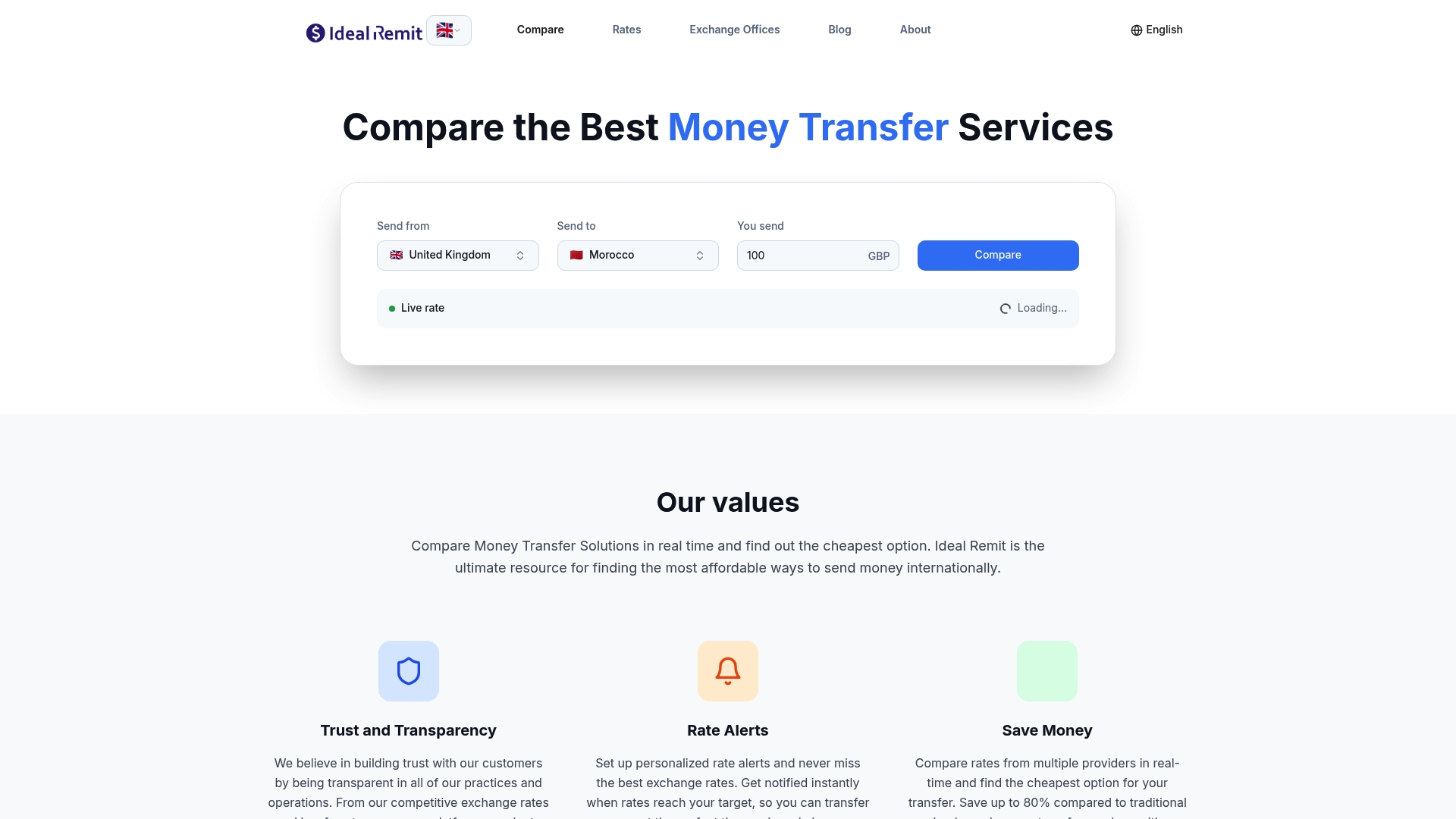
IdealRemit aggregates live rates, fees, and exchange rate markups across licensed providers in real time, so the cheapest legitimate option for your route surfaces first. Whether you are a UK sender comparing routes to South Asia, a US sender looking at the Mexico corridor, or anywhere in between, the platform displays the receive amount — the only number that matters when you compare — alongside delivery speed and payout options.
For UK-based senders, the UK comparison page covers the major outbound corridors with current rates. US senders can compare US transfer services across the largest providers in one view. For ongoing analysis of fee trends, scam alerts, and corridor-specific guidance, the IdealRemit blog updates regularly with the data senders actually need. Savings of up to 80% versus bank rates are not theoretical — they are sitting in the comparison results waiting to be claimed.
Frequently asked questions
How can I really save up to 80% on an international transfer?
The 80% figure comes from comparing typical bank pricing (around 14.55% globally, per Q1 2025 World Bank data) against the cheapest digital MTOs (around 3.55%). The savings come from switching provider type, choosing wallet or cash payout over bank deposit, and selecting a corridor with strong competition.
Are cheap money transfer providers safe?
The cheap ones that are also licensed are safe. The licensing check (FCA in the UK, FinCEN in the US, equivalent regulators elsewhere) takes under two minutes and is non-negotiable. An unlicensed provider quoting a low rate is not actually cheap once you factor in the risk of losing the full transfer.
What is APP fraud and how does it affect international transfers?
Authorized push payment fraud is when a scammer manipulates you into authorizing a transfer yourself, usually through impersonation or emotional pressure. Because you authorized the payment, banks and providers are often not required to reimburse you. Global losses reached an estimated $442 billion in 2025, making out-of-band recipient verification the most important security step.
Should I use a credit card or bank transfer to fund my transfer?
Bank debit is usually cheapest and offers strong fraud protection. Credit cards are faster but add 1-3% in card-network fees, and some providers categorize them as cash advances. Wire transfers from a bank account add bank-side fees that often erase the digital provider's savings, so they only make sense for very large amounts.
Recommended
Written by
Brahim Oubrik
Brahim Oubrik, a senior data engineer who experienced firsthand the challenges of sending money internationally. Living in France while supporting his family in Morocco, Brahim regularly needed to transfer funds across borders. Drawing on his background in data engineering, Brahim decided to solve this problem not just for himself, but for the millions of others navigating the same difficulties. He built Ideal Remit to bring clarity to the international money transfer market.