
TL;DR:
- A money transfer workflow involves sequential steps—initiation, validation, approval, and execution—that ensure funds are securely sent from sender to recipient. Cross-border transfers are more complex than domestic ones due to additional banking hops, FX conversions, and regulatory checks, which increase costs and delays. Optimizing transfers involves selecting the appropriate payment rail, validating beneficiary data before payout, and relying on confirmed payout states rather than timing assumptions.
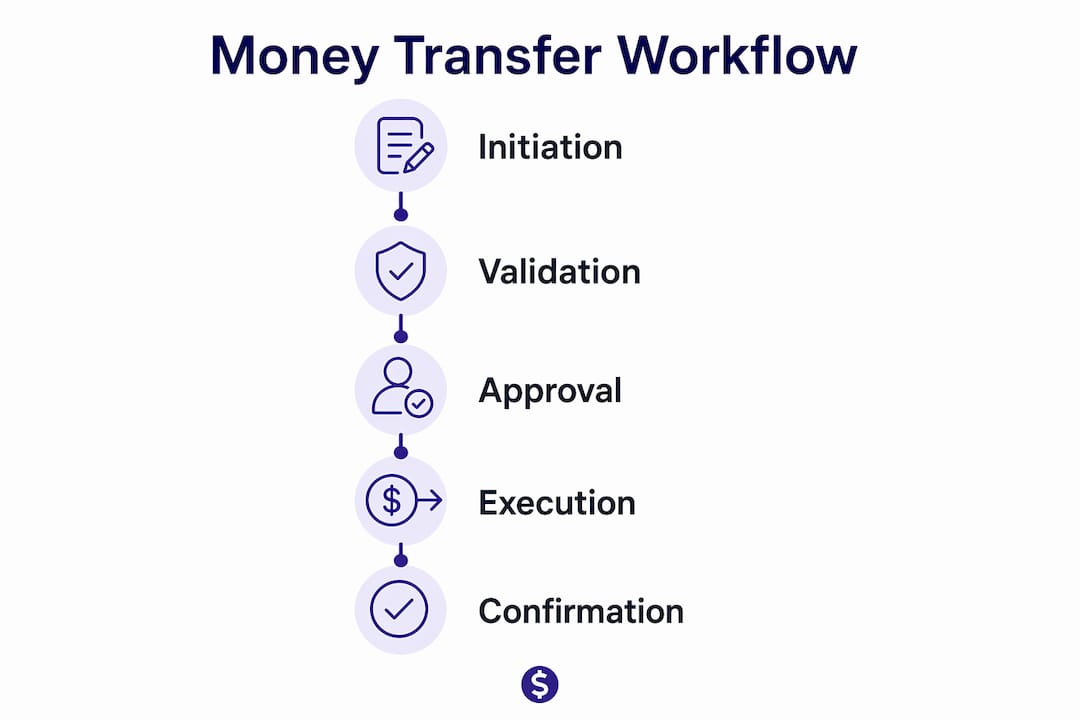
A money transfer workflow is the structured sequence of steps that moves funds securely from sender to recipient, covering data collection, validation, authorization, and final settlement. For individuals and small businesses sending money internationally, mastering this process is the difference between a fast, low-cost transfer and one that arrives late, short, or not at all. The core stages are initiation, validation, approval, and execution. Each stage carries specific risks and optimization points that most senders never examine. This article breaks down every stage, explains where cross-border transfers get complicated, and gives you concrete tools to reduce costs and avoid common failures.
What are the key stages in a money transfer workflow?
The typical remittance workflow follows a seven-step sequence: data collection, wallet confirmation, beneficiary validation, FX quote fetching, FX execution, and payout dispatch. Each step must complete successfully before the next begins. Skipping or rushing any stage is the most common cause of failed or delayed payments.
Stage 1: Initiation. The sender creates a payment request and provides beneficiary details, including full name, account number, routing code, and bank address. Incomplete data at this stage causes downstream failures that are expensive to reverse.

Stage 2: Validation. The system checks that all data fields are complete, accurate, and consistent. This includes format checks on IBAN or account numbers, address verification, and identity confirmation. Sanctions compliance must be embedded here as a workflow gate, not handled as paperwork after execution. OFAC screening, for example, is expected before payment execution and repeated as policy requires.
Stage 3: Approval. Authorization levels are applied. For small businesses, this might mean a manager sign-off above a certain threshold. For automated systems, it means passing all compliance checks before the payment instruction is released.
Stage 4: Execution. Funds move across a payment rail such as EFT, wire, ACH, or SWIFT. The system dispatches the transfer and then waits. This is where most workflow designs fail. PayMongo's send_money step waits for an asynchronous callback or polls the Transfers API before concluding, which prevents race conditions where a system assumes completion before the bank confirms it.
Pro Tip: Never advance a workflow to the next stage based on a timer. Wait for a confirmed status callback from the payment network. Assumed timing creates disputes and double payments.
How does the cross-border money transfer workflow differ from domestic?
Domestic transfers move through a single payment network, typically ACH in the United States or Faster Payments in the UK, with one clearing house and one settlement cycle. Cross-border payments add complexity because routing and settlement require additional steps, additional parties, and additional compliance checks at each hop.
The key differences are:
- Correspondent banking hops. An international wire via SWIFT often passes through two or three correspondent banks before reaching the recipient's institution. Each correspondent bank hop adds fees typically ranging from $10 to $30, and those fees accumulate quickly, reducing the amount the recipient actually receives.
- FX conversion. Most cross-border transfers require a currency exchange at some point in the chain. The rate applied, and who applies it, directly affects the final payout amount. Providers like Wise apply the mid-market rate with a transparent fee. Traditional banks often apply a marked-up rate with no disclosure.
- Nostro and vostro accounts. Correspondent banks hold pre-funded accounts in foreign currencies on behalf of other banks. Settlement draws from these accounts, which means delays occur when those accounts are underfunded or when cutoff times are missed.
- Regulatory and corridor-specific rules. Transfers to Morocco, Nigeria, or the Philippines each carry different documentation requirements, transfer limits, and beneficiary validation rules. A workflow optimized for Europe may fail entirely in Southeast Asia.
The table below shows how payment networks compare across key dimensions for cross-border use:
| Network | Speed | Cost | Best use case |
|---|---|---|---|
| SWIFT gpi | 1 to 5 days | High (correspondent fees) | Large business wire transfers |
| SEPA | Same day to 1 day | Low | Eurozone transfers |
| ACH | 1 to 3 days | Low | US domestic and some cross-border |
| RTP / Faster Payments | Seconds | Low to medium | Real-time domestic and select corridors |
| Local-to-local rails | Hours to 1 day | Low | Emerging market payouts via aggregators |
Using local payment rails for payouts reduces correspondent banking fees and improves timing relative to SWIFT correspondent wire transfers. This is the core logic behind how remittance aggregators like those compared on Idealremit operate: they route your transfer through local networks at the destination rather than sending a SWIFT wire the entire way.
What practical steps can you take to optimize your transfer process?
Optimization starts with choosing the right payment rail for each corridor. A SWIFT wire to a major European bank is slower and more expensive than a SEPA transfer. A wire to a recipient in the Philippines costs more than routing through a local payout network. The cross-border transfer process has more options than most senders realize.
The comparison below shows where each approach wins:
| Approach | Cost | Speed | Reliability | Best for |
|---|---|---|---|---|
| Bank wire (SWIFT) | High | Slow | High | Large, infrequent transfers |
| Remittance aggregator | Low | Fast | High | Regular small to mid transfers |
| Digital wallet transfer | Very low | Instant | Medium | Recipient has same platform |
| Same-day ACH | Low | Same day | High | US-based business payouts |
| Local-to-local payout | Low | Fast | High | Emerging market corridors |
Same-day ACH reduces settlement time but depends on cutoff times. Nacha's updated limits make it viable for larger business payouts, but a missed cutoff pushes your transfer to the next business day. Know your provider's cutoff schedule before you initiate.
Accurate beneficiary data is the single most controllable variable in your workflow. Staging beneficiary validation before payout submission prevents costly reversals. A returned wire costs $15 to $50 in bank fees and delays the recipient by days. Verify the IBAN, SWIFT/BIC code, and account name before every transfer, not just the first time.
Idempotency keys and unique payment identifiers per payout and FX trade make retries safe and support audit trails. If your payment system or provider allows you to assign a unique reference to each transfer, use it. This prevents duplicate payments when a network timeout causes your system to retry.
Pro Tip: Set up rate alerts on Idealremit to catch favorable exchange rate windows. For regular business transfers, even a 0.5% improvement in the FX rate compounds significantly over a year.
What are common mistakes in money transfer workflows and how do you fix them?
Most transfer failures trace back to a small set of recurring errors. Recognizing them before they happen saves time, money, and frustration.
- Missing cutoff times. Banks and payment processors have hard cutoff times for same-day processing. A wire submitted at 4:45 PM EST when the cutoff is 4:30 PM waits until the next business day. For time-sensitive payroll or supplier payments, submit at least two hours before the cutoff.
- Incorrect beneficiary data. A single wrong digit in an account number or routing code causes a return or a misdirected payment. Misdirected payments to wrong accounts can take weeks to recover. Always confirm beneficiary details directly with the recipient before the first transfer.
- Misunderstanding fee responsibility codes. SWIFT transfers use SHA (shared fees), OUR (sender pays all), and BEN (recipient pays all) codes. SHA is the default, meaning correspondent banks deduct their fees from the transfer amount. If your recipient must receive an exact amount, use OUR. Most senders never change this setting and then dispute why the recipient received less than expected.
- Ignoring asynchronous callback failures. In automated payment systems, a failed webhook means your workflow never receives the confirmation it needs to advance. Webhook-confirmed payout states are more reliable than timing assumptions, and a missed callback leaves your workflow in a frozen state.
- Skipping status tracking. SWIFT gpi provides a Unique End-to-End Transaction Reference (UETR) that lets you track a wire at every correspondent hop. Not using it means you have no visibility into where a delayed payment is sitting.
"Funds availability and settlement finality can diverge. Workflows should be driven by payout state events, not fixed timers." This principle from payment infrastructure design applies equally to a freelancer tracking a client payment and a small business managing supplier payouts.
For remittance delays specifically, the fix is almost always one of three things: better beneficiary data, a faster payment rail, or a provider with direct local network access at the destination.
Key takeaways
Optimizing your money transfer workflow requires choosing the right payment rail, validating beneficiary data before submission, and treating confirmed payout states as the only reliable signal of completion.
| Point | Details |
|---|---|
| Four core stages | Every transfer follows initiation, validation, approval, and execution in sequence. |
| Cross-border adds cost | Each SWIFT correspondent hop adds $10 to $30 in fees, reducing recipient payout. |
| Local rails beat SWIFT | Routing through local payment networks cuts cost and speeds delivery in most corridors. |
| Data quality controls success | Incorrect beneficiary data causes returns that cost fees and delay recipients by days. |
| State-driven workflows win | Confirm completion via webhook or callback, never by assuming a timer has elapsed. |
Why I think most senders are optimizing the wrong thing
Most individuals and small businesses focus on the exchange rate when choosing a transfer provider. The rate matters, but it is rarely the biggest variable in your total cost. The payment rail your provider uses, and whether they have direct local network access at the destination, determines both the speed and the true all-in cost of your transfer.
I have seen businesses save 30% on transfer costs not by finding a better rate, but by switching from a SWIFT wire to a local-to-local payout through a remittance aggregator. The rate was nearly identical. The difference was eliminating two correspondent bank hops.
The other thing most senders ignore is workflow state management. Whether you are using a manual process or an automated system, treating the confirmed payout state as your operational source of truth prevents disputes, duplicate payments, and reconciliation headaches. Compliance screening embedded as a workflow gate, not a post-transfer checkbox, keeps you protected without slowing down legitimate payments.
For small businesses sending regular international payouts, the investment in understanding your payment workflow pays back quickly. Automate what you can, validate beneficiary data before every transfer, and use a comparison tool to verify you are on the best rail for each corridor.
— Brahim
How Idealremit helps you find the best transfer option
Choosing the right provider for your international money transfer workflow should not require hours of research across a dozen websites.

Idealremit aggregates real-time rates, fees, and delivery speeds from providers including Wise, Remitly, Western Union, and MoneyGram, so you can compare the true cost of each option in seconds. The platform supports transfers to over 100 countries and lets you set personalized rate alerts so you never miss a favorable window. Savings of up to 80% compared to traditional bank transfers are possible when you route through the right provider for your specific corridor. Compare transfer providers now and find the fastest, most cost-effective option for your next international payment.
FAQ
What is a money transfer workflow?
A money transfer workflow is the structured sequence of steps that moves funds from sender to recipient, including initiation, validation, approval, and execution. Each stage must complete successfully before the next begins to prevent errors, delays, or compliance failures.
Why do international transfers cost more than domestic ones?
International transfers route through multiple correspondent banks, each charging transit fees of $10 to $30 per hop, and require FX conversion and additional compliance checks. Using local payment rails at the destination eliminates most of these fees.
What is the SHA fee code in a SWIFT transfer?
SHA means shared fees, where the sender pays their bank's fee and correspondent banks deduct their fees from the transfer amount before it reaches the recipient. Use the OUR code if the recipient must receive the exact amount you send.
How can I track an international wire transfer?
SWIFT gpi assigns a Unique End-to-End Transaction Reference (UETR) to every wire, allowing you to track the payment at each correspondent bank hop in real time. Ask your bank or provider for the UETR at the time of submission.
What is the fastest way to send money internationally?
Real-time payment networks and local-to-local payout rails deliver funds in hours or minutes for most corridors, compared to one to five days for standard SWIFT wires. Providers with direct local network access at the destination consistently outperform traditional bank wires on both speed and cost.