Real Estate Wire Fraud: What it Is and How it Works
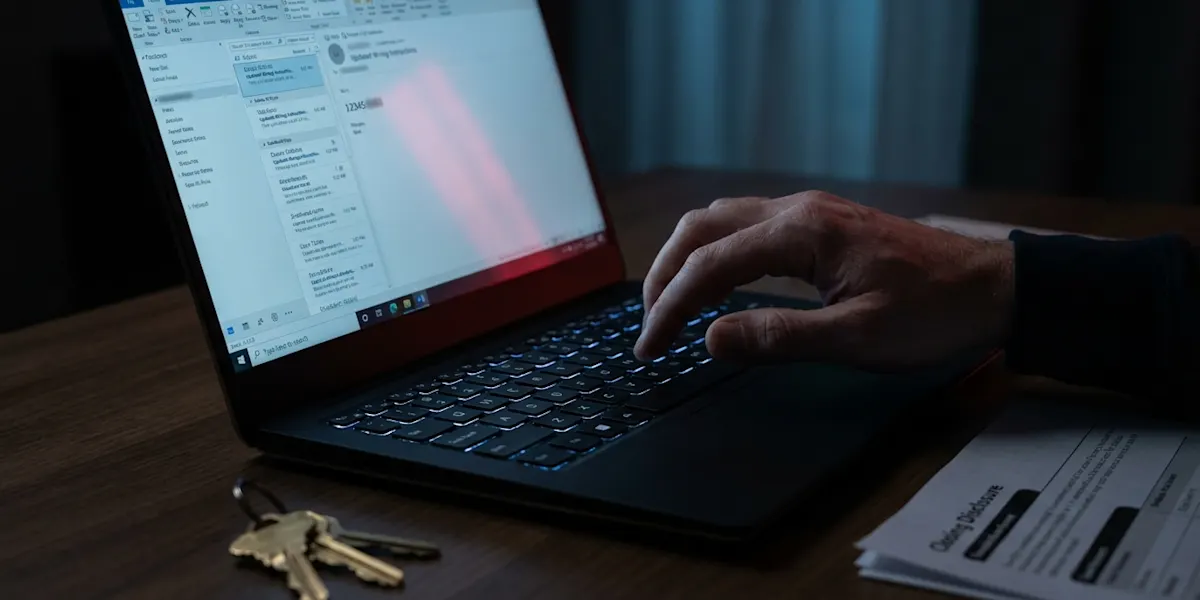
The FBI IC3 reported over $396 million in real estate and rental fraud losses in 2023, with individual victims losing an average of $150,000 to $200,000 in a single wire transfer. In many cases, that is an entire down payment. A family's entire savings. Gone in minutes.
Real estate wire fraud occurs when criminals intercept or impersonate communications between parties in a property closing and redirect the buyer's wire transfer to a fraudster-controlled bank account. The target could be your down payment, your earnest money deposit, or your entire settlement balance.
Here is what makes it so devastating: these are not clumsy phishing emails from strangers. They are surgically targeted attacks where fraudulent instructions often come from the actual compromised email account of your title company, real estate agent, or closing attorney. The email looks legitimate because, in many cases, it technically is.
This guide explains exactly how these attacks work, the warning signs that reveal them, and step-by-step prevention protocols for every party in the transaction. If you are an international buyer wiring cross-border funds for a US, UK, or Australian property purchase, pay special attention. Your risk profile is even higher.
What Is Real Estate Wire Fraud?
Real estate wire fraud is a targeted form of business email compromise in which criminals intercept or manipulate the wiring instructions exchanged during a property closing to redirect the buyer's down payment, earnest money, or settlement funds to a fraudster-controlled bank account. It is the highest-dollar-value consumer wire fraud category tracked by the FBI.
Real estate closings are uniquely attractive to wire fraudsters for four structural reasons. First, the wire amounts are very large and completely routine. Nobody finds a $250,000 wire surprising during a closing. Second, multiple parties exchange sensitive financial details via email throughout the transaction. Third, hard contractual deadlines create time pressure that discourages careful verification. Fourth, public records and MLS listings allow criminals to identify specific transactions, parties, closing dates, and dollar amounts before they ever send a single fraudulent email.
The key distinction: the criminal does not hack the banking system. They hack the communication channel through which wiring instructions are transmitted, then substitute their own account details. It is a man-in-the-middle attack on email, not on the bank itself.
Real Estate Wire Fraud vs. Mortgage Fraud vs. Title Fraud: Key Differences
"Real estate wire fraud," "mortgage fraud," and "title fraud" are frequently confused because they all involve property transactions. But they are entirely different crimes targeting different assets through different methods.
| Factor | Real Estate Wire Fraud | Mortgage Fraud | Title Fraud | Rental Scam |
|---|---|---|---|---|
| What is stolen | Closing funds (down payment, earnest money, settlement) | Loan proceeds via false application | Property ownership via forged deeds | Deposits and rent from prospective tenants |
| How it works | Wiring instructions manipulated via email compromise | Falsified income, assets, or property value | Forged ownership documents filed with county recorder | Fake property listings on Craigslist, Zillow |
| Who is the victim | Homebuyer or seller | Lender | Property owner | Prospective tenant |
| Typical loss | $50,000 to $500,000+ per incident | Varies (lender absorbs loss) | Entire property value (ownership dispute) | $1,000 to $5,000 (deposit + rent) |
| Criminal method | Business email compromise, phishing | Document falsification | Forgery, identity theft | Impersonation of landlord or owner |
| Recovery prospects | Very low (irreversible wire) | Lender absorbs loss | Legal title dispute (years) | Low (cash or wire) |
A homebuyer can be victimized by real estate wire fraud while having a perfectly legitimate mortgage and clean title. These crimes are completely independent of each other.
One important note on FBI data: the IC3 groups "real estate" and "rental" fraud together in its annual reporting. This means the headline figures include both property purchase wire fraud and rental scams. Even accounting for this grouping, the wire-fraud-specific subset of property closings represents hundreds of millions in annual losses.
How Real Estate Wire Fraud Works: The Attack Chain
Real estate wire fraud follows a methodical, multi-stage attack chain. It is not a random opportunistic email. Understanding each stage reveals why the fraud is so convincing and, more importantly, exactly where you can stop it.
There are five stages. Each one builds on the last.
Stage 1: Transaction Targeting and Reconnaissance
The attack begins long before any fraudulent email is sent. Criminals identify active transactions through four main channels.
Public property records. Pending sales, title transfers, and mortgage filings are public record in most US counties. Criminals monitor county recorder databases for new filings. This gives them property address, approximate sale price, and the parties involved.
MLS listings. A "pending" or "under contract" status on Zillow, Realtor.com, or Redfin signals that a closing is imminent. The listing reveals the property address, listing agent, and approximate sale price. This is freely available to anyone.
Social media. Buyers and agents frequently post about accepted offers. "Just went under contract!" announces the transaction, the agent's name, and the timeline to anyone watching.
Compromised email accounts. The most direct method. If a criminal has already compromised a real estate agent's or title company's email, they can see every active transaction in the pipeline instantly.
From reconnaissance, the criminal harvests everything they need: property address, sale price, buyer and seller names, agent names, title company details, closing date, and communication patterns. This intelligence is what makes the eventual fraudulent email so devastatingly convincing.
Stage 2: Email Account Compromise
Email compromise is the attack's enabling step. Once a criminal controls or monitors a relevant email account, everything else follows.
There are three primary compromise methods.
Spear phishing. A targeted email crafted to look like a legitimate service, a DocuSign notification, an email provider login prompt, or an MLS login page, tricks the recipient into entering credentials on a fake site. Real estate professionals are heavy DocuSign and cloud tool users, which creates abundant phishing surfaces.
Credential stuffing. The professional's email and password were exposed in a previous data breach (LinkedIn, Adobe, and similar sites have all suffered major breaches). The criminal tests those credentials against the professional's work email. Password reuse is extremely common and is the single largest enabler of real estate email compromise.
Dark web purchase. Compromised real estate professional email accounts are actively sold on dark web marketplaces, sometimes with transaction pipelines already identified for the buyer.
Here is the critical part: after gaining access, the criminal does NOT immediately send a fraudulent email. Instead, they set up email forwarding rules or inbox monitoring that allows them to read all incoming and outgoing messages silently. The account owner has no idea they have been compromised. This patience is what makes the attack so effective.
Stage 3: Silent Monitoring and Transaction Intelligence
After compromising an email account, the criminal enters a monitoring phase that can last days to weeks.
During this time, they read the full email chain to identify every party and learn how each person communicates, including their signatures, tone, and naming conventions. They track the closing timeline precisely, knowing the exact closing date, the expected wire amount, and when wiring instructions will be sent.
They also set up inbox rules. These email forwarding or filtering rules redirect specific messages (any email containing "wiring instructions" or "wire transfer," for example) to the criminal while deleting them from the victim's inbox. This means the victim never sees the legitimate instructions that were supposed to arrive.
Most importantly, the criminal identifies the trust chain. They learn which party the buyer trusts most and will most likely follow instructions from. This is typically the title company or closing attorney.
This surveillance is exactly what makes the fraudulent email so convincing. The criminal knows the correct closing date, the property address, the exact dollar amount, and the specific person the buyer expects to hear from. The fraudulent email does not arrive out of context. It arrives precisely when the buyer expects it.
Stage 4: The Fraudulent Wiring Instructions
This is typically the only visible action the criminal takes. And it is designed to be indistinguishable from a legitimate communication.
There are three delivery methods.
Sent from the actual compromised email account. The most dangerous variant. The email genuinely comes from the title company's or attorney's real email address because the criminal controls the account. There is no spoofing to detect. Your email client will show the correct sender name, correct email address, and correct signature.
Sent from a look-alike domain. The criminal registers a domain nearly identical to the legitimate company, for example firstamericantit1e.com instead of firstamericantitle.com, and sends from an address that appears correct at a glance.
Spoofed sender address. The display name and apparent sender address are forged. The underlying email headers would reveal a different origin, but virtually no one inspects headers during a stressful closing process.
The email arrives 24 to 72 hours before the closing date. It references the specific property address and closing date. It matches the legitimate party's email signature and communication style. And it contains "updated" or "corrected" wiring instructions with a new routing number and account number.
Common phrasing includes: "Our bank has changed, please use the updated wiring instructions below," "There has been a last-minute change to our escrow account," or "Please disregard the previous instructions and use these instead."
The criminal only needs to change the routing number and account number. Everything else in the email can be, and usually is, completely accurate. They have been monitoring the real transaction for weeks.
Stage 5: Fund Extraction and Disappearance
Once you initiate the wire to the fraudulent account, the extraction operation begins immediately. Not within hours. Within minutes.
Funds are split and moved to multiple secondary accounts (called mule accounts), converted to cryptocurrency, or withdrawn as cash at multiple locations. Within 24 to 48 hours, the money has typically been layered through enough intermediaries to be effectively untraceable.
The discovery gap is brutal. You often do not realize the fraud for one to three days. You believe your closing is proceeding normally until the legitimate title company contacts you asking where the funds are, or you arrive at the closing table and discover the money was never received. By that point, the extraction is complete.
For international wires, this is even worse. Cross-border wire recalls require coordination across two to three correspondent banks in different jurisdictions, each adding processing time and requiring separate recall requests through different regulatory frameworks. The recovery window shrinks with every additional intermediary.
The FBI IC3 Recovery Asset Team has successfully frozen domestic wires reported within 72 hours, with a demonstrated success rate of approximately 73% (verify with latest IC3 annual report). But for funds already extracted, especially internationally, recovery is extremely rare.
Who Is Targeted by Real Estate Wire Fraud?
Any party in a real estate transaction can be targeted. Here is how the risk breaks down by role.
-
Homebuyers are the primary financial target. They wire the largest single sum (down payment plus closing costs) and are often first-time participants unfamiliar with closing procedures. First-time buyers are especially vulnerable because they have no prior experience to compare against. They do not know what "normal" looks like.
-
Home sellers are targeted for proceeds diversion. After closing, the criminal impersonates the seller to redirect disbursement of sale proceeds to a different account. Less common than buyer-targeted fraud, but increasingly reported.
-
Title companies and escrow agents are the most valuable email compromise target. Compromising one title company email account exposes every active transaction in their pipeline simultaneously. Title company impersonation is the most common attack vector in buyer-targeted wire fraud.
-
Real estate agents and brokers are targeted because their email accounts provide transaction intelligence and are used to redirect earnest money deposits. Agents often use personal email accounts or have weaker security practices than institutional title companies.
-
Closing attorneys serve the same function as title companies in states where attorneys handle closings. They face identical email compromise risk and are high-value impersonation targets.
-
International buyers purchasing US, UK, or Australian property face compounded risk. They are unfamiliar with local closing customs, their cross-border wire transfers take longer to settle (providing a wider extraction window), and cross-jurisdictional complexity makes wire recall significantly harder. International buyers may also be less likely to initiate a phone callback for verification due to time zone and language barriers.
Warning Signs of Real Estate Wire Fraud
If any of the following warning signs are present, do not wire the funds. Stop, call the title company at a phone number you independently verify, and confirm every detail verbally before proceeding.
-
Last-minute change to wiring instructions. Any email requesting you use "updated," "corrected," or "new" wiring details, especially within 48 hours of closing, is the single most critical red flag. Legitimate wiring instructions do not change at the last minute.
-
Instructions received via email only. Legitimate title companies increasingly deliver wiring instructions through secure portals, not email. If instructions arrive in a plain email or email attachment, verify through a separate channel before acting.
-
Urgency pressure. "Wire immediately to avoid closing delay" or "Time-sensitive, must be sent today." Scammers create artificial urgency specifically to prevent you from verifying. Real professionals understand verification takes time.
-
Email address anomalies. The sender's email domain differs slightly from the legitimate company. An extra letter, a number replacing a letter, a different top-level domain. Check character by character, not at a glance.
-
Request to keep communication via email only. If the sender discourages phone calls ("I am in meetings all day, please just follow the email instructions"), this prevents the callback verification that would expose the fraud immediately.
-
Different bank or bank location than expected. If the title company is in Virginia but the wire is routed to a bank in a different state or country, stop and investigate.
-
Account name mismatch. The recipient account name does not match the title or escrow company name. Ask your bank to confirm the recipient account name before sending.
-
Unsolicited wiring instructions. You receive wiring details before you requested them or before your closing process has reached the wire stage. Timing matters.
-
Instructions differ from the closing disclosure. The bank details on the wiring instructions do not match what was listed on your closing disclosure or preliminary settlement statement.
-
Any request to wire to a personal account. Legitimate closing funds go to escrow or trust accounts held by title companies or attorneys. Never to an individual's personal bank account.
How to Protect Yourself from Real Estate Wire Fraud: A Step-by-Step Guide
These ten steps give you a complete protection protocol. Follow all of them. Not just the convenient ones.
-
Get wiring instructions in person or via secure portal. Request that your title company or closing attorney provide wiring instructions through an encrypted secure portal, in person at their office, or by hand-delivered hard copy. Never rely on emailed wiring instructions alone, regardless of how legitimate they appear.
-
Call to verify before wiring. Before sending any wire, call the title company or closing attorney to verbally confirm every detail: bank name, routing number, account number, and account holder name. Critical: use a phone number you independently verify from the company's official website, your original engagement letter, or a phone book. Not a number provided in the email containing the instructions.
-
Verify the recipient account name with your bank. When initiating the wire, ask your bank to confirm that the recipient account name matches the title or escrow company. If the name is an individual or an unfamiliar entity, stop the transaction.
-
Treat any last-minute change as a fraud signal. If you receive "updated" wiring instructions at any point, treat it as a potential fraud attempt and re-verify through independent channels before acting. Every time. No exceptions.
-
Confirm your title company uses email security. Ask whether they have implemented DMARC, DKIM, SPF authentication, and multi-factor authentication on all email accounts. Companies following ALTA Best Practices should be able to confirm these measures.
-
Avoid sharing closing details on social media. Do not post about your pending home purchase, closing date, or agent and title company names until after the transaction is complete.
-
Send a small test wire first. If possible, wire a small amount ($100) first and confirm receipt with the title company before sending the full closing amount. This adds one verification layer with minimal risk.
-
Wire early in the day. Sending a wire early gives maximum time for detection and recall if something goes wrong. A wire sent at 4:30 PM on a Friday before a holiday weekend has virtually no recovery window if fraud is detected.
-
Set up transaction alerts. Enable real-time alerts on your bank account for all outgoing wire transfers. You want to know the moment a wire leaves your account.
-
Establish a verbal passcode. At the start of the transaction, agree on a verbal passcode or code word with your title company that must be provided during any phone verification of wiring instructions. This prevents criminals from calling you first to pre-empt your callback.
What Title Companies and Real Estate Agents Should Do
Wire fraud prevention is not solely the buyer's responsibility. Here is what industry professionals should be doing to protect their clients.
-
Implement ALTA Best Practices. The American Land Title Association's seven pillars include specific wire fraud protocols. Adoption is a signal of professional commitment to security.
-
Deliver wiring instructions through secure portals only. Never send wiring instructions via unencrypted email. Platforms like CertifID and Qualia provide encrypted delivery with identity verification built in.
-
Mandate multi-factor authentication on all company email accounts. This single measure prevents the majority of email compromise attacks. It is non-negotiable.
-
Deploy DMARC, DKIM, and SPF email authentication. These technical standards prevent domain spoofing and impersonation of the company's email domain by criminals using look-alike addresses.
-
Educate every buyer at the start of the transaction. Provide a wire fraud warning document at the initial meeting or engagement, explaining that the company will never email wiring instructions alone and will never change bank details during a transaction.
-
Provide a dedicated verification phone number. Give buyers a direct, verified phone number for wire confirmation that is documented in the engagement letter. This makes callback verification easy and expected.
-
Monitor employee email accounts for unauthorized forwarding rules. Regularly audit email accounts for inbox rules that forward or delete messages. These are the clearest indicator of a compromised account.
If you are a buyer reading this: ask your title company which of these measures they follow. If they cannot confirm most of them, that is information worth acting on.
Real Estate Wire Fraud for International Buyers
International buyers face every risk that domestic buyers face, plus several more.
Unfamiliarity with local closing customs. A buyer from China, India, or the Middle East purchasing their first US property may not know what "normal" wiring instructions look like, whether email delivery is standard, or what verification protocols to expect. Criminals exploit this knowledge gap deliberately.
Cross-border wire settlement delays. International SWIFT wires routed through correspondent banks take one to five days to settle. A domestic wire recalled within hours may be recoverable. An international wire in transit through multiple intermediary banks is significantly harder to freeze, and the extraction window is wider.
Time zone barriers. When the buyer is eight to twelve time zones away from the title company, real-time phone verification becomes logistically difficult. Criminals know this and time their fraudulent emails to arrive when verification calls are least convenient.
Language and cultural barriers. Non-native English speakers may not catch subtle email anomalies like slight domain misspellings or unusual phrasing. Cultural norms around questioning authority figures, including attorneys and agents, may also reduce willingness to challenge instructions.
Jurisdictional complexity in recovery. If the fraudulent receiving account is in a third country, recovery requires coordination across three jurisdictions with different legal frameworks, different law enforcement cooperation agreements, and different timelines. This is extraordinarily difficult in practice.
Three specific recommendations for international buyers. First, always conduct wire verification calls regardless of time zone inconvenience. Set an alarm if necessary. Second, use a regulated international money transfer provider with fraud detection capabilities rather than a direct bank wire for your closing funds. Some providers offer transaction verification and fraud monitoring that standard banks do not. Third, engage a local real estate attorney as an independent verification layer between you and the title company. A local attorney who knows the closing process in that jurisdiction adds a critical human checkpoint.
Real Estate Wire Fraud Statistics
The numbers are sobering. All figures below should be verified with the latest FBI IC3 Annual Report before publication.
| Metric | Figure | Source |
|---|---|---|
| Total real estate/rental fraud losses (2023) | $396.9 million | FBI IC3 |
| Average loss per real estate wire fraud incident | $150,000 to $200,000 (est.) | Industry estimates |
| BEC losses overall (includes real estate BEC) | $2.9 billion (2023) | FBI IC3 |
| IC3 Recovery Asset Team success rate (domestic wires reported quickly) | ~73% funds frozen | FBI IC3 |
| Percentage of transactions involving a fraud attempt | ~1 in 3 (est.) | ALTA/CertifID data |
Three trend observations worth noting. First, losses have increased year-over-year as criminals refine targeting techniques using public records and automated email compromise tools. Second, the adoption of secure closing portals is growing but remains far from universal across the industry. Third, the success rate of callback verification in preventing completed fraud is extremely high when implemented consistently. The challenge is getting every party to implement it every time.
What to Do If You Are a Victim of Real Estate Wire Fraud
If you have wired closing funds and suspect they went to a fraudulent account, every minute matters. Execute these steps within the first hour if at all possible.
-
Call your bank immediately. Contact the wire transfer department, not general customer service, and request an emergency wire recall. If the wire was domestic, the bank can initiate a recall through Fedwire. If international, request a SWIFT gpi recall through correspondent banking channels. Tell them explicitly that this is a fraud case, not a general recall request.
-
File a complaint with the FBI IC3 at ic3.gov. For wire fraud losses in real estate, specifically request that your case be referred to the IC3 Recovery Asset Team (RAT). Provide the wire amount, sending bank, receiving bank, routing number, account number, and date and time. The RAT works with financial institutions to freeze funds in the receiving account for rapidly reported domestic wires.
-
Contact your title company and closing attorney immediately. They need to know the closing funds were diverted so they can pause the transaction, notify the seller, and cooperate with law enforcement.
-
File a police report. Required by some banks and insurance companies to process fraud claims. Get a copy of the report number.
-
Contact the receiving bank directly if possible. If you know which bank received the wire, call their fraud department and request an emergency freeze on the receiving account.
-
Contact the FTC at ReportFraud.ftc.gov and your state attorney general.
-
Consult a real estate attorney. You may have legal claims against parties in the transaction whose negligent email security practices (no MFA, no encryption, no ALTA Best Practices compliance) enabled the fraud. This area of litigation is actively evolving.
-
Do not send additional money. If someone contacts you claiming additional funds are needed to "recover" or "unfreeze" the original wire, this is a secondary scam targeting you again while you are vulnerable.
The honest recovery picture: the FBI IC3 RAT has demonstrated approximately 73% success in freezing domestic BEC wire transfers reported within 72 hours (verify with current figures). For international wires and funds already fully extracted, recovery is rare. Reporting still matters, both for any possible recovery and to enable criminal prosecution.
Can You Recover Money from Real Estate Wire Fraud?
Recovery of real estate closing funds lost to wire fraud is possible but highly time-dependent. The FBI IC3 Recovery Asset Team has frozen approximately 73% of reported domestic BEC wire transfers when victims report within 72 hours. Once funds are withdrawn from the receiving account, particularly international accounts, recovery rates drop to near zero.
Three critical recovery facts you need to understand.
Speed is everything. Wire recall success correlates almost entirely with how quickly you report. If the receiving bank has not yet released the funds, they can be frozen and returned. Each hour of delay reduces the probability significantly.
Standard title insurance does NOT cover wire fraud. This is one of the most dangerous misconceptions buyers carry into closing. Title insurance protects against defects in property title, including liens, encumbrances, and ownership disputes. It does not protect against loss of closing funds sent to a fraudulent account. Some title companies now offer specific wire fraud protection endorsements or standalone cyber fraud insurance policies. Ask about this specifically before closing.
Legal liability is evolving. In some cases, victims have successfully sued title companies, closing attorneys, and real estate agents whose negligent cybersecurity practices contributed to the compromise. Courts are increasingly willing to examine whether professionals followed ALTA Best Practices, implemented MFA, and encrypted their communications. If you have suffered a loss, consult a real estate attorney before assuming you have no legal recourse.
Frequently Asked Questions About Real Estate Wire Fraud
How common is real estate wire fraud?
Real estate wire fraud is alarmingly common. The FBI IC3 reported over $396 million in real estate and rental fraud losses in 2023, and industry estimates suggest approximately 1 in 3 real estate transactions involves a fraud attempt in some form. While not every attempt succeeds, the frequency means every homebuyer should treat wire fraud prevention as a mandatory part of the closing process, not an optional precaution.
Does title insurance cover real estate wire fraud?
Standard title insurance does not cover real estate wire fraud. Title insurance protects against defects in property ownership, including liens, encumbrances, and title disputes, not against loss of closing funds sent to a fraudulent account. However, some title companies and insurers now offer specialized wire fraud protection endorsements or standalone cyber fraud insurance policies. Ask your title company specifically about wire fraud coverage before closing and understand what is and is not included.
Will my bank stop a fraudulent real estate wire transfer?
Banks generally do not verify the purpose or legitimacy of wire transfers. They process the instructions as given. Your bank will send the wire to whatever account you specify, even if it belongs to a fraudster. Some banks now display wire fraud warnings during initiation, and Confirmation of Payee systems (where adopted) can flag account name mismatches, but these protections are not universal. The primary responsibility for verifying wiring instructions falls on you. Always confirm details through a phone callback before wiring.
Can real estate wire fraud happen with cashier's checks?
Real estate closings funded by cashier's check are not vulnerable to wire interception fraud because there is no electronic transfer to redirect. However, cashier's checks carry their own risks: counterfeit cashier's checks are common in real estate scams, and unlike wire transfers, funds appearing available in your account may be reversed days later when a fraudulent check bounces. Both methods carry risks. Wire fraud is about interception; check fraud is about counterfeiting.
What is the FBI IC3 Recovery Asset Team?
The FBI IC3 Recovery Asset Team (RAT) is a specialized unit that works with financial institutions to freeze funds in wire fraud cases reported quickly, typically within 72 hours. When a real estate wire fraud victim files a complaint at ic3.gov, the RAT can contact the receiving bank directly to request an emergency hold on the account. For domestic wires reported promptly, the RAT has demonstrated an approximately 73% success rate in freezing funds. Rapid IC3 reporting is the single most important recovery action you can take.
Who is liable for real estate wire fraud losses?
Liability for real estate wire fraud is legally complex and actively evolving. The victim typically bears the immediate financial loss because they authorized the wire transfer. However, courts have increasingly held title companies, closing attorneys, and real estate agents liable when their negligent cybersecurity practices (lack of MFA, failure to encrypt wiring instructions, failure to follow ALTA Best Practices) contributed to the compromise. Errors and omissions (E&O) insurance may cover some professional liability. Consult a real estate attorney if you have suffered a loss.
Can international buyers protect themselves from real estate wire fraud?
International buyers can protect themselves by following the same verification protocols as domestic buyers, with additional precautions. Always confirm wiring instructions by phone regardless of time zone inconvenience. Request a secure closing portal for encrypted instruction delivery. Consider using a regulated international money transfer provider with fraud detection capabilities rather than a direct SWIFT bank wire, as some providers offer transaction verification and fraud monitoring that banks do not. Engage a local real estate attorney as an independent verification layer between you and the title company.
Is real estate wire fraud increasing?
Yes, real estate wire fraud has increased significantly year over year. FBI IC3 data shows consistent growth in both the number of complaints and total losses in the real estate and rental fraud category. Industry surveys from ALTA and CertifID indicate that fraud attempts are becoming more sophisticated, with criminals using AI to craft more convincing emails and deepfake voice calls to bypass phone callback verification. The shift to digital closings accelerated during the COVID-19 pandemic further expanded the attack surface. The trend is expected to continue.
Conclusion
The theft of closing funds through manipulated wiring instructions is one of the most financially devastating forms of consumer fraud, not because it is technologically sophisticated, but because it exploits the trust, time pressure, and routine nature of real estate settlement processes.
Three non-negotiable protection principles.
First, never rely on emailed wiring instructions alone. Verify every detail by calling the title company at an independently sourced phone number before wiring a single dollar.
Second, treat any change to wiring instructions as a fraud signal until proven otherwise through direct verbal confirmation. Every time. No exceptions.
Third, act within hours if you suspect funds were misdirected. The FBI IC3 Recovery Asset Team's ability to freeze funds depends entirely on the speed of reporting.
If you have a closing coming up and you are reading this page, you are already doing the most important thing: educating yourself before the wire goes out. Share this guide with your real estate agent, title company, and closing attorney. Ask each of them to describe their wire fraud prevention protocols. If they cannot, that information is worth having before you transfer your down payment.
Written by
Brahim Oubrik
Brahim Oubrik, a senior data engineer who experienced firsthand the challenges of sending money internationally. Living in France while supporting his family in Morocco, Brahim regularly needed to transfer funds across borders. Drawing on his background in data engineering, Brahim decided to solve this problem not just for himself, but for the millions of others navigating the same difficulties. He built Ideal Remit to bring clarity to the international money transfer market.