Stop Weeks of Delay: Source of Funds Checks for Remitters


A source of funds check verifies where the specific money for a transaction came from and is used to guard against money laundering and other financial crime. Banks, payment platforms, and remittance providers run these checks under Anti-Money Laundering and Know Your Customer rules, most often when a payment is unusually large, comes from a new counterparty, or crosses borders. A wire transfer, a home purchase, or a crypto cash-out can all trigger one.
TL;DR:
- Large international or cross-border transfers, real estate transactions, and crypto withdrawals are the most common triggers for source of funds checks.
- Providing clear, consistent documentation like bank statements, transfer confirmations, or sale agreements speeds up review and reduces delays.
- Combining source of funds verification with source of wealth checks is common for high-risk individuals or unusually large transactions to assess overall financial credibility.
- Unresolved discrepancies or lack of supporting evidence can lead to transaction delays, account restrictions, or outright declines, especially with foreign or informal sources.
- Automated software aids in initial review, but human analysts verify the documents and cross-checks, with complex cases possibly taking weeks to resolve.
Table of Contents
- What a Source of Funds Check Actually Covers
- Source of Funds vs. Source of Wealth: Where the Line Sits
- What Triggers a Check, and Why Regulators Care
- The Documents That Actually Satisfy a Reviewer
- Red Flags That Slow Down or Escalate a Review
- How Institutions Actually Verify What You Submit
- A Checklist to Speed Up Your Own Review
- What Remittance Senders Should Have Ready
- What Happens If You Can’t Prove Where the Money Came From
- Why Requirements Differ by Country and Industry
- The Software Doing This Work Behind the Scenes
- Privacy Trade-offs Nobody Talks About Enough
- Real-World Patterns: How These Reviews Actually Play Out
- A Fair Process Protects the Customer Too
- Where to Go for the Original Guidance
- Sources
- FAQ
What a Source of Funds Check Actually Covers
A source of funds check does not ask about your entire financial life. It asks about the specific money moving in one transaction. That distinction trips people up constantly: you can be worth $2 million and still get flagged because a $40,000 deposit doesn’t have a clear paper trail behind it.
The money in question usually comes from one of a handful of places:
- Salary or self-employment income deposited into your account
- Proceeds from selling a property, business, or investment portfolio
- A gift or inheritance from a family member
- A personal or business loan
- Liquidated stocks, bonds, or retirement accounts
- Cryptocurrency converted to fiat currency
What counts as relevant evidence shifts depending on the transaction’s purpose. A mortgage down payment invites scrutiny of the closing timeline and the seller’s identity. A large international wire invites questions about the sender, the relationship between sender and recipient, and why the money is moving at all. The same $20,000 deposit can require a pay stub in one context and a full loan agreement in another.
Source of Funds vs. Source of Wealth: Where the Line Sits
Source of funds and source of wealth get used interchangeably by people who’ve never had to prove either one, but they answer different questions. SoF traces the origin of the specific money in a specific transaction, like the $75,000 wire you just sent for a car purchase. Source of wealth (SoW) traces how you built your overall net worth over years or decades, including your career, business ownership, or family inheritance.
Wolfsberg Group guidance treats SoW and SoF as related but distinct pieces of risk assessment, with SoF corroborated in proportion to the transaction’s risk level. Institutions typically ask for SoW on top of SoF when the customer is a politically exposed person (PEP), falls into a high-risk category, or the transaction size is large enough that a single pay stub can’t plausibly explain it.
What Triggers a Check, and Why Regulators Care
Certain transaction types almost automatically trigger a review: wire transfers above a certain threshold, real estate purchases, cryptocurrency deposits and withdrawals, funds arriving from a third party rather than the account holder, and cross-border transfers generally. None of this is arbitrary.
The Bank Secrecy Act requires U.S. financial institutions to track the origin and destination of funds, and cash transactions above the legal reporting threshold automatically generate a Currency Transaction Report. For everything else, institutions apply a risk-based approach, meaning they decide case by case whether a transaction’s size, pattern, or counterparty warrants a closer look.
Some of this happens at onboarding, when a bank first sets up your account and wants a baseline understanding of your finances. The rest is event-driven: a specific transaction crosses a threshold or looks unusual against your normal activity, and that single event pulls a review.
The Documents That Actually Satisfy a Reviewer
Reviewers want a clean, traceable line from the money’s origin to the account it landed in. Practical compliance guidance points to a fairly consistent set of primary evidence:
- Bank statements showing the deposit and the account history around it
- Pay stubs or W-2 forms for income-based deposits
- Settlement or closing statements for real estate or business sales
- Brokerage sell confirmations for liquidated investments
- SWIFT or MT103 wire confirmations for cross-border transfers
Supporting documents fill the gaps a primary document leaves open. A gift letter explaining who sent money and why. A signed loan agreement. Probate records if the funds came from an inheritance. Tax returns that corroborate a stated income level.
Pro Tip: Organize documents in chronological order and label each one with a one-line note explaining what it proves. A reviewer who has to guess why you attached a document will always ask a follow-up question, and that follow-up is what turns a two-day review into a three-week one.
Red Flags That Slow Down or Escalate a Review
Certain patterns get flagged almost every time: a large deposit with no clear explanation, a round-number “loan” from someone the account holder can’t clearly identify, or funds that route through an unrelated third party before landing in the destination account.
Verification gets genuinely hard in a few recurring situations, so following proper verification steps for prop traders can help handle these challenges effectively. Foreign documentation doesn’t always translate cleanly into formats a U.S. institution recognizes. Informal community savings arrangements, common in many immigrant communities, rarely produce the paper trail a bank expects. Cryptocurrency is its own category. On-chain records prove a transaction happened, but industry guides note that tracing crypto to a specific owner still usually requires off-ramp exchange records that tie the wallet to a real identity.
When the story doesn’t add up, outcomes range from a simple request for more documents to a formal escalation. In the most serious cases, unresolved discrepancies push a case into enhanced due diligence or a Suspicious Activity Report filing.
How Institutions Actually Verify What You Submit
The process behind the scenes runs through a few consistent stages. A frontline analyst reviews the documents you submit and checks them for internal consistency: do the dates line up, does the amount match, does the name on the pay stub match the account holder. From there, the analyst tries to corroborate the story against independent sources, cross-checking a business sale against public registries, a wire against SWIFT confirmation records, or a brokerage claim against the firm’s own records.
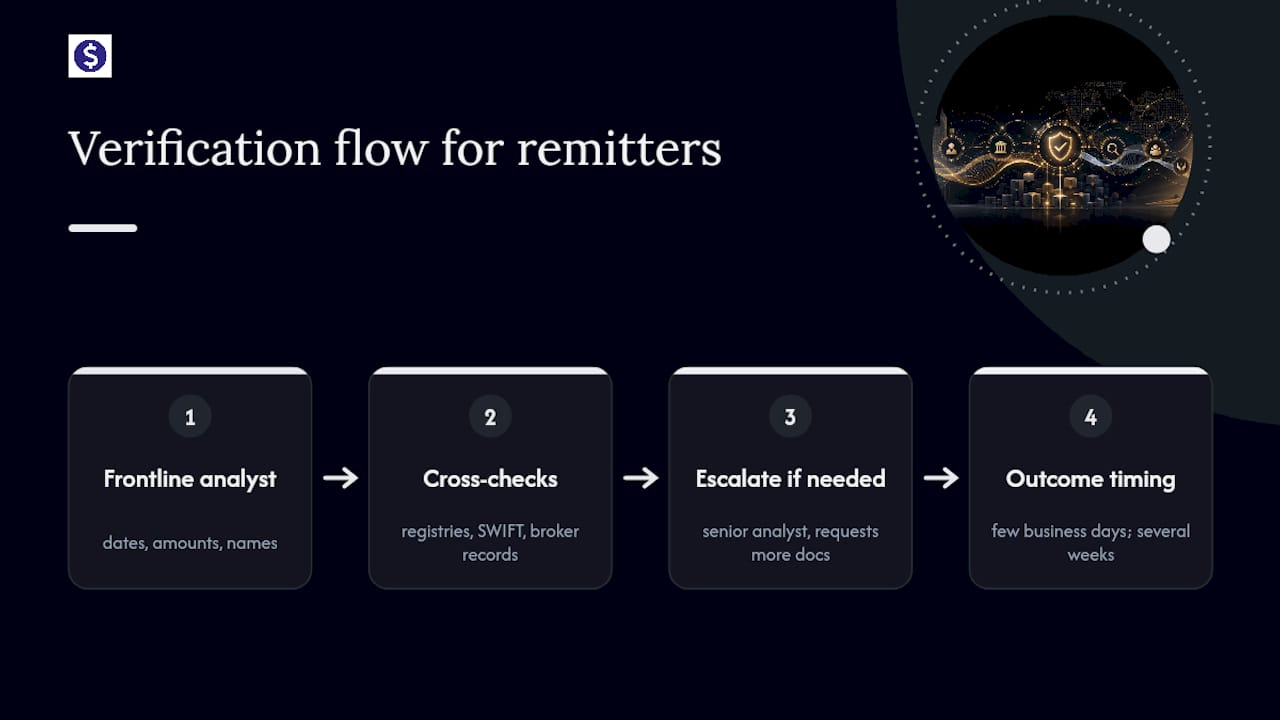
If something doesn’t reconcile, or the transaction sits in a higher risk tier, the case escalates to enhanced due diligence, where a senior analyst applies more judgment and may request additional documentation. Straightforward cases with clean documentation can clear in a few business days; complex cases, especially ones involving foreign paperwork or crypto, can take several weeks according to compliance guides.
One detail catches people off guard: if a reviewer’s concerns rise to the level of filing a Suspicious Activity Report, the institution is legally barred from telling you it happened. Silence on a case isn’t necessarily good news, and it isn’t necessarily bad news either. It’s confidentiality doing its job.
A Checklist to Speed Up Your Own Review
The single biggest lever you control is timing. Gather your evidence before you initiate a high-value transaction, not after a reviewer asks for it.
- Pull bank statements covering at least the period the deposit occurred, not just the day of
- Get a signed, dated gift letter if any portion of the funds came from a relative or friend
- Request wire confirmations (MT103) directly from the sending institution rather than relying on a screenshot
- Line up sale or settlement documents in advance if the funds trace back to a property or business sale
- Reply to reviewer requests within a day or two, and give them one clear point of contact
Institutions move fastest on files where the story matches the documents on the first pass. Every follow-up question adds days, sometimes weeks, to a review that could have cleared in one round.
What Remittance Senders Should Have Ready
Cross-border transfers carry their own version of this problem, and it comes up constantly for people sending money home. Keep your transfer receipt, the payer’s pay stub if someone else funded the transfer, and the platform’s own confirmation number on hand before you send.
A few patterns specific to remittances cause avoidable delays:
- A third party funding your transfer without a clear paper trail linking them to you
- Promotional balance top-ups that don’t match your stated income source
- Payments routed through multiple accounts before reaching the final platform
A detailed international transfer security checklist walks through exactly what documentation keeps a transfer moving instead of stuck in review, and the broader international transfer best practices guide covers timing and provider selection alongside it.
What Happens If You Can’t Prove Where the Money Came From
Failing a source of funds check rarely ends with a polite decline. The immediate consequence is usually a frozen or delayed transaction, sometimes for weeks, while the institution decides whether to accept partial explanations or push the case into enhanced due diligence. Accounts can be restricted or closed outright if a bank concludes it can’t get comfortable with the story behind a deposit.
For real estate, this can mean a closing falls through because the down payment can’t clear in time. For a business transaction, it can mean a wire gets returned to the sender, sometimes with fees on both ends. For crypto conversions, exchanges will often hold funds indefinitely rather than release them into an account they can’t verify.
The regulatory side carries heavier consequences for the institution than for most individual customers. Banks that fail to properly investigate suspicious transactions face regulatory penalties, and that pressure is exactly why frontline staff push so hard for documentation even on transactions that feel routine to the customer. For an individual, the practical risk is rarely criminal liability unless the funds genuinely came from illegal activity. It’s account restriction, reputational friction with that institution going forward, and in serious or repeated cases, a report to law enforcement that the customer never sees or hears about directly.
The honest takeaway: an unresolved SoF check doesn’t usually end in charges. It ends in a closed door at that particular institution, and that door can stay closed for good.
Why Requirements Differ by Country and Industry
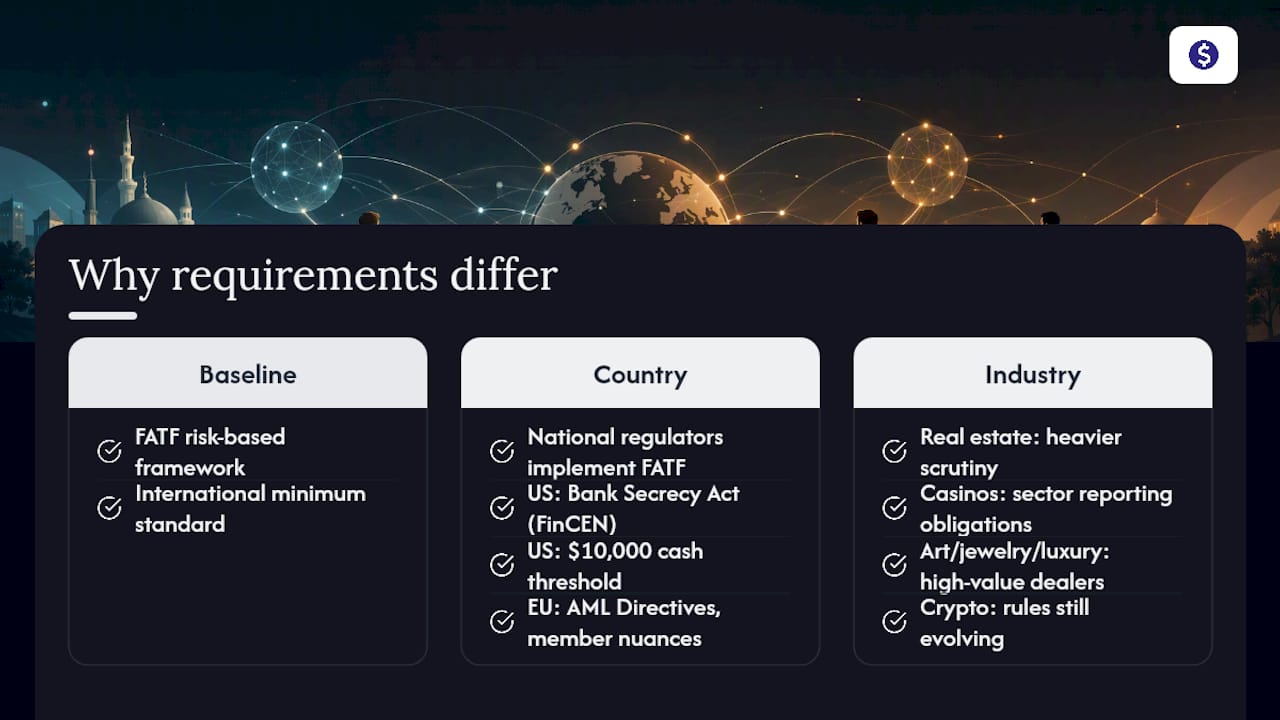
There’s no single global standard for how deep a source of funds check goes. The Financial Action Task Force (FATF) sets the international baseline, requiring a risk-based due diligence framework, but each country implements that baseline through its own regulators, and each industry layers on its own thresholds.
In the United States, banks operate under the Bank Secrecy Act with FinCEN as the enforcement authority, and the $10,000 cash threshold is a bright line even though most SoF requests happen well below that figure through risk-based judgment calls. The European Union runs a comparable but separately codified framework through its Anti-Money Laundering Directives, with member states applying their own supervisory nuances on top.
Industry matters as much as geography. Real estate transactions attract heavier scrutiny almost everywhere because property has historically been a favored vehicle for laundering large sums through a single, legitimate-looking purchase. Casinos and high-value dealers in art, jewelry, and luxury goods carry their own sector-specific reporting obligations in most jurisdictions. Cryptocurrency exchanges operate under rules that are still catching up to how the assets actually move, which is part of why crypto-funded transactions tend to draw more questions than a comparable bank-funded one.
For someone moving money internationally, the practical implication is simple: don’t assume the document that satisfied one bank in one country will automatically satisfy a different institution, in a different country, in a different industry. Ask what that specific provider needs before you assume anything.
The Software Doing This Work Behind the Scenes
Most SoF verification at scale runs through software, not a human reading every pay stub line by line. Document verification tools extract data from statements, IDs, and confirmations automatically, flagging inconsistencies like a mismatched name or an altered date far faster than manual review could.
Transaction monitoring systems sit on top of that, watching account activity for patterns that deviate from a customer’s established baseline, a sudden spike in wire volume, for instance, or deposits from a jurisdiction the customer has never transacted with before. These systems generate the alerts that route a transaction toward manual SoF review in the first place. KYC glossaries and vendor explainers tie SoF checks directly into this monitoring layer, alongside sanctions screening and PEP checks that run in parallel.
Case management platforms then give analysts a single workspace to log which documents came in, what corroboration source confirmed each claim, and where judgment calls were made. That documentation trail matters more than most customers realize. A defensible SoF file records not just the conclusion an analyst reached but the actual path they took to get there: the specific documents requested, the registries or filings used to cross-check them, and any gaps in plausibility that got flagged along the way. Supervisors examining a bank’s compliance program want to see that reasoning laid out, not just a stamp of approval.
None of this eliminates human judgment entirely. Software flags anomalies and speeds document handling, but the final call on whether a story is plausible still sits with a person.
Privacy Trade-offs Nobody Talks About Enough
Handing over bank statements, pay stubs, and gift letters means handing over a fairly detailed picture of your financial life to an institution, and sometimes to whatever third-party verification vendor that institution uses. That data doesn’t disappear after the review closes. Retention periods for compliance records typically run for years under most regulatory frameworks, which means your SoF documentation sits in a bank’s files well past the transaction it was collected for.
The tension is real and mostly unresolved. Regulators want more documentation to fight financial crime effectively. Customers reasonably want less of their financial history sitting in more databases than necessary. Data protection frameworks like the General Data Protection Regulation in the EU and various U.S. state privacy laws put some guardrails on how that information gets stored and shared, but AML obligations generally override a customer’s ability to simply refuse to provide it or demand deletion on request.
The practical advice here isn’t complicated: only provide what’s specifically requested, ask what a vendor’s data retention policy actually says if you’re unsure, and don’t assume that a document you submit for one transaction stays walled off from that institution’s broader profile of you. It usually doesn’t.
Real-World Patterns: How These Reviews Actually Play Out
A few recurring scenarios illustrate how SoF checks resolve in practice, drawn from the kinds of situations compliance teams handle routinely rather than any single named case.
A customer wiring $150,000 for a home down payment, with the money sitting in their account for six months before the purchase, usually clears quickly. Bank statements showing a gradual buildup from salary deposits tell a coherent story that needs little else.
A customer receiving a $60,000 gift from a parent overseas faces a slower path. The bank typically wants a signed gift letter, proof of the parent’s own financial capacity to give that amount, and a wire confirmation matching the stated sender. Foreign documentation formats often need translation or notarization, which is where these cases tend to stall.
A customer converting $80,000 in cryptocurrency to fiat ahead of a large purchase usually faces the heaviest scrutiny of the three. Exchanges and receiving banks want the full transaction history on the exchange, proof of the original fiat deposit that funded the crypto purchase years earlier, and often a written explanation of the investment’s origin. Cases missing that off-ramp documentation regularly stall for weeks or get declined outright.
The pattern across all three: institutions move fast when the paper trail is continuous and slow to a crawl the moment a gap appears in that chain.
A Fair Process Protects the Customer Too
Rigorous source of funds practice isn’t just a regulator’s demand sitting on top of the customer relationship. Done well, it protects customers from having their accounts used as a pass-through for someone else’s illicit money, and it protects institutions from penalties that would otherwise raise costs for everyone. The best files document not just what was collected but why a reviewer found it convincing, which is exactly the record that keeps a legitimate customer’s transaction moving instead of stuck in limbo.
— Brahim
Where to Go for the Original Guidance
For readers who want the primary sources instead of a summary, a few are worth bookmarking. FinCEN is the U.S. regulator enforcing the Bank Secrecy Act and the agency that receives Suspicious Activity Reports. FATF sets the international standard that most national frameworks are built on. Wolfsberg Group publishes the guidance banks actually use to distinguish SoF from SoW in practice. The IRS explains how the Bank Secrecy Act applies to everyday reporting thresholds.
If you’re preparing an international transfer and want to see how supported providers and corridor-specific payout options compare before you send, a dedicated provider comparison page lists the options available, and a Morocco corridor page shows what cash pickup and local partner networks look like for one widely used route.
This article is general information, not a substitute for advice from a qualified financial advisor. Consult a qualified financial professional about your own circumstances before acting on anything here.
Sources
- Bank Secrecy Act guidance — IRS
- Wolfsberg Source of Wealth and Source of Funds FAQs
- FATF recommendations — FATF
- Source of Funds: Verification and Compliance Checks — LegalClarity
FAQ
What Should I Put for Source of Funds?
Name the specific origin of the money involved in that transaction, such as salary, a property sale, a gift, or a loan, and back it with the matching document: a pay stub, closing statement, gift letter, or loan agreement. Vague answers like “savings” without supporting paperwork almost always trigger a follow-up request.
How Long Does a Source of Funds Check Take?
Straightforward cases with clean, consistent documentation often clear within a few business days, while complex cases involving foreign paperwork or cryptocurrency can take several weeks. The timeline depends almost entirely on how quickly the paper trail can be corroborated.
Why Is My Bank Asking for My Source of Funds?
Banks are required under the Bank Secrecy Act to monitor where money in an account comes from, and a specific deposit or transfer may have crossed a size, pattern, or risk threshold that triggers a closer look. It doesn’t necessarily mean anything is wrong. It usually means the transaction fell into a category their compliance program flags automatically.
What Happens if I Can’t Provide a Source of Funds?
The transaction is typically delayed, restricted, or declined outright if the institution can’t get comfortable with where the money came from. In more serious or unresolved cases, the account itself can be restricted, and the case may be escalated internally without the customer ever being told why.