
TL;DR:
- Customer support is essential in building trust and reducing dissatisfaction in international money transfers. It includes transactional assistance handled mostly by AI and complex issues managed by trained specialists with escalation paths. High-quality, transparent, and multilingual support features foster customer loyalty and help mitigate operational risks.
Customer support is the primary trust mechanism in international money transfers, determining whether senders feel confident their funds will arrive safely and on time. Customer support issues are the leading cause of dissatisfaction in money transfer services, cited in 29% of negative reviews. That number tells you something critical: speed and low fees matter, but they cannot compensate for poor communication when something goes wrong. The role of customer support in remittance extends well beyond answering questions. It covers transparency, compliance, fraud resolution, and the kind of human reassurance that keeps customers coming back.
What types of customer support exist in remittance services?
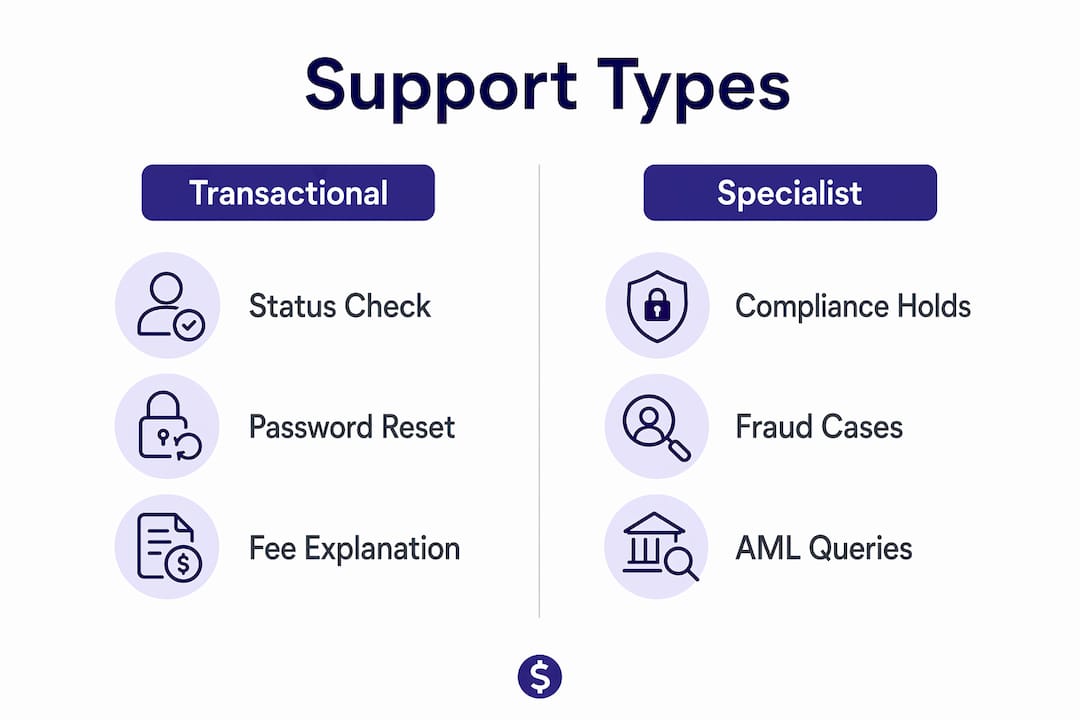
Remittance customer support falls into two broad categories: transactional support and specialist support. Understanding the difference helps you evaluate whether a provider can actually handle your needs.

Transactional support covers routine interactions. This includes transfer status inquiries, password resets, fee explanations, and basic account verification questions. These interactions are high volume and low complexity. Most providers now handle them through AI-driven chatbots or automated messaging systems. One well-documented example: messaging accounts for 92% of support volume at some digital remittance platforms, with AI resolving the majority of those contacts autonomously. That shift frees human agents for work that actually requires judgment.
Specialist support handles the cases where automation fails. Compliance holds, anti-money laundering (AML) inquiries, fraud investigations, and foreign exchange (FX) disputes all require trained human agents with regulatory authority. Not all customer support is equal; the crucial gap is the ability to escalate complex compliance or fraud issues to authorized specialists. A chatbot can tell you your transfer is pending. Only a specialist can release a compliance hold.
| Support Type | Primary Function | Typical Channel | Best For |
|---|---|---|---|
| Transactional | Status checks, resets, FAQs | Chatbot, email, app | Routine, low-stakes inquiries |
| Specialist | Compliance, fraud, FX issues | Phone, live chat, dedicated manager | Complex, high-stakes cases |
| Bilingual human | Cross-border emergencies | Phone, live chat | Language barriers, urgent transfers |
| AI-assisted hybrid | Volume management + escalation | Messaging, chatbot + agent | Blended efficiency and empathy |
Pro Tip: Always confirm that a provider offers a clear escalation path to a human specialist before you send a large transfer. A provider with only chatbot support is a liability when a compliance hold freezes your funds.
How does effective customer support build trust in remittance?
Trust is the currency that keeps remittance customers loyal. Transparent and reliable support strongly influences trust and repeat usage in remittance services. When support is opaque or slow, customers perceive the entire transfer as risky, even if the underlying technology is sound.
Poor transparency is a specific, measurable problem. When providers fail to explain why a transfer is delayed or why an AML hold was triggered, customers assume the worst. Clear, documented communication resolves AML hold situations effectively and prevents avoidable churn. The customer who understands why their transfer was flagged is far more likely to stay than the one left guessing.
Culturally localized and multilingual support drives higher user satisfaction than generic interfaces, particularly in underserved markets. A Moroccan sender in France and a Filipino worker in Dubai have different languages, different time zones, and different emotional contexts for their transfers. Generic English-only support fails both of them. Providers who invest in remittance service reliability through tailored human support build loyalty that fee cuts alone cannot buy.
Trust-building support features that matter most:
- 24/7 availability across time zones, so urgent issues never wait until business hours
- Human empathy during fund delays or freezes, when customers are most anxious
- Compliance clarity, meaning plain-language explanations of AML holds and verification steps
- Multilingual agents who communicate in the sender's or recipient's native language
- Proactive status updates that inform customers before they need to ask
Support is not a cost center. It is a risk management tool that reduces compliance escalations, chargebacks, and operational disruptions. Providers who treat it as overhead pay for that decision in churn.
What challenges does customer support solve in remittance?
The most common pain points in remittance are delayed transfers, fund freezes, compliance holds, payment errors, and language barriers. Each one creates anxiety for the sender and potential hardship for the recipient. Effective support addresses all of them, but the approach matters as much as the outcome.
Speed is not the primary metric. Good support prioritizes issue resolution over mere response speed, reducing churn and regulatory risk. A fast reply that provides no useful information is worse than a slightly slower reply that actually solves the problem. Customers remember how their problem was handled, not how quickly the first message arrived.
Bilingual 24/7 human teams provide peace of mind for fund security and smooth transfer processing across time zones. When a transfer to a family member in West Africa stalls at 11:00 PM on a Friday, a bilingual agent who can access the account, explain the hold, and initiate a resolution is irreplaceable. No FAQ page substitutes for that.
AI integration changes the workload distribution without eliminating the need for human expertise. One digital remittance platform achieved a 74% AI agent handle rate, resolving most customer inquiries autonomously. That efficiency gain means human agents spend their time on the cases that genuinely need them.
Best practices for remittance customer support operations:
- Offer 24/7 multilingual access via phone and live chat, not just email or ticketing systems.
- Train agents on AML and compliance basics so they can explain holds in plain language without creating liability.
- Build clear escalation protocols that move complex fraud or compliance cases to authorized specialists within defined time limits.
- Use AI for volume management on routine inquiries, reserving human agents for emotional and regulatory complexity.
- Document every interaction to create a resolution trail that protects both the customer and the provider.
- Measure resolution quality, not just response time, as the primary support performance metric.
How do specialized support roles add value for businesses?
Business remittance users have needs that standard consumer support cannot meet. High-volume senders, payroll processors, and import-export businesses face currency exposure, compliance obligations, and cash flow timing pressures that require expert guidance, not scripted responses.
High-value users prefer providers offering dedicated account managers who understand their cash flow and FX context. That expertise reduces operational uncertainty and builds long-term loyalty. A dedicated account manager who knows your payment schedule, your recipient countries, and your typical transfer volumes can flag a compliance issue before it becomes a freeze. A general support desk cannot.
Dedicated account managers and FX specialists reduce payment uncertainty by providing operational context and currency market insights. For a business sending $50,000 monthly to suppliers in three countries, knowing when to lock in a rate or how to structure a transfer to avoid a compliance flag has direct financial value. That is a fundamentally different service than answering "where is my transfer?"
Specialist agents also handle fraud investigations with the authority to act. When a business account is targeted by social engineering or a payment is misdirected, a specialist with account-level access and regulatory training can freeze the transfer, initiate a recall, and coordinate with compliance teams. General agents cannot do any of that.
Pro Tip: When evaluating a remittance provider for business use, ask specifically for the name and direct contact of your assigned account manager. Providers who cannot give you a named contact are offering general support, not specialist service.
What emerging trends are shaping remittance customer support?
The remittance support model is shifting from transactional to relationship-driven, and the technology driving that shift is AI. Zendesk AI integration increased operational efficiency by 38% at one major digital remittance platform, reduced costs, and enabled human agents to focus on empathetic support. That model is becoming the industry standard.
The key insight is that AI and human support are not competing. They are complementary. AI handles volume; humans handle complexity and emotion. The providers who get this balance right will define the next generation of remittance customer experience. Those who over-automate will face the same 29% dissatisfaction rate that already plagues the sector.
Customers increasingly expect transparency in money transfers as a baseline, not a differentiator. Proactive notifications, real-time status updates, and plain-language compliance explanations are moving from premium features to table stakes. Providers who still rely on reactive support, where customers must chase information, will lose ground to those who push updates automatically.
| Emerging Technology | Impact on Support | Customer Benefit |
|---|---|---|
| AI chatbots | Handles routine volume autonomously | Faster resolution for simple issues |
| Messaging-first platforms | Shifts support to async channels | Convenience across time zones |
| Multilingual AI | Extends language coverage at scale | Reduced language barriers |
| Specialist escalation tools | Routes complex cases to experts | Faster resolution for high-stakes issues |
| Proactive notification systems | Reduces inbound inquiry volume | Customers informed without asking |
Key Takeaways
Effective customer support in remittance is the single most important factor in building trust, reducing churn, and managing compliance risk across international money transfers.
| Point | Details |
|---|---|
| Support drives trust | Transparent, reliable support directly increases repeat usage and customer loyalty. |
| AI handles volume, humans handle complexity | A 74% AI handle rate frees specialists for compliance, fraud, and emotional cases. |
| Bilingual 24/7 access is non-negotiable | Multilingual human teams resolve cross-border emergencies that automation cannot. |
| Specialist support adds measurable business value | Dedicated account managers reduce FX uncertainty and prevent costly compliance holds. |
| Resolution quality beats response speed | Customers stay loyal when problems are solved clearly, not just acknowledged quickly. |
Why support quality is the real competitive edge in remittance
I have spent years watching remittance providers compete on fees and exchange rates, and I understand why. Those numbers are easy to compare and easy to market. But the providers who retain customers long-term are almost never the cheapest. They are the ones whose support teams answered the phone at midnight when a transfer was frozen.
The uncomfortable truth is that most remittance providers underinvest in support because they measure it as a cost, not as a revenue driver. Every customer who churns after a poorly handled compliance hold represents not just a lost transaction but a lost relationship worth years of repeat business. The math on investing in specialist agents and multilingual teams is straightforward once you account for retention.
What I find most overlooked is the emotional dimension. Remittances are not abstract financial transactions. They are rent payments for a parent, school fees for a child, emergency funds for a family in crisis. When something goes wrong, the sender is not frustrated. They are scared. A support agent who responds with empathy and clarity in that moment does something no algorithm can replicate. They restore trust at the exact moment it is most fragile.
My view is that the providers who will lead this sector in the next five years are those who treat support as a product, not a department. That means investing in training, multilingual capacity, specialist escalation paths, and proactive communication. The best practices for international transfers increasingly reflect this shift, and providers who ignore it will find that low fees are not enough to hold customers when things go wrong.
- Brahim
Find providers that back their transfers with real support
Knowing what good remittance support looks like is only useful if you can find providers who actually deliver it. Idealremit makes that comparison straightforward.
Idealremit aggregates real-time rates, fees, and provider details across more than 100 countries, so you can evaluate not just cost but reliability. The platform highlights trusted remittance providers known for transparent communication and strong customer service records. Whether you are sending money to Morocco, the Philippines, or anywhere across Africa, Asia, or the Americas, you can compare transfer options side by side and choose a provider whose support standards match your expectations. Savings of up to 80% compared to traditional banks are possible when you know where to look.
FAQ
What is the role of customer support in remittance?
Customer support in remittance manages transfer inquiries, resolves compliance holds, handles fraud cases, and provides the transparency that builds sender trust. It functions as both a service function and a risk management tool.
What types of customer support do remittance services offer?
Remittance providers offer transactional support for routine inquiries, specialist support for compliance and fraud cases, bilingual human teams for cross-border emergencies, and AI-assisted hybrid models that combine automation with human escalation.
Why does poor customer support cause remittance customers to leave?
Poor support transparency increases perceived risk and reduces repeat usage. Customer support issues are cited in 29% of negative money transfer reviews, making them the leading driver of dissatisfaction in the sector.
How does AI improve customer support in money transfers?
AI handles high-volume routine inquiries autonomously, freeing human agents for complex cases. One digital remittance platform achieved a 74% AI agent handle rate, increasing operational efficiency by 38% while maintaining human empathy for sensitive issues.
What should businesses look for in remittance customer support?
Businesses should prioritize providers with dedicated account managers, FX specialists, and clear escalation paths for compliance or fraud issues. Named contacts and documented escalation protocols are the clearest signals of genuine specialist support.