Weekend Exchange Rates: How to Avoid Extra Weekend Costs

Weekend exchange rates are almost always Friday's final interbank price, frozen and republished, or a provider's own out-of-market quote layered with a markup. Interbank currency trading shuts down after the New York close on Friday and doesn't reopen until Sunday evening, so anyone converting money on a Saturday or Sunday is either seeing a stale number or paying a premium for the convenience of moving money when the real market is closed.
Three things protect you right now:
- Convert before Friday's close if you know you'll need foreign currency over the weekend.
- Screenshot the provider's locked, in-app quote the moment you get it, including the timestamp.
- Compare the total landed cost (rate plus fee), never just the headline exchange rate.
If you only do one thing: move the transaction into the weekday window whenever your schedule allows it. That single choice avoids most weekend markup entirely.
Key Takeaways
Weekend exchange rates reflect Friday's frozen interbank close or a provider's out-of-market quote, and comparing total landed cost before sending is the single most reliable way to avoid overpaying.
| Point | Details |
|---|---|
| Markets pause on weekends | Interbank FX trading closes Friday evening and doesn't reopen until Sunday evening U.S. Eastern time. |
| Weekend quotes carry two risks | You're seeing either a stale Friday close or a provider markup layered on top of it. |
| Fees hide in the rate | A markup costing roughly $8 on a $1,000 transfer, before any flat fee. |
| Lock and document your quote | Screenshot the timestamp, rate label, and fee breakdown before confirming any weekend transaction. |
| Compare total cost, not headline rates | Idealremit lets you check locked quotes and landed amounts across providers like Wise and OANDA before you send. |
Table of Contents
- How Weekend Exchange Rates Work: Friday Close to Sunday Reopen
- Why Weekend Rates Can Be Worse Than Weekday Ones
- What to Check in a Provider's Weekend Pricing Policy
- A Worked Example: USD to EUR on a Saturday
- When to Convert and When to Wait
- How to Confirm the Rate You'll Actually Pay
- What to Do If You Think You Overpaid on a Weekend Transfer
- Comparing Total Weekend Cost Across Providers
- When Weekend Cost Is Worth Paying
- Compare Providers Before Your Next Weekend Transfer
- Sources
- FAQ
How Weekend Exchange Rates Work: Friday Close to Sunday Reopen
The foreign exchange market doesn't have a single central exchange. It's a network of banks and dealers trading around the clock from Sunday evening through Friday evening, then going quiet. Once New York trading winds down on Friday, there's no active interbank settlement until Sydney and Asian markets reopen Sunday evening, U.S. Eastern Time. That gap, usually somewhere around 5:00 PM Friday to 5:00 PM Sunday Eastern, shifts an hour earlier or later depending on daylight saving transitions in the U.S. or overseas.
During that window, any rate you see quoted is either:
- A frozen snapshot of Friday's final interbank price, or
- A provider-generated number built off that Friday close plus their own adjustment.
Neither reflects live trading, because there isn't any to reflect. The Federal Reserve's H.10 release publishes official weekly foreign exchange rates and remains the closest thing to an authoritative benchmark for what a given currency pair was actually worth at the close of the trading week. It's not updated in real time, but it's a solid anchor point for checking whether a provider's Friday-referenced rate lines up with reality.
Why Weekend Rates Can Be Worse Than Weekday Ones
A few distinct mechanisms drive the gap between what you'd pay on a Tuesday and what you'd pay on a Sunday.
- Out-of-market markup. Some providers widen their margin specifically for weekend transactions, since they're pricing risk with no live market to hedge against.
- Stale Friday-close quotes. Others simply display Friday's number without adjustment, which feels neutral until Sunday's reopen reveals the currency moved and you locked in the old price.
- Wider spreads on weekend instruments. Some brokers offer separate weekend trading products for major pairs. These are broker-created instruments with thinner liquidity and noticeably wider spreads than the standard interbank market.
- Swap and rollover charges. Positions held over the weekend sometimes carry a rollover fee, often tripled midweek to account for the two closed days.
Plan limits compound this. Many transfer apps cap free or standard-rate conversions per month or per transaction size, and weekend transfers that push past that limit can trigger a fair-usage fee on top of any rate markup.
Pro Tip: Before confirming any weekend conversion, check three things on the quote screen: whether it says "locked" or "indicative," whether there's a separate fee line item beyond the rate itself, and whether the timestamp is recent or references Friday's close.
What to Check in a Provider's Weekend Pricing Policy
Providers generally fall into three pricing patterns for weekend conversions. Some lock a mid-market rate in the app and charge a transparent, separate fee. Others generate their own out-of-market quote with the markup baked directly into the exchange rate rather than itemized as a fee. A third group applies fair-usage limits, where anything above a monthly threshold reverts to a less favorable rate.
Before relying on any weekend quote, dig into the provider's terms for:
- The exchange-limit threshold that triggers a rate change.
- Language specifying when out-of-market markups apply (usually tied to interbank market hours, not calendar days).
- How card-funded transfers are priced differently from bank-funded ones on weekends.
When you're looking at the actual quote screen, confirm these fields specifically:
- A timestamp showing when the rate was generated.
- A label indicating whether it's a mid-market rate or a provider rate.
- An explicit fee line, separate from the exchange rate itself.
- A clear statement of whether the quote is locked (executable) or indicative (subject to change).
Provider policies shift often enough that citing last year's fee schedule is risky. Always verify the current terms on the provider's own fee page before sending money based on something you read weeks ago.
A Worked Example: USD to EUR on a Saturday
Here's how the math plays out for a real transfer. Say Friday's interbank close for USD to EUR sits at 0.9200, meaning $1,000 converts to €920.00. That's the number you'd find cross-referenced against the Treasury's currency exchange rate converter or the Fed's H.10 release for that week.
Now suppose a provider's Saturday quote shows 0.9120, with a flat $4.99 transfer fee. Here's how to work out what that actually costs you:
- Convert at Friday's close: $1,000 × 0.9200 = €920.00.
- Convert at the provider's weekend rate: $1,000 × 0.9120 = €912.00.
- Subtract the fee's dollar equivalent from the weekend total, or just track it separately.
- Calculate the difference: €920.00 minus €912.00 equals an €8.00 shortfall from the rate markup alone.
- Add the fixed fee's impact, then express the whole thing as a percentage of the original $1,000.
| Item | Value |
|---|---|
| Friday close rate (USD/EUR) | 0.9200 |
| Provider weekend rate | 0.9120 |
| Transfer amount | $1,000.00 |
| Amount at Friday close | €920.00 |
| Amount at weekend rate | €912.00 |
| Rate markup cost | €8.00 |
| Flat transfer fee | $4.99 |
That is a modest hit from the rate alone, before the fixed fee even enters the picture. On a $1,000 transfer, that's real money. On a larger business payment, that same percentage translates to a significant amount.

When to Convert and When to Wait
Timing decisions come down to a simple tradeoff: cost versus convenience. If you can plan ahead, these tactics consistently beat weekend pricing:
- Convert during the week, ideally Tuesday through Thursday when spreads tend to be tightest.
- Hold a foreign currency balance in advance if you know you'll need to spend or send money over a weekend.
- Set a rate alert so you convert automatically when the market hits a target you're comfortable with.
- Schedule transfers to execute during weekday market hours even if you initiate them earlier.
For a business making payroll or supplier payments abroad, waiting two days for a better rate sometimes isn't realistic. If a weekend payment is contractually due, accepting the convenience markup can be the right call. It's a business decision, not a mistake, as long as you know the size of the cost you're accepting.
Pro Tip: If your provider offers rate alerts or scheduled transfers, set a target rate and a Monday-morning execution time. That way you capture a weekday price without staring at currency charts all weekend.
How to Confirm the Rate You'll Actually Pay
Before you hit send, gather four pieces of evidence: the quote's timestamp, its rate label (mid-market versus provider-set), the itemized fee, and whether it says "locked" or "indicative."
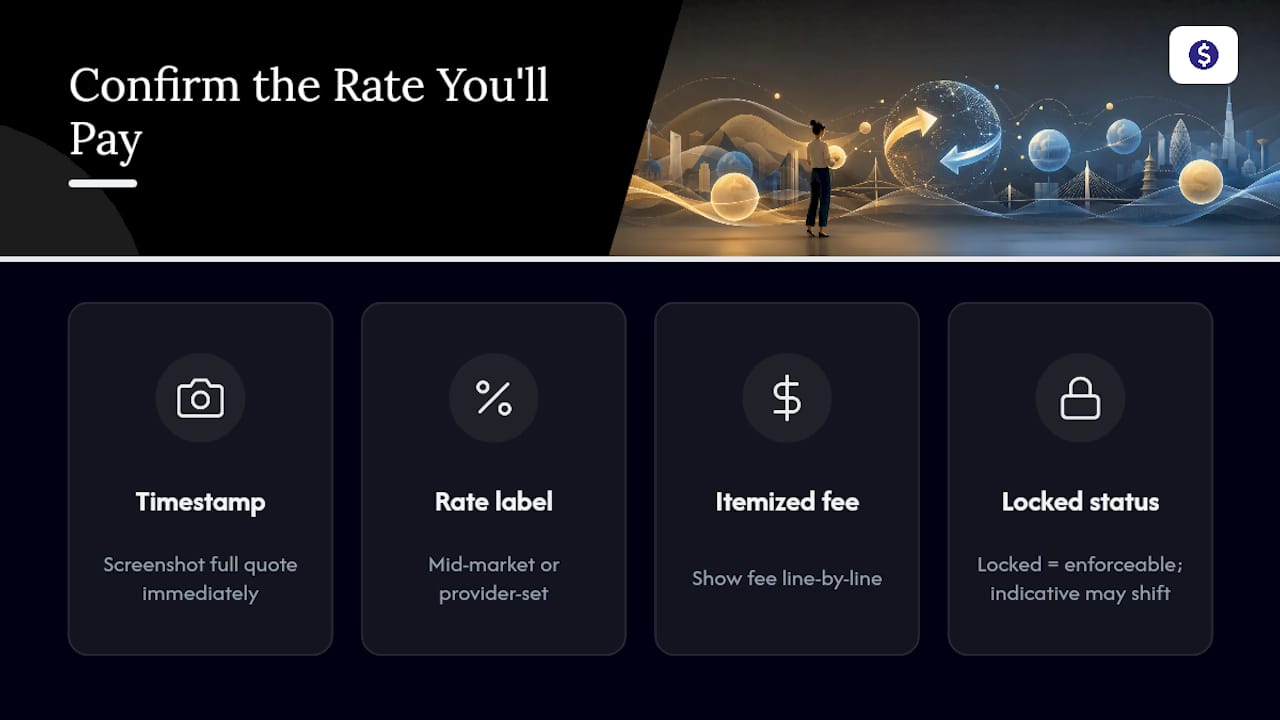
Take a screenshot of the full quote screen the moment you see it, and save a copy of the provider's current terms page for that transaction type. If the platform offers email confirmation or a transaction log entry, request it. A locked quote is contractually enforceable for its stated window, usually a few minutes to an hour, while an indicative quote can shift before you confirm, which matters most during thin weekend liquidity.
What to Do If You Think You Overpaid on a Weekend Transfer
- Collect your evidence: screenshots, timestamps, and the transaction ID.
- Contact provider support directly with the specific discrepancy, citing the quoted rate versus the rate actually applied.
- Escalate to a formal complaint channel if support doesn't resolve it, referencing the provider's own published fee schedule.
Pro Tip: Keep the fee schedule screenshot alongside your transaction receipt. Refunds happen when a provider misapplies its own stated policy, but outcomes vary by provider and by jurisdiction, so don't assume a guaranteed resolution.
Comparing Total Weekend Cost Across Providers
A comparison tool earns its keep here by pulling locked in-app quotes, total landed cost, and payout speed into one view instead of leaving you to check five apps separately. That's the difference between comparing headline rates and comparing what actually lands in the recipient's account.
Before sending on a weekend, run through this:
- Compare the same transfer amount across weekday and weekend quotes to see the real spread.
- Check whether your transfer size trips any plan limit or fair-usage threshold.
- Confirm the final landed amount, not just the advertised exchange rate.
Pro Tip: Use a rate-alert feature paired with a total-cost calculator, like the ones built into Idealremit's comparison tools, rather than eyeballing headline rates across five different tabs.
When Weekend Cost Is Worth Paying
Convenience has a price, and sometimes that price is fair. If a weekend transfer covers rent due Monday morning or an emergency family expense, the modest markup is cheaper than the stress of missing a deadline. My rule of thumb: individuals sending under a few hundred dollars for time-sensitive needs should just pay the weekend rate and move on. Businesses moving larger sums should default to scheduled weekday transfers and document why any exception happened.
Compare Providers Before Your Next Weekend Transfer
Weekend markups are easy to miss when you're only glancing at a headline rate, which is exactly why a side-by-side comparison matters more on a Saturday than any other day of the week. Idealremit pulls live quotes from providers including Revolut, Wise, and OANDA alongside dozens of others, so you can see the actual landed amount, not just an advertised number that ignores fees.

Instead of opening three or four apps to compare a Friday quote against a Sunday one, you check a single comparison page and see the total cost laid out. If a transfer can wait until Monday, Idealremit's rate alerts flag when the market hits your target. If it can't wait, you'll at least know exactly what the weekend convenience is costing you before you confirm anything. Compare live rates and fees now to see what your transfer would actually cost this weekend versus waiting for the market to reopen.
Sources
- Forex
- Foreign Exchange Rates - H.10 - August 12, 2026
- Currency Exchange Rates Converter
- Exchangerates
- Forex Weekend Trading Guide: Gaps, Swaps and Holding Positions
This article is general information, not a substitute for advice from a qualified financial advisor. Consult a qualified financial professional about your own circumstances before acting on anything here.
FAQ
What Are Exchange Rates Like on Weekends?
Weekend exchange rates are typically Friday's final interbank closing price, either displayed as-is or adjusted with a provider markup, since the interbank market itself is closed.
Do Exchange Rates Change on the Weekend?
Interbank rates don't move over the weekend because the market isn't trading, but the rate a provider quotes you can still shift based on their own markup policy or fee structure.
What Is the Best Day of the Week to Exchange Currency?
Tuesday through Thursday tend to offer the tightest spreads, since liquidity is deepest in the middle of the trading week and providers have less reason to apply out-of-market pricing.
Which Day Gives the Best Exchange Rate?
There's no single universal best day, but weekday conversions made before Friday's close consistently avoid the stale quotes and markups tied to weekend pricing, and tools like Idealremit's comparison platform let you check the current spread before committing.