Cheapest Way to Send Money to India from the US (2026 Data)

In short: the top of this market is almost a tie. TapTapSend, Bancoli, LemFi, Xoom, Sendwave, PandaRemit, XE and Remitly all finished within 0.46 percentage points of each other — about $4.60 on a $1,000 transfer.
The real decision is at the bottom. OFX costs 3.24%, more than double the next most expensive and eight times the typical provider. On $500 a month, that is $195 a year against roughly nothing.
And for two providers, the right answer depends entirely on how much you send.
In a hurry? Compare live USD to INR rates — updated every two hours.
India is the world's largest recipient of remittances, taking in $135.46 billion in FY2025, up 14% on the year. The United States is its single biggest source, and advanced economies — the US, UK and Canada — now account for more than half of all money sent to India, overtaking the Gulf states for the first time.
We tracked the rates and fees published by twelve providers every two hours between 22 April and 4 October 2026: 22,166 observations across 154 days, each compared against the mid-market rate on the same day.
The full ranking
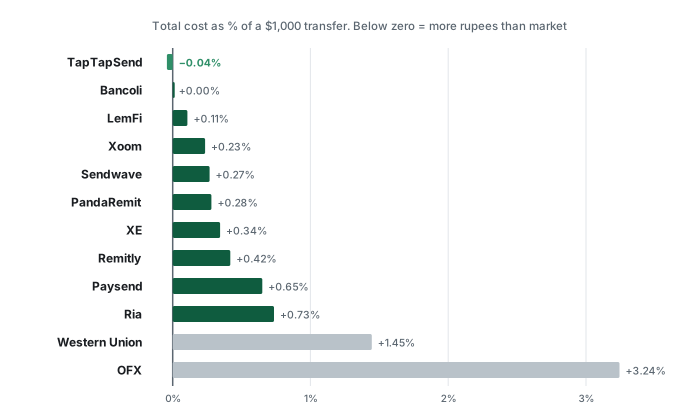
Total cost as a percentage of a $1,000 transfer, bank-funded, including both fees and exchange-rate margin. Negative values mean the provider delivered more rupees than the mid-market reference. Averages over 154 days.
Rupees received on a $1,000 transfer, after fees
| Provider | Cost | Rupees received | vs. cheapest |
|---|---|---|---|
| TapTapSend | −0.04% | 95,456 | — |
| Bancoli | 0.00% | 95,419 | −37 |
| LemFi | 0.11% | 95,317 | −139 |
| Xoom | 0.24% | 95,193 | −263 |
| Sendwave | 0.27% | 95,162 | −294 |
| PandaRemit | 0.28% | 95,150 | −306 |
| XE | 0.34% | 95,089 | −367 |
| Remitly | 0.42% | 95,019 | −437 |
| Paysend | 0.65% | 94,869 | −587 |
| Ria | 0.74% | 94,718 | −738 |
| Western Union | 1.45% | 94,048 | −1,408 |
| OFX | 3.24% | 92,326 | −3,130 |
Eight providers deliver between 95,019 and 95,456 rupees on $1,000 — a spread of 437 rupees, or roughly $4.60. For most senders, picking any of those eight is a reasonable decision.
Then there is OFX at 92,326 rupees, 3,130 rupees behind. On a corridor this competitive, that gap is hard to explain by anything other than pricing strategy.
How much you send changes the answer
Two providers charge a flat fee — Paysend averages $5.66 and Ria $3.00 — and flat fees punish small transfers disproportionately.
Cost by transfer size, where it varies
| Provider | $200 | $500 | $1,000 | $2,500 |
|---|---|---|---|---|
| Paysend | 2.91% | 1.22% | 0.65% | 0.31% |
| Ria | 1.93% | 1.03% | 0.74% | 0.56% |
| All others | Cost does not change with amount | |||
At $200, Paysend is the second most expensive option on the board. At $2,500, it is the ninth cheapest and beats Western Union, Ria and OFX comfortably. Ria moves the same way, less dramatically.
Practically: below about $500, avoid both. Above about $2,000, Paysend becomes genuinely competitive. Every other provider on this corridor charges a pure percentage, so the amount makes no difference to them.
Paying by card costs more with three providers
Cost by payment method, where it differs
| Provider | Bank transfer | Debit card | Difference |
|---|---|---|---|
| Xoom | 0.24% | 1.28% | +1.05 pts |
| Ria | 0.74% | 1.53% | +0.80 pts |
| XE | 0.34% | 0.65% | +0.30 pts |
Xoom moves from fourth place to tenth if you fund with a card. The other nine providers charge the same either way.
Welcome rates are modest here
Four providers price the first transfer below the rest, but the gaps are far smaller than on other corridors.
First transfer compared with every transfer after it
| Provider | First transfer | Thereafter | Difference |
|---|---|---|---|
| Western Union | 0.34% | 1.45% | 1.10 pts |
| Ria | −0.37% | 0.74% | 1.10 pts |
| Remitly | −0.32% | 0.42% | 0.73 pts |
| PandaRemit | −0.44% | 0.28% | 0.72 pts |
Worth putting in context. Western Union's welcome gap is 1.10 points here. On the US–Mexico corridor it is 3.99 points, and on UK–Pakistan 3.16. Where competition is tightest, there is less room for a loss-leading welcome rate — and US–India is the tightest corridor we track.
Four providers took turns in front
TapTapSend led on 80 of 154 days, Bancoli on 46, Sendwave on 23 and LemFi on 5. The average daily gap between best and worst was 3.33 percentage points, or $33.31 per $1,000 — but almost all of that gap is OFX.
Strip out the bottom two and the daily decision is worth a few dollars. That is the honest summary of this corridor: get out of the expensive tail, and the rest is noise.
The rupee has weakened
Over the tracking window the rupee fell 2.6% against the dollar, from 93.76 to 96.21 per dollar. The same $1,000 transfer that produced about 93,760 rupees in late April produced about 96,208 by early October.
Currency moves are outside your control. The 3,130-rupee gap between the best and worst provider is not.
What to do
Avoid the expensive tail. OFX at 3.24% and Western Union at 1.45% cost multiples of the alternatives for the same service.
Match the provider to the amount. Below $500, skip the flat-fee providers. Above $2,000, Paysend is competitive again.
Fund by bank transfer if you use Xoom, Ria or XE. Card costs up to 1.05 points more.
Do not agonise over the top eight. They are within $4.60 of each other on $1,000. Pick on speed, payout method or app quality instead.
Check today's USD to INR rate or go to live provider comparisons for India.
Sending elsewhere from the US? We track the same data for Mexico, the Philippines and Colombia.
Method and limitations
Rates and fees were collected automatically every two hours between 22 April and 4 October 2026 from twelve providers on the USD/INR corridor: Bancoli, LemFi, OFX, PandaRemit, Paysend, Remitly, Ria, Sendwave, TapTapSend, Western Union, XE and Xoom. Total: 22,166 observations across 154 days.
Total cost is the gap between the rupees actually received — after fees and at the rate actually applied — and the rupees the mid-market rate would deliver on the same day. Unless stated otherwise, figures are for bank-funded transfers at $1,000. Over the period the mid-market USD/INR rate moved between 93.76 and 96.74, averaging 95.42.
Two rates are recorded per provider: the promotional rate offered on a first transfer, and the standard rate applied afterwards.
Limitations. The window starts on 22 April because that is when all twelve providers were being tracked, so every provider is measured on the same days. Wise is not included — our collection for it begins on 10 August and is too sparse to rank fairly, which is a real gap given its prominence on this corridor. MoneyGram and Abound are excluded for the same reason. Seventy-one Paysend observations were discarded as outliers deviating more than 5% from the market rate.
The mid-market reference is a published market rate rather than an interbank fix. Because the leading providers price within a fraction of a percent of it, small differences at the top of the table should be treated as a near-tie rather than a meaningful ranking.
This study covers digital transfers only. It does not price bank wires, cash pickup, or services such as ICICI Money2India and similar bank-operated channels.
Frequently asked questions
What is the cheapest way to send money to India from the US?
TapTapSend averaged −0.04%, with Bancoli at exactly market rate and LemFi at 0.11%. But the top eight are within 0.46 points of each other, so the more useful question is which to avoid.
How much does it cost to send $1,000 to India?
Your recipient gets about 95,456 rupees with TapTapSend and 92,326 with OFX — a 3,130-rupee difference. Most providers land between 95,000 and 95,450.
Does the amount change which provider is cheapest?
For two of them. Paysend's $5.66 fee is 2.91% of a $200 transfer but 0.31% of a $2,500 one. Ria's $3 fee behaves the same way.
Bank transfer or debit card?
Bank transfer. Xoom costs 1.05 points more by card, Ria 0.80 and XE 0.30. The other nine charge the same either way.
Why is the welcome rate smaller than on other corridors?
Western Union's first-transfer gap is 1.10 points here against 3.99 on US–Mexico. Where standard rates are already close to market, there is less headroom for a loss-leading introductory offer.
IdealRemit study — US to India corridor. Raw data available on request.