Don't Get Stranded: 5 Ways Travelers Get Cash Abroad With Transfer Apps
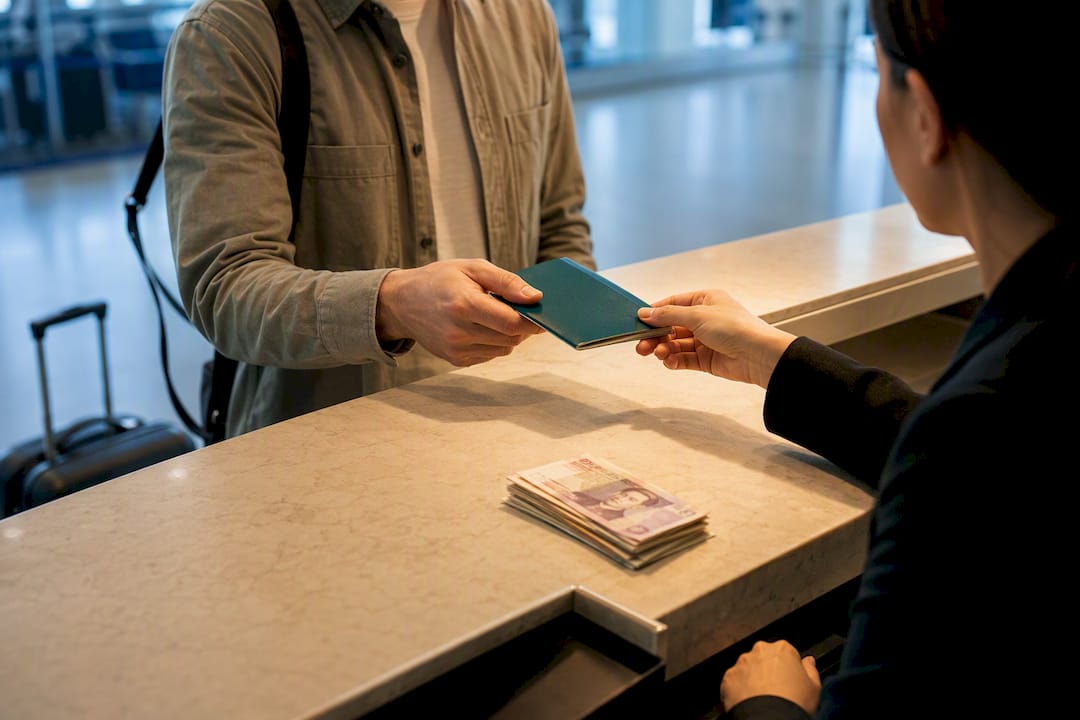
The fastest way to get cash while traveling is to send money for cash pickup through an app or move funds to your own bank account and hit a local ATM, and you should set up both before you leave. Cash pickup and card-funded transfers deliver in minutes; ACH-funded bank transfers cost less but take a day or more. Carry at least two access methods, since a single app or card failing overseas is the most common way a trip turns into a scramble for cash.
TL;DR:
- Cash pickup at agent locations with networks like Western Union or MoneyGram offers same-day availability but requires exact ID matching and prior setup.
- Bank transfers funded via ACH are cheaper but may take one to three business days to arrive, making them less suitable for emergencies.
- International money transfer apps like Zelle, Venmo, and Cash App are generally unusable abroad due to US-only banking routes; use PayPal or similar for cross-border transfers instead.
- Always configure two-factor authentication and save support contacts before departure to avoid lockouts or delays caused by foreign SIM or signal issues.
- Testing small transfers ahead of time helps verify your setup and ensures faster, smoother cash access during travel.
Table of Contents
- How Do You Get Cash When Traveling With Money Transfer Apps?
- How Do You Send Money for Cash Pickup or Bank Withdrawal?
- Do P2P Apps Like Venmo and Zelle Work Internationally?
- Which App Features Actually Matter for Travelers?
- How Much Do Fees and Exchange Rates Really Cost You?
- Security and Backup Plans That Actually Hold Up
- What I've Learned Watching Travelers Get This Wrong
- Check Rates and Agent Coverage Before You Send a Dollar
- Sources
- FAQ
How Do You Get Cash When Traveling With Money Transfer Apps?
You have five realistic paths to physical cash abroad, and they rank differently depending on whether you need money in twenty minutes or twenty hours.
- Cash pickup at an agent location. Apps built on networks like Western Union, MoneyGram, or WorldRemit let you send money to yourself, then walk into a local branch with ID and a pickup code. Cash pickup networks let recipients without a local bank account collect cash directly, and if you fund the transfer with a debit or credit card, same-day pickup is often available.
- Send to your own bank account, then withdraw at an ATM. This is usually the cheapest route if you fund it through ACH from your checking account, though it is also the slowest, sometimes taking a few business days to post. Once it lands, use your bank's ATM finder to avoid partner-network surcharges.
- Multi-currency travel accounts and prepaid travel cards. These let you hold several currencies and pull local cash from ATMs at close to the wholesale exchange rate, which matters most if you cross borders more than once on a trip.
- P2P transfer to a trusted local contact. If you have a friend, host, or colleague already in the country, sending them money instantly and having them hand you cash sidesteps agent lines entirely, though it depends on trust and their availability.
- ATM withdrawals with an app-linked debit or prepaid card. This is the most convenient day-to-day method. Always choose to be charged in the local currency rather than US dollars when the ATM prompts you. That prompt is dynamic currency conversion, and it almost always costs more than letting your card network handle the exchange.
Cash pickup and card-funded transfers win on speed. Bank-funded ACH transfers win on cost. Which one you need depends on whether you are solving an emergency or planning a week ahead.
How Do You Send Money for Cash Pickup or Bank Withdrawal?
Getting this right takes a bit of setup before you leave, and a specific sequence once you're on the ground.
- Before you go: create accounts on your chosen apps and complete identity verification (KYC) while you still have easy access to your driver's license, passport, and a stable internet connection. Verification abroad, on hotel WiFi, is where a lot of trips lose an afternoon.
- Link your funding source. Connect your checking account for ACH transfers if you're planning ahead, and keep a debit card linked as backup for anything urgent.
- Save agent addresses and support numbers for your destination city before departure. Apps show live agent maps, but you want this saved locally in case data is unreliable when you land.
- Initiating a cash pickup: you'll need the recipient's full legal name exactly as it appears on their government ID, the destination country and city, and sometimes a specific payout location. The app generates a pickup code and a confirmation SMS. Agents typically require the recipient's name to match their ID exactly, and will reject variants, so if you're picking up your own transfer, double-check that your account name matches your passport precisely.
- Sending to your own bank account: expect a confirmation email or notification once the transfer initiates, and another once funds post. ACH transfers commonly take one to three business days. Once posted, use your bank's app to locate in-network ATMs and avoid third-party withdrawal fees.
Pro Tip: Send a small test transfer, maybe $20 to $50, before you leave or right when you land. It confirms the payout mechanics, agent hours, and ID requirements without putting a large sum at risk if something goes wrong.
The most common failure points are a name mismatch between your app account and your ID, choosing a payout method the destination agent doesn't actually support, and showing up with the wrong form of identification. Confirm accepted ID types on the app before you travel, not at the counter.
Do P2P Apps Like Venmo and Zelle Work Internationally?
Mostly, no, and this trips up more travelers than any other part of the process. Zelle, Venmo, and Cash App route through the US banking network (via the Automated Clearing House and card networks tied to US bank accounts), so they generally cannot send funds to a foreign bank account or a recipient without a US-linked account. If your plan was to Zelle yourself cash while abroad, that plan doesn't work in most cases.
- Domestic-only apps to skip for international cash access: Zelle, Venmo, and Cash App, since none support cross-border payouts to foreign accounts or cash agents.
- Use instead: PayPal's international transfer service, or a cash-pickup network app, both built specifically for cross-border delivery. PayPal supports sending to bank accounts, mobile wallets, and cash pickup locations, with same-day pickup common when the sender funds it by card.
- Transfer limits and hold times vary by provider and by how you fund the transfer; instant, card-funded transfers cost more but clear faster than bank-funded ones, which can take a few days.
- Two-factor authentication is the silent trip-killer. If your bank or app relies on SMS codes to your US number or a device token, you may get locked out the moment you land on a foreign SIM or lose signal. Request international access enrollment or printed backup codes from your bank before departure so an authentication prompt doesn't strand you.
Set this up a week ahead, not at the airport gate, since some of these enrollment requests take a day or two to process on the bank's end.
Which App Features Actually Matter for Travelers?
Not every feature on a money transfer app's landing page matters once you're standing at an ATM in a foreign city with a dying phone battery. A few things do.
- Cash pickup footprint: confirm the app has active agent locations in the specific city you're visiting, not just the country. Coverage in a capital doesn't guarantee coverage in a smaller town.
- Delivery flexibility: the strongest apps let you choose between bank deposit, mobile wallet, and cash pickup from the same transfer, so you can adapt if one option isn't available on arrival.
- Fee and exchange-rate transparency: you want to see the total cost, fee plus markup, before you confirm, not buried after you've committed.
- Daily and per-transaction limits: these vary by app and by destination country, and they matter more on longer trips where you're sending multiple times.
Match the app to your actual trip. A weekend in a major capital rarely needs more than a card and a backup wallet app. A month in a rural region calls for verified cash pickup agents and possibly a local contact as backup, since ATMs can be sparse.
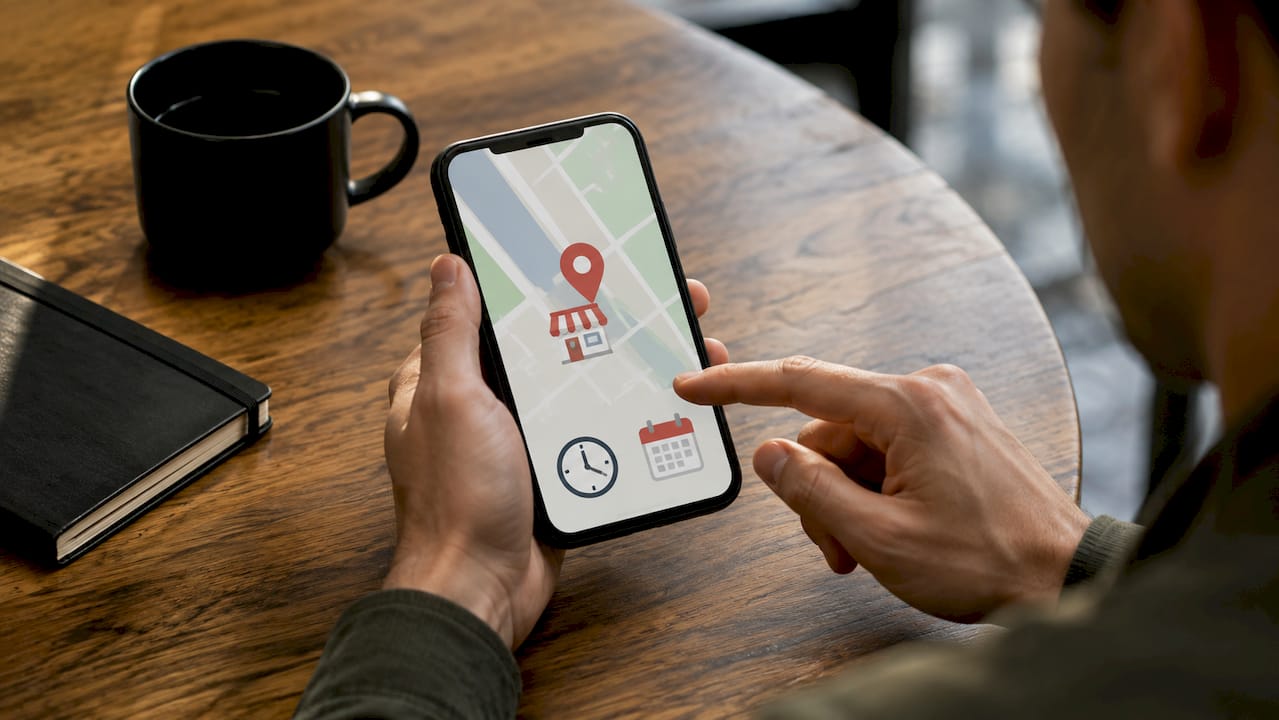
Pro Tip: Before you send anything, look up the exact agent address on a map, and check its listed hours against your arrival time. Plenty of agents close on Sundays or early on weekdays, and a transfer sitting there uncollected does you no good at 9 p.m.
How Much Do Fees and Exchange Rates Really Cost You?
The advertised fee is rarely the whole story. Total cost comes from four places: a flat fee, a percentage fee, an exchange-rate markup baked into the conversion, and any ATM fees on the withdrawal end.
- ACH funding (from your checking account) is typically the cheapest way to fund a transfer, but also the slowest, often one to three business days.
- Debit card funding sits in the middle: faster than ACH, moderate in cost.
- Credit card funding is usually the most expensive option and can trigger a cash-advance fee on top of the transfer fee, since funding an international transfer with a credit card often increases upfront costs.
Licensed money-transfer companies often beat banks on both cost and speed, particularly once you account for the exchange-rate markup banks tend to layer on quietly. Comparing only the upfront fee misses this. Two providers can post the same $4.99 fee, and one can still cost you $15 more once the exchange rate is factored in.
As a rule: instant and card-funded transfers usually arrive same-day, standard bank-funded transfers land in one to three business days, and the cheapest routes can take close to a week. Before sending, check total landed cost, the fee plus the markup, against the delivery speed you actually need. A tool like Idealremit's rate comparison lets you see both side by side instead of guessing.
Security and Backup Plans That Actually Hold Up
The travelers who get stuck abroad usually aren't unlucky. They just relied on one method and had no plan B when it failed.
- Enable two-factor authentication before departure, and separately confirm your bank supports international access rather than assuming it does.
- Save your bank's international collect-call number somewhere offline, not just in an app that needs data to open.
- Back up your device access: a lost or dead phone shouldn't mean losing access to every account. Write down account numbers and support lines somewhere physical.
- Carry a small local cash reserve, plus at least two card-based payment methods, since banks recommend never relying on a single access method while traveling.
- Screenshot every transfer confirmation, pickup code, and agent address before you lose signal, and keep the transfer ID handy in case an agent needs to verify it manually.
Checking live exchange rates and rate alerts before you send lets you pick the cheapest delivery method for that specific day, since rates shift daily and a provider that was cheapest last week isn't always cheapest today.
Pro Tip: Keep a photo of your ID and passport stored in an encrypted note or password manager, separate from your physical documents. If an agent asks for identification and your bag is elsewhere, you still have proof on your phone.
What I've Learned Watching Travelers Get This Wrong
Most cash problems abroad trace back to overconfidence in a single method, not bad luck. Someone assumes Zelle will work internationally, or their bank blocks a card the moment it detects a foreign transaction because nobody flagged the trip in advance.
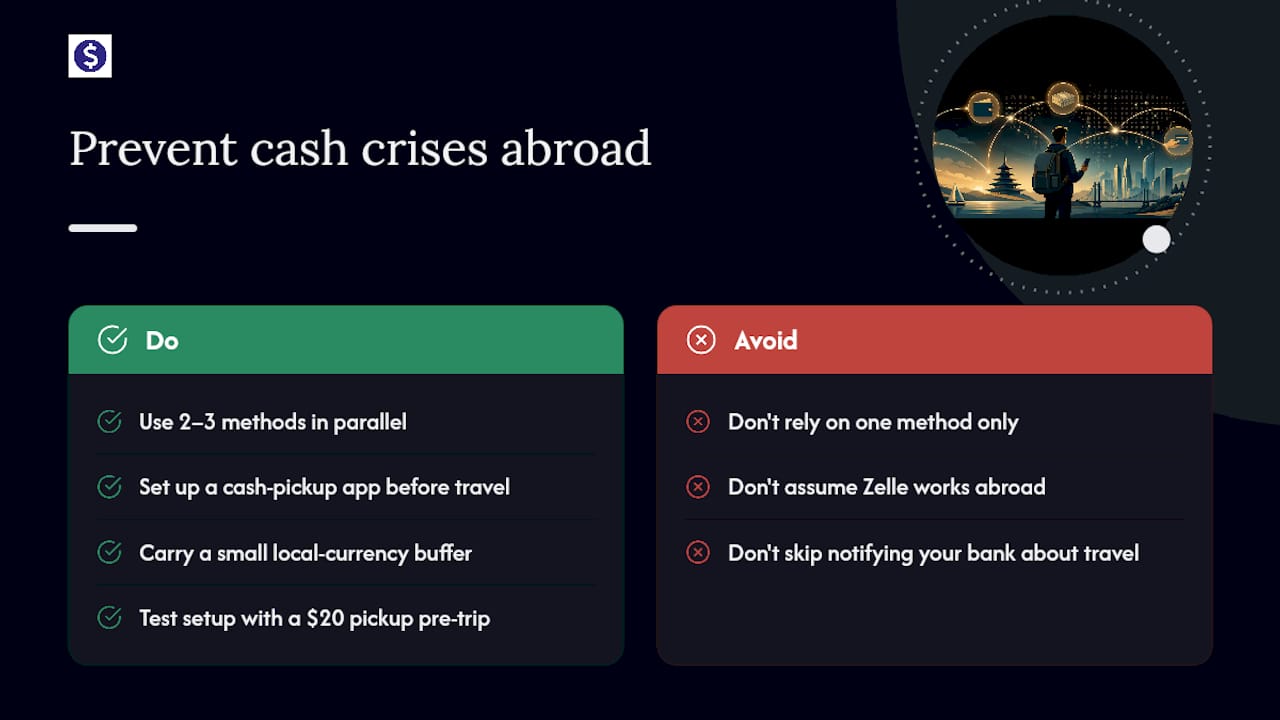
The travelers who never have a cash crisis are the ones running two or three methods in parallel: a linked debit card, a cash-pickup app already set up, and a small buffer of local currency in their bag. None of these alone is bulletproof. Together, they almost always are.
Test everything small before you need it big. A $20 pickup transfer the week before departure tells you more about whether your setup works than any amount of research.
- Brahim
Check Rates and Agent Coverage Before You Send a Dollar
Idealremit gives you what most travelers are missing at the exact moment they need it: a real-time comparison of what different providers actually charge and deliver, side by side, instead of trusting whichever app you already have installed.
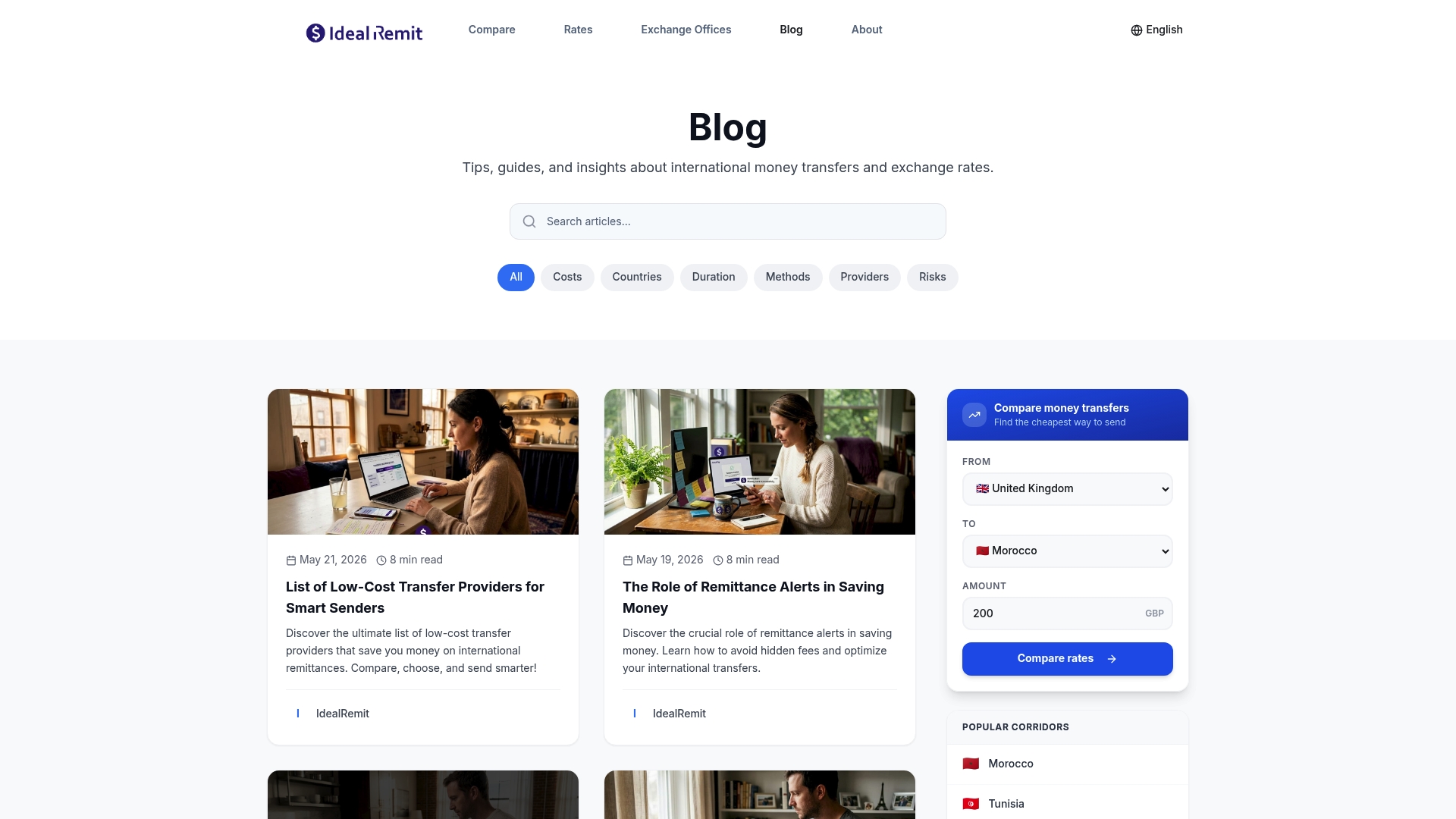
Idealremit pulls live rates, fees, and provider coverage across more than 100 countries, so you can see the total landed cost, not just the advertised fee, before you commit to a transfer. Set a rate alert for your destination currency, and you'll know when the market shifts in your favor instead of sending on a bad day by accident. You can also confirm which providers have active cash-pickup agents in your specific destination city, which matters far more than country-level coverage once you're actually there. Before your next trip, run your route through Idealremit's comparison tool and check whether a cheaper, faster option exists for the exact amount and currency you plan to send.
Sources
- Tips for managing money while traveling abroad - Wells Fargo
- 7 Best Ways to Send Money Internationally 2026 - NerdWallet
- Send Money Internationally | Transfer Money Abroad | PayPal US
FAQ
How Do You Get Cash While Traveling Internationally?
Send money to yourself for cash pickup through an app like PayPal/Xoom or a cash-pickup network, or transfer to your own bank account and withdraw at a local ATM. Cash pickup and card-funded transfers move fastest; bank-funded ACH transfers cost less but take longer.
Is There an App That Lets You Travel and Get Paid?
Money transfer apps don't pay you to travel, but several let you move your own money ahead of a trip so cash or a payout is waiting at your destination. That's a funding strategy, not an income source.
What Are Good Money Transfer Apps for International Use?
Apps built on cash-pickup networks like Western Union, MoneyGram, and WorldRemit, plus PayPal's international transfer service, are designed for cross-border delivery. Compare their live rates and fees through a tool like Idealremit before choosing one for your trip.
Can Zelle Be Used Internationally?
No. Zelle routes through the US banking network and generally cannot send funds to a foreign bank account or a recipient outside the US.
Do ATMs Charge Extra Fees When You Withdraw Abroad?
Yes, often a flat withdrawal fee plus a currency conversion markup, and choosing "local currency" instead of "US dollars" at the prompt usually saves you money versus accepting the ATM's dynamic conversion rate.