
TL;DR:
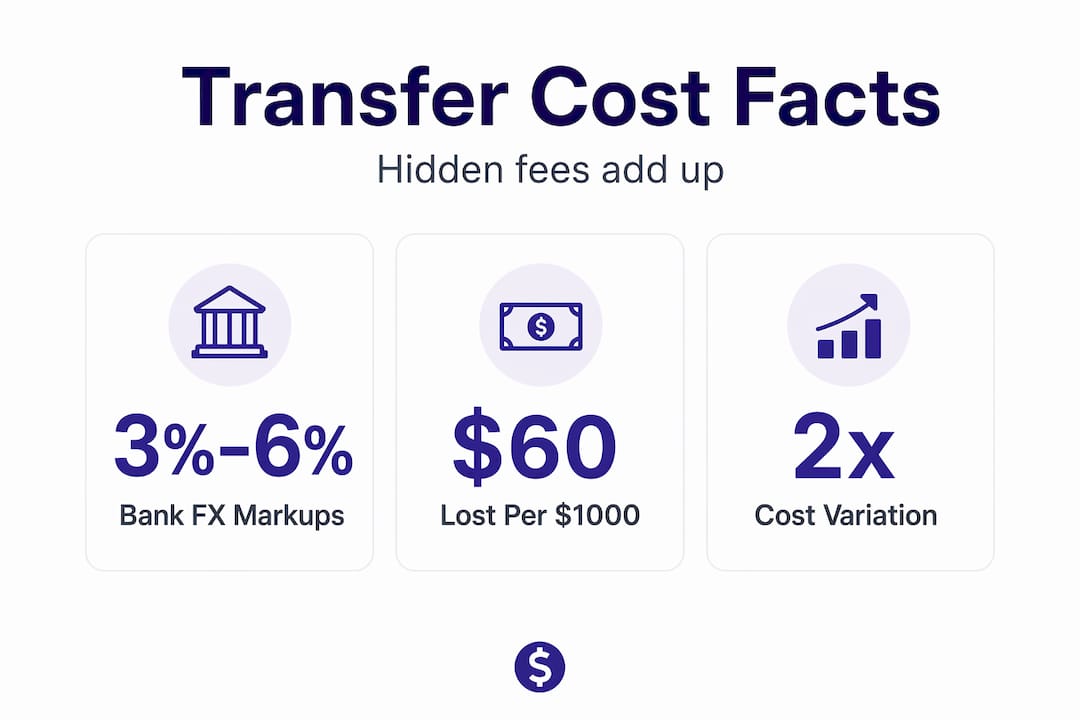
- Hidden FX markups often cost more than the transfer fee itself, with banks charging 3%–6%.
- Choosing the right provider depends on transfer size and corridor, with fintechs favored for amounts under $10K.
Every time you send money abroad, you're likely losing more than you realize. The culprit isn't just the transfer fee printed on the receipt. This foreign transfer savings guide breaks down the hidden costs most senders never notice, explains how to choose the right provider for your specific transfer size and destination, and gives you the timing and execution strategies that actually move the needle. Whether you're an expat managing monthly living expenses, an immigrant sending remittances home, or a small business paying overseas suppliers, this guide is built for you.
Table of Contents
- Key takeaways
- Understanding the real cost of foreign transfers
- Choosing the right provider for your transfer
- Timing and funding your transfers smartly
- Verifying success and avoiding costly mistakes
- Strategies by user profile: expats, immigrants, and businesses
- What most senders still get wrong
- Start saving on your next transfer with Idealremit
- FAQ
Key takeaways
| Point | Details |
|---|---|
| Hidden FX markups cost the most | Banks charge 3%–6% in exchange rate markup; switching to fintech can cut that to under 1%. |
| Provider choice depends on transfer size | Match your provider to your amount: fintech apps for under $10K, brokers for $100K+. |
| Timing reduces costs meaningfully | Send on weekdays, ideally Monday through Thursday, to avoid wider spreads and higher fees. |
| Fund via bank debit, not credit card | Credit cards add 1%–3% to your transfer cost; bank debit is usually free or near-free. |
| Consolidate transfers when possible | One larger transfer costs less overall than multiple small ones due to fewer flat fees. |
Understanding the real cost of foreign transfers
Most people look at the fee and stop there. That's the mistake. The transfer fee is only one part of what you actually pay, and often it's the smaller part.
The gap between the fee and the true cost
Every international transfer involves an exchange rate. The rate your provider uses is almost never the real mid-market rate you'd find on Google or XE. The difference between that mid-market rate and what you're charged is called the FX markup, and it functions as a silent fee you never see itemized. Traditional banks charge a 3% to 6% FX markup, while specialized fintech providers typically land between 0.4% and 0.7% for transfers under $10,000. That gap is enormous.
To see what that means in practice: a 2% rate discrepancy costs you $20 on a $1,000 transfer. Scale that to $10,000 and you're losing $200 or more in a single transaction, purely from the exchange rate. Most people sending money home every month have no idea they're absorbing that cost.
Beyond FX markups, watch for:
- Recipient fees: Some corridors charge the receiving bank or mobile wallet a landing fee. Your recipient gets less than expected even if your end looks clean.
- Flat transaction fees: These hurt small transfers disproportionately. A $5 fee on a $50 transfer is 10%.
- Correspondent bank fees: Wire transfers often pass through intermediary banks, each of which may take a cut.
- Delivery speed premiums: Faster transfers usually cost more. Know when speed is worth paying for.
Understanding exchange rate impact on your transfers is what separates informed senders from those who consistently overpay.
Choosing the right provider for your transfer
There is no single best provider. The right answer depends on how much you're sending, where you're sending it, and how fast it needs to arrive. Provider fit depends on transfer size, corridor, and speed requirements, not brand popularity.
Here's a practical breakdown by transfer size:
| Transfer size | Best provider types | Why |
|---|---|---|
| Under $10,000 | Wise, Revolut, Remitly | Near mid-market rates, low flat fees, fast delivery |
| $10,000–$100,000 | OFX, CurrencyFair | Better rate tiers, no flat fees on larger amounts |
| Over $100,000 | Dedicated currency brokers | Live spread quoting nearly always beats automated pricing |
For large transfers specifically, dedicated currency brokers who quote live spreads almost always beat automated app pricing. The relationship takes a little time to build, but the savings on a $200,000 property purchase or a major supplier payment can easily reach four figures.
Corridor matters just as much as size. Cost differences by corridor can be dramatic. Sending USD to EUR on a well-traveled route is competitive. Sending USD to a West African country through a niche provider may carry steep fees that a more specialized remittance service would avoid entirely. Always verify that your chosen provider actually supports your route and check whether the landed amount matches what you calculated using the mid-market rate.
Pro Tip: Get quotes from at least two or three providers on the same day and time before committing. Exchange rates shift throughout the day, so comparing quotes from different days means you're comparing apples to oranges.
If you're curious about alternatives to bank transfers, fintech platforms and dedicated brokers consistently outperform traditional banks on most routes. There are also stablecoin-based transfer options using USDT or USDC that can reduce corridor fees further, though they carry counterparty and tax risks that make them unsuitable for most casual senders.
Timing and funding your transfers smartly
Getting the right provider is half the equation. The other half is knowing when to send and how to fund the transfer.
-
Send on weekdays, not weekends. Mid-market rates are most stable Monday through Thursday. Friday afternoons and weekends see wider spreads and higher fees because liquidity drops and providers hedge their risk by padding the rate.
-
Monitor rates before committing. Most major providers and comparison platforms let you set rate alerts. You define a target rate and get notified when the market hits it. This is one of the simplest international transfer savings tips that almost nobody uses consistently.
-
Use bank debit to fund your transfer. Credit cards often add 1% to 3% to the transaction cost through cash advance fees or foreign transaction charges. Bank debit is usually free or carries only minimal cost. That 2% saving on a $5,000 transfer is $100 back in your pocket.
-
Consider limit orders for non-urgent transfers. A limit order lets you set a target exchange rate and the transfer executes automatically when the market reaches it. You avoid the guesswork of watching rates manually.
-
Use forward contracts for predictable future payments. Small businesses paying regular international invoices can lock in today's rate for a transfer weeks or months away. This eliminates exchange rate risk and simplifies budgeting.
Pro Tip: Timing FX transfers consistently over months adds up to real savings. Combine rate monitoring with a standing schedule to avoid impulsive transfers on bad-rate days.
It also pays to consolidate your transfers. One $1,000 transfer costs less in total than four $250 transfers, because flat fees apply to every transaction regardless of size. If your recipient situation allows it, batch smaller amounts into less frequent, larger sends.
Verifying success and avoiding costly mistakes
Saving money on the transfer itself means nothing if the money gets stuck, returned, or sent to the wrong place. Errors in recipient details are more common than people admit, and the consequences range from annoying to expensive.
Before confirming any transfer, triple-check:
- Account number or IBAN: One wrong digit sends the money to a stranger or into a processing void.
- SWIFT/BIC code: This routes the transfer to the right bank. An outdated or incorrect code causes delays and correspondent bank fees.
- Recipient name: Many banks require an exact match between the name on the transfer and the account holder. A nickname or abbreviation can trigger a rejection.
- Recipient country and currency: Sending USD to an account that only accepts local currency may trigger an automatic conversion at a poor rate.
Errors in recipient details lead to delays and reversal fees that can wipe out any savings you worked to achieve. Double-checking takes two minutes. Fixing a misdirected wire can take weeks.
On compliance: Transfers of $10,000 or more trigger mandatory anti-money laundering reporting in the United States and many other countries. Large transfers require complete records of the amount, purpose, and applicable rates. Gaps in documentation can cause compliance delays. Keep a simple log for every transfer above that threshold, including screenshots of the rate and confirmation number.
Scams are another real risk. Be wary of any request to send money urgently to a new recipient, especially if it came through email or messaging apps. Legitimate providers never ask you to change payment details over chat. If something feels off, call the provider directly using the number on their official website, not one provided in a message.
For a detailed checklist, the international transfer security checklist from Idealremit covers both safety and cost efficiency in one place.
Strategies by user profile: expats, immigrants, and businesses
Not every sender has the same needs. Here's a quick reference to focus your money transfer savings strategies based on who you are.
| Sender type | Best strategies | Key watch-out |
|---|---|---|
| Expat (regular living costs) | Rate alerts, scheduled transfers, fintech apps | Weekend rate spreads |
| Immigrant (family remittances) | Consolidate transfers, corridor-specific providers | Recipient fees at destination |
| Small business (supplier payments) | Forward contracts, broker relationships, limit orders | Compliance records for large amounts |
For expats, budgeting for life abroad typically means maintaining 3 to 6 months of living expenses in the destination currency, often $10,000 to $20,000. Building transfers in larger batches during favorable rate windows saves money and reduces the mental overhead of watching rates constantly.

For immigrants sending regular remittances, the corridor is everything. A provider that is cheap on US to Mexico transfers may be expensive on US to Philippines. Use a comparison platform every few months to confirm you're still on the best route.
For small businesses, inconsistent or sporadic transfers often increase total costs and complicate compliance. Scheduling regular transfers and keeping proper records reduces both risk and fees over time.
What most senders still get wrong
I've spent years studying how people move money across borders, and the pattern is always the same. People focus on the fee they can see and ignore the rate they can't. A provider charging zero in fees but using a 4% FX markup is more expensive than one charging $10 flat with a 0.5% markup on any transfer above $500. Yet the first option always looks better at first glance.
The second mistake I see constantly is brand loyalty without math. Using a well-known name because it feels safe is understandable. But the cost gap between a trusted household name and a specialized fintech on a $5,000 transfer can easily exceed $100. That's real money, not a rounding error.
What actually works, in my experience, is treating every transfer like a small purchasing decision. Check the rate. Compare two providers. Fund via bank debit. Send on a Tuesday. None of these steps take more than five minutes, and together they can cut your transfer cost by 50% or more compared to walking into a bank branch.
The foreign exchange transfer advice I'd give anyone managing recurring transfers is this: build a simple routine. Same day of the week. Same comparison habit. Same record-keeping format. Consistency reduces costs and keeps you compliant without turning into a part-time job.
— Brahim
Start saving on your next transfer with Idealremit
You now have the framework. The next step is putting it into practice without spending an hour on research every time you send money.
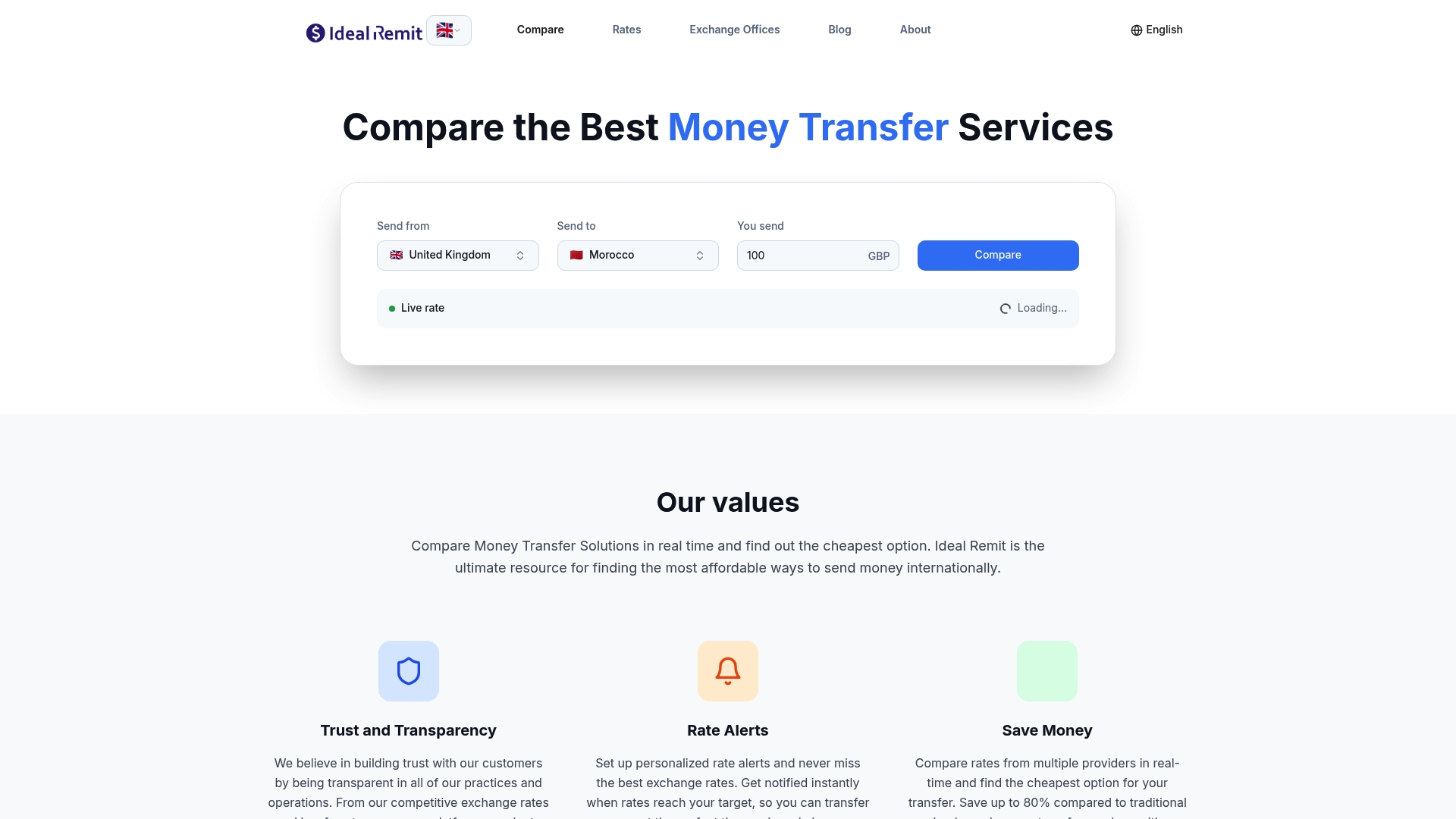
Idealremit is built exactly for this. The platform aggregates real-time rates and fees from trusted providers including Western Union, MoneyGram, Remitly, Wise, and more, so you can compare transfer rates side by side in seconds. You can set personalized rate alerts, track live exchange rates, and calculate exactly how much you'd save on your next transfer compared to your bank. Idealremit covers transfers to over 100 countries, with up-to-date 2026 provider data and savings calculations showing up to 80% in potential reductions versus traditional banks. If you're in the UK, the cheapest transfer options comparison tool gives you the same live data tailored to your market. Stop guessing. Start comparing.
FAQ
What is the biggest hidden cost in foreign transfers?
The exchange rate markup is typically the largest hidden cost. Banks charge 3% to 6% above the mid-market rate, which can cost far more than any visible transfer fee on larger amounts.
When is the best time to send money abroad?
Monday through Thursday mornings generally offer the most stable mid-market rates. Friday afternoons and weekends tend to carry wider spreads as liquidity decreases.
How do I choose between providers for different transfer sizes?
For transfers under $10,000, fintech apps like Wise or Revolut offer near mid-market rates. For $10,000 to $100,000, providers like OFX offer better rate tiers. Above $100,000, a dedicated currency broker will usually beat automated pricing.
Do I need to report large international transfers?
Yes. In the United States, transfers of $10,000 or more trigger mandatory anti-money laundering reporting. Keep records of the amount, purpose, and exchange rate used for every large transfer.
Is it cheaper to send one large transfer or several small ones?
One larger transfer is almost always cheaper. Flat fees apply per transaction, so consolidating multiple smaller amounts into one send reduces the total fee burden significantly.