

TL;DR:
- The total cost of RIA Money Transfer includes a flat fee and an exchange rate markup above the mid-market rate, which many senders overlook. RIA's fees vary widely depending on the payment method and corridor, with the highest fees linked to credit card funding and the exchange rate markup influencing the final recipient amount. Understanding both components is vital for choosing the most cost-effective option and accurately assessing the true transfer cost.
The RIA transfer rate is the total cost you pay when sending money internationally through RIA Money Transfer, combining both flat transaction fees and a hidden exchange rate markup applied above the mid-market rate. Most senders focus only on the advertised fee and miss the second cost entirely. RIA operates in 190+ countries with bank deposits, debit cards, credit cards, and cash pickup options, each carrying different fee structures. Understanding both cost components before you send is the difference between a good deal and an expensive surprise.

What is the RIA transfer rate and how does it work?
The RIA transfer rate is not a single number. It is a dual revenue model combining a flat transfer fee plus an exchange rate markup, and both reduce what your recipient actually receives. This structure is standard across the remittance industry, but RIA's specific numbers vary significantly by payment method, destination corridor, and transfer amount.
RIA shows you the total fee before you confirm a transfer. That transparency is genuinely useful. The catch is that the exchange rate markup is baked into the quoted rate itself, not listed as a separate line item, so you need to compare RIA's offered rate against the mid-market rate to see the real cost.
How do RIA money transfer fees break down by payment method?
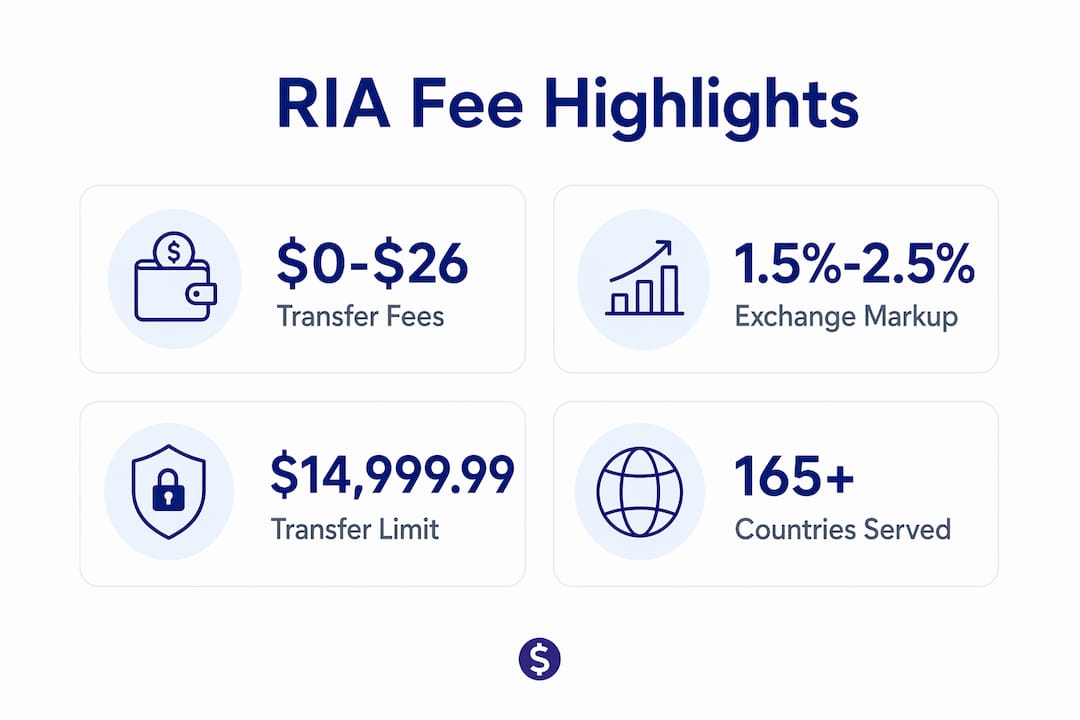
RIA's transfer fees vary sharply depending on how you fund the transfer. For a USD to INR corridor, bank deposits cost roughly $0-$5, debit cards run $5-$8, and credit cards can reach $26. That range is wide enough to matter on any transfer size.
The table below shows typical fee ranges across common payment methods and corridors:
| Payment Method | USD to INR | USD to CAD | USD to MXN |
|---|---|---|---|
| Bank Transfer (ACH) | $0-$3 | $0-$3 | $0-$4 |
| Debit Card | $5-$8 | $4-$7 | $5-$8 |
| Credit Card | Up to $26 | Up to $20 | Up to $22 |
| Cash (Agent) | $4-$10 | $4-$8 | $4-$9 |
Credit card payments carry the highest fees for a specific reason. Your card issuer may classify the transaction as a cash advance charge, adding a separate fee that RIA does not control and does not display in its quote. That means the $26 you see could be the floor, not the ceiling.
Pro Tip: ACH bank transfers are the cheapest funding method, but they take 3-5 business days to process. If cost matters more than speed, always choose bank transfer over debit or credit card.
How does ria's exchange rate markup affect your total cost?
The exchange rate markup is the cost most senders underestimate. RIA applies a markup of 1.5%-2.5% above the mid-market rate on major corridors. On small transfers, this feels minor. On larger amounts, it overtakes the flat fee entirely.
Here is a concrete example. If the mid-market rate for USD to INR is 84.00 and RIA offers 82.50, that 1.5-rupee difference represents a 1.79% markup. On a $1,000 transfer, you lose roughly $17.90 to the markup alone, before any flat fee is applied. On a $5,000 transfer, that same markup costs you about $89.50.
The calculation works like this:
- Find the current mid-market rate (Google "USD to INR" gives you this instantly).
- Note RIA's quoted exchange rate for your corridor.
- Subtract RIA's rate from the mid-market rate, then divide by the mid-market rate.
- Multiply that percentage by your transfer amount.
- Add the flat fee to get your true total cost.
Understanding why exchange rates matter is the single most important skill for anyone sending money regularly. The markup is not a scam. It is how RIA earns revenue. But ignoring it means you are comparing providers on incomplete information.
Pro Tip: Always check the final recipient amount, not just the advertised fee. Two providers with identical flat fees can deliver very different amounts to your recipient if their exchange rate margins differ.
What are ria's transfer limits and why do they matter?
Transfer limits directly affect how you plan large or recurring payments. U.S. senders face a $14,999.99 limit per 30-day period, while Canadian users are capped at CAD $3,000 per day. Cash-funded transfers carry an even lower ceiling, typically around $495 per transaction.
These limits exist for regulatory compliance reasons, primarily anti-money-laundering rules. They are not arbitrary. But they create real planning challenges for businesses or families sending large amounts regularly.
Key limits to know before you send:
- U.S. online transfers: $14,999.99 per rolling 30-day period
- Canada online transfers: CAD $3,000 per day
- Cash-funded transfers: Approximately $495 per transaction
- State-specific limits: Some U.S. states impose lower caps based on local regulations
- Verification tiers: Completing full identity verification can unlock higher limits in some corridors
If you need to send more than the standard limit, splitting transfers across multiple days is the most practical workaround. Just account for the fact that each transfer carries its own flat fee, so splitting a large transfer increases your total fee cost proportionally.
How do RIA rates compare to other money transfer providers?
RIA's exchange rate margins sit below traditional bank wire transfers, which typically charge $25-$50 in fees plus a 3%+ rate markup, but above digital-first platforms like Wise, which charges a transparent percentage fee with no exchange rate markup at all. That positions RIA in the middle of the market on cost.
The comparison table below covers the key variables:
| Provider | Typical Fee | Exchange Rate Markup | Network Size | Cash Pickup |
|---|---|---|---|---|
| RIA Money Transfer | $0-$26 | 1.5%-2.5% | 190+ countries | Yes, 165+ countries |
| Western Union | $0-$30+ | 1.5%-3% | 200+ countries | Yes |
| MoneyGram | $0-$25 | 1.5%-3% | 200+ countries | Yes |
| Wise | 0.4%-2% of amount | 0% (mid-market rate) | 80+ countries | No |
| Remitly | $0-$3.99 | 1%-2% | 170+ countries | Limited |
RIA's strongest advantage is its cash pickup network covering 165+ countries. For recipients without bank accounts in countries like India, the Philippines, or Mexico, that physical reach is genuinely valuable. Wise offers better rates but requires both sender and recipient to have bank accounts.
The difference between banks and remittance companies comes down to overhead. Banks maintain branches and compliance infrastructure that costs money. Remittance specialists like RIA pass some of those savings on, but still earn margin through exchange rates. Digital-first platforms cut further by eliminating physical locations entirely.
How to calculate your total RIA transfer cost
Calculating your real transfer cost takes three minutes and saves real money. Follow these steps every time before you confirm a transfer:
- Get the mid-market rate. Search Google or use XE.com for the current rate between your currencies.
- Note RIA's quoted rate. This appears in the transfer calculator on RIA's website or app.
- Calculate the markup cost. Subtract RIA's rate from the mid-market rate, divide by the mid-market rate, and multiply by your transfer amount.
- Add the flat fee. RIA shows fees transparently before confirmation, so this number is visible.
- Check for intermediary bank fees. If your recipient uses a bank that routes through correspondent banks, additional fees may be deducted without notice. Ask your recipient's bank whether they charge incoming wire fees.
One common pitfall: in-person RIA agent locations may quote different rates than the online platform. Agent location rates can vary because of local overhead costs, so always verify the online rate before walking into a store.
Pro Tip: RIA occasionally offers promotional codes that reduce flat fees. Check RIA's website and coupon aggregator sites before sending. A $3 code on a $500 transfer is a 0.6% saving before you even compare exchange rates.
Key takeaways
The true cost of a RIA transfer is always the flat fee plus the exchange rate markup combined, and the recipient's final amount is the only reliable measure of value.
| Point | Details |
|---|---|
| Dual cost structure | Every RIA transfer includes a flat fee plus an exchange rate markup of 1.5%-2.5%. |
| Payment method matters | Bank transfers cost $0-$5; credit cards can reach $26 plus card issuer cash advance fees. |
| Transfer limits apply | U.S. senders are capped at $14,999.99 per 30 days; cash transfers max out around $495. |
| Compare recipient amounts | The final amount your recipient receives is the only accurate way to compare providers. |
| Physical network advantage | RIA's cash pickup in 165+ countries serves recipients without bank accounts better than digital-only platforms. |
Why "zero fee" ads are the oldest trick in remittances
I have spent years watching people make the same mistake: they see "zero fees" and assume they are getting the best deal. They are not. The true cost is always in the exchange rate, and a provider advertising no fees while offering a 3% rate markup is more expensive than one charging a $5 flat fee with a 1% markup on any transfer above $200.
RIA is not the cheapest option on the market. Wise consistently offers better exchange rates for senders and recipients who both have bank accounts. But RIA is not trying to be the cheapest. It is trying to be the most accessible, and for many corridors and recipient situations, that is the right tradeoff.
My honest advice: use RIA when your recipient needs cash pickup or lives in a corridor where digital-first platforms have limited coverage. Use Wise or Remitly when both parties have bank accounts and you want to minimize the exchange rate cost. Never use a credit card to fund a remittance transfer unless you have no other option. The combination of RIA's credit card fee and your card issuer's cash advance charge can easily cost 5%-8% of the transfer amount.
Run the numbers before every transfer. Rates change daily. A provider that was cheapest last month may not be cheapest today. The role of exchange rate transparency in this industry is still evolving, and the senders who understand both cost components consistently keep more money in their recipients' hands.
— Brahim
Find the best RIA transfer options in one place
Comparing RIA transfer rates manually against Western Union, MoneyGram, Wise, and Remitly takes time you probably do not have. Idealremit aggregates live rates, fees, and transfer speeds from the top providers so you can see the real cost of each option side by side in seconds.

Idealremit tracks exchange rate markups, not just flat fees, which means the comparison you see reflects what your recipient actually receives. You can set personalized rate alerts, calculate savings across providers, and identify the cheapest corridor for your specific transfer amount. For anyone sending money internationally more than once a year, that kind of real-time rate comparison is worth bookmarking. Idealremit covers 100+ countries and shows you options across the full cost spectrum, from cash pickup networks to digital-first platforms.
FAQ
What is the RIA transfer rate exactly?
The RIA transfer rate is the combined cost of RIA's flat transaction fee plus its exchange rate markup above the mid-market rate. Both components reduce the amount your recipient receives.
How much does RIA charge to send money internationally?
RIA's fees range from $0 for bank deposits to up to $26 for credit card payments, depending on the destination and payment method. The exchange rate markup adds an additional 1.5%-2.5% on top of those fees.
Are there hidden fees with RIA money transfer?
RIA displays its flat fees before you confirm, but the exchange rate markup is embedded in the quoted rate rather than listed separately. Intermediary banks may also deduct fees that RIA does not control or disclose upfront.
How do i find the best RIA transfer options for my corridor?
Use RIA's online price calculator to compare payment methods for your specific corridor, then check the final recipient amount against at least one other provider before confirming. Platforms like Idealremit make this side-by-side comparison faster.
Is RIA cheaper than a bank wire transfer?
Yes. Traditional bank wire transfers typically cost $25-$50 in fees plus a 3%+ exchange rate markup. RIA's markup of 1.5%-2.5% and lower flat fees make it a cheaper option than most banks, though digital-first platforms like Wise generally offer better rates still.