Send Money to Ghana from USA: Fast, Low-Cost Options
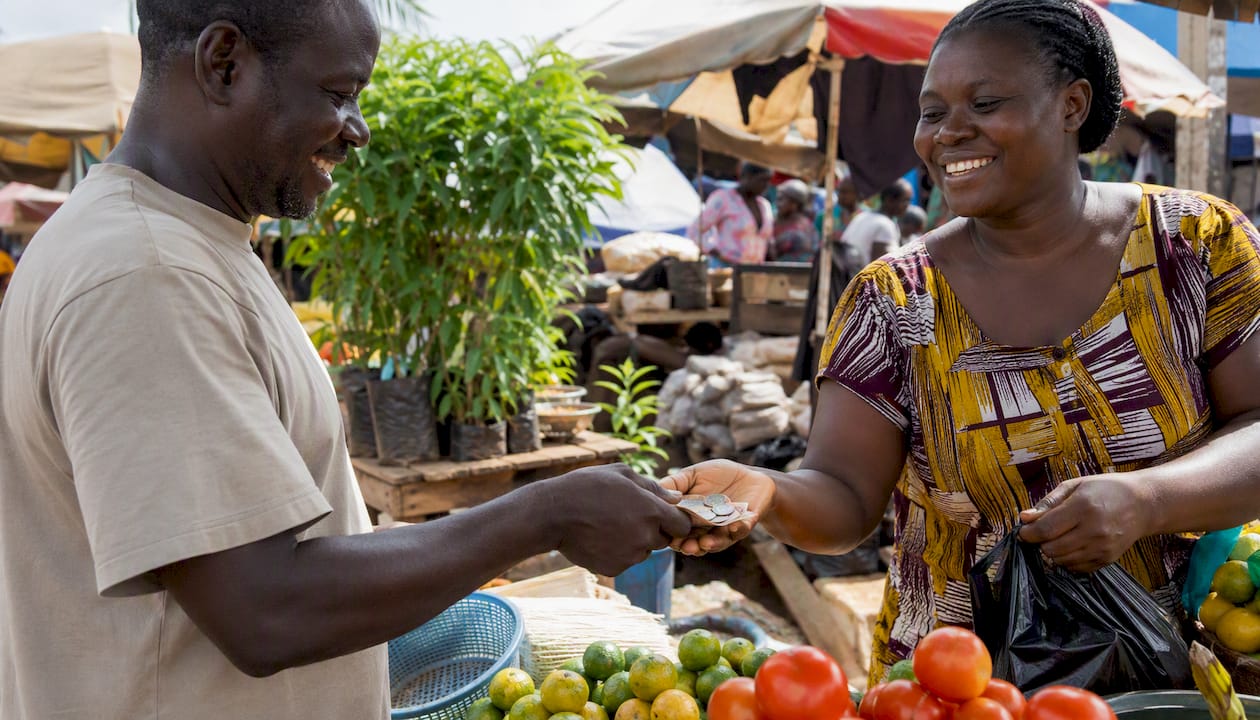
The fastest, cheapest, and most reliable way to send money to Ghana from the USA depends on where your recipient will spend it: mobile-wallet delivery to MTN Mobile Money (MoMo) wins on speed, bank deposit wins on trust for larger sums, and cash pickup still matters for recipients without a MoMo account or bank branch nearby. No single provider wins every category, which is exactly why comparing rates before you send matters more than picking a brand out of habit.
Here's the shortlist that covers most situations:
- Urgent support (medical bills, emergencies): A mobile-first app with MoMo delivery, since funds often land in minutes rather than hours.
- Small, recurring transfers (monthly family support): Whichever provider currently has the tightest exchange-rate margin on that specific week, checked through a comparator like Idealremit rather than assumed.
- Large one-time transfers (school fees, property, business payments): Bank deposit through a provider that lets you lock in a rate, since banks in Ghana that operate under Bank of Ghana oversight handle bigger sums with more paper trail.
- First-time senders unsure which provider to trust: Stick to platforms registered with FinCEN as money services businesses in the U.S., which is a baseline legal requirement, not a nice-to-have.
Key Takeaways
The cheapest and fastest way to send money to Ghana from the U.S. depends on your recipient's payout method, and comparing live rates beats defaulting to one familiar provider.
| Point | Details |
|---|---|
| Match method to recipient | Choose MoMo for speed, bank deposit for large or formal transfers, cash pickup when neither is available. |
| Fees aren't the whole cost | Exchange-rate margin can cost more than the visible fee, so compare both together. |
| Funding method changes speed and cost | ACH is cheaper but slower; debit or credit cards are faster but often add a fee. |
| Verify recipient details exactly | A mismatched name or wrong account number is the top cause of delayed transfers. |
| Compare rates with Idealremit before sending | Idealremit shows the "you send / recipient gets" breakdown across providers for the USD to Ghana corridor. |
Table of Contents
- How to Send Money to Ghana from USA: The Real Trade-offs
- Which Provider Category Fits Your Priorities?
- How Do You Actually Send Money to Ghana?
- Bank Deposit, MoMo, or Cash Pickup: What Should You Choose?
- What Do Fees and Exchange Rates Actually Cost You?
- What Verification and Security Checks Should You Expect?
- How Do You Pick the Right Provider for Your Situation?
- What Does the Data Say About the USD to Ghana Corridor?
- Compare Rates Before You Send Money to Ghana
- Where to Verify Rates and Requirements
- Sources
- FAQ
How to Send Money to Ghana from USA: The Real Trade-offs
Every method for sending money to Ghana from the USA involves the same three variables pulling against each other: speed, cost, and delivery method. A provider that's fast to MoMo might charge more on a bank deposit. A provider with rock-bottom fees might take a full business day for cash pickup. Understanding this tension is the actual skill here, not memorizing a "best" provider.
Wise built its reputation on transparent, upfront pricing. It reports that 74% of transfers arrive in under 20 seconds, and 95% arrive in less than a day, with bank deposit as the primary payout method to Ghana. Western Union takes a different approach, leaning on physical reach: it offers online, app, and in-person sending, with recipients able to choose bank deposit, cash pickup, or mobile wallet. Remitly splits its speed tiers by funding method, noting that debit or credit card funding can trigger express, near-instant delivery when that option is available for your route.
MoneyGram competes on network size and upfront cost display, showing total cost before you confirm anything, plus agent locations across Ghana for cash pickup. Sendwave and similar mobile-first apps often post the sharpest pricing specifically for MoMo deliveries, according to corridor analysis from SendMoneyCompare, which found meaningful price spreads between the cheapest and most expensive providers on the USD to Ghanaian cedi corridor. WorldRemit rounds out the field with straightforward signup and both mobile money and bank deposit as core payout choices for Ghana.
That's six real players, and none of them is universally "best." The right one changes based on what your recipient needs and how much you're sending.
Which Provider Category Fits Your Priorities?
| Best For | Delivery Methods | Typical Fees | Rate Transparency | Speed | US Payment Methods | Transfer Limits | Support |
|---|---|---|---|---|---|---|---|
| Mobile-first apps (Sendwave-style) | MoMo, some bank | Low flat fee | High, often shown before confirming | Minutes for MoMo | Debit card, bank account | Lower per-transfer caps | App-based, limited phone support |
| Specialist online providers (Wise, WorldRemit) | Bank deposit, MoMo | Low to moderate, scales with amount | High, upfront calculator | Minutes to 1 day | ACH, debit/credit card, bank transfer | Mid to high, verification-dependent | Email and chat support |
| Cash-pickup networks (Western Union, MoneyGram) | Cash pickup, bank, mobile wallet | Moderate to higher on small sends | Moderate, shown before confirming | Minutes to hours for pickup | Card, bank account, in-person cash | High, extensive agent network | Phone, in-person agents, strong reliability track record |
| Traditional banks | Bank deposit only | Highest flat wire fees | Low, rate margin often hidden | 2 to 5 business days | Wire transfer, bank account | Very high, best for large sums | Branch and phone support |
On a $500 transfer, the gap between categories shows up fast. A mobile-first app might charge a $2.99 flat fee with a tight exchange-rate margin, delivering roughly $495 worth of cedis after conversion. A traditional bank wire on the same $500 could easily eat $25 to $45 in fees alone, before you even account for a wider exchange-rate spread that quietly shaves off more value. That's not a rounding error. It's the difference between your recipient getting real, spendable cedis and getting shorted by a bank that doesn't have to compete for your business.
Mobile-first apps tend to be cheapest for MoMo and fastest for small, frequent transfers, but they usually cap how much you can send per transaction. Specialist online providers balance cost and reach well, supporting both MoMo and bank deposit with decent transparency. Cash-pickup networks justify slightly higher fees with dense agent networks, which matters if your recipient lives somewhere without reliable mobile banking. Traditional banks are the slowest and most expensive option for this corridor, full stop, and exist mainly as a fallback for very large, formal transfers.
How Do You Actually Send Money to Ghana?
Sending money to Ghana from the U.S. follows the same basic sequence no matter which provider you pick.
- Choose your provider based on how your recipient wants to receive funds. If they use MoMo, prioritize a provider that supports it directly rather than one that only does bank deposit.
- Sign up and verify your identity. Expect to submit a government-issued ID and basic personal information; this is standard know-your-customer (KYC) practice, not a red flag.
- Add your recipient's details. This step differs by delivery method, so have the right information ready before you start (see checklist below).
- Choose your delivery method (MoMo, bank deposit, or cash pickup) and confirm the "you send / recipient gets" breakdown before paying.
- Pay using your preferred funding method: ACH bank transfer, debit or credit card, or wire, depending on what the provider supports.
- Track the transfer using the provider's tracking number or in-app status, and confirm with your recipient once funds arrive.
Before you start, gather the right recipient details for the delivery method you're using:
- MoMo delivery: the recipient's registered mobile number and confirmation that the account is Ghana Card linked and fully KYC-verified.
- Bank deposit: full account number, the recipient's bank name, and the SWIFT/BIC code for that branch.
- Cash pickup: the recipient's full legal name exactly as it appears on their government ID, since mismatches are the most common cause of delayed pickups.
Common hiccups worth knowing about ahead of time: verification delays usually happen when your ID photo is blurry or your billing address doesn't match your bank records, issues explained in detail by Bank Transfers - Cray. Incorrect account numbers are the top cause of failed bank deposits, so double-check digits rather than trusting autofill. And if you're funding by ACH, remember your bank transfer itself can take a day or two to clear before the provider even starts processing the international leg, which catches a lot of first-time senders off guard.
Bank Deposit, MoMo, or Cash Pickup: What Should You Choose?
Ghana's remittance market runs on three payout rails, and each one serves a different kind of recipient.
MTN Mobile Money is the default for most everyday transfers now, and for good reason. Money typically lands in a MoMo wallet within minutes, the recipient doesn't need a bank account, and MoMo works even in rural areas with limited banking infrastructure. The catch is registration: the wallet has to be active and properly linked to a Ghana Card for the transfer to go through cleanly. MoMo also interoperates with several banks, so recipients can move funds from their wallet into a bank account later if they want to.
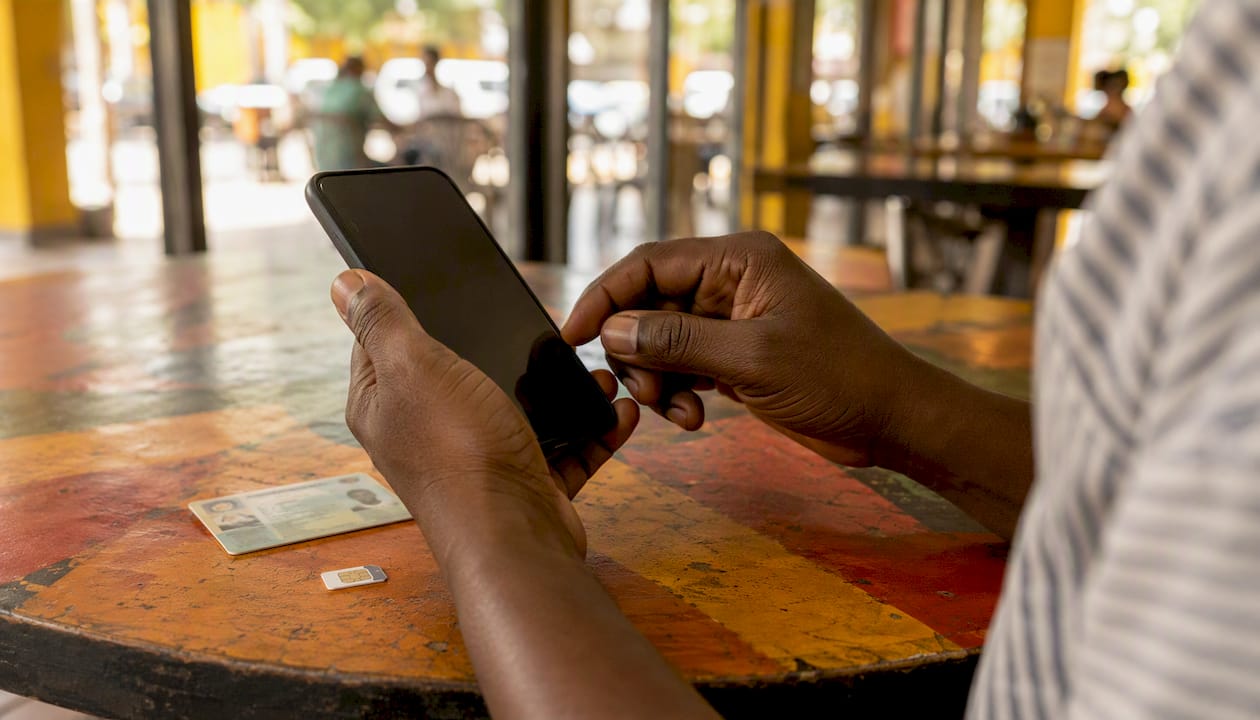
Bank deposit is the right call for larger, more formal transfers, like school fees or a property payment. Delivery typically takes anywhere from a few hours to one full business day, and you'll need the recipient's exact account number plus their bank's SWIFT/BIC code. Banks also leave a cleaner paper trail, which matters if the transfer needs to be documented for tax or legal reasons down the line.
Cash pickup still fills a real gap for recipients who don't have a MoMo wallet or bank account, particularly older relatives or people in areas without reliable digital banking. Pickup requires a valid government-issued ID matching the name on the transfer, and it's typically available within minutes to a few hours at agent locations run by networks like Western Union and MoneyGram.
Mobile-first apps and specialist online providers generally lean hardest into MoMo support. Cash-pickup networks bring the widest physical agent footprint for pickup. Traditional banks stick almost exclusively to bank deposit, which is part of why they're rarely the fastest option here.
What Do Fees and Exchange Rates Actually Cost You?
Two separate costs eat into every transfer: the fee the provider shows you upfront, and the exchange-rate margin baked into the conversion rate, which is often invisible unless you know to look for it. A provider advertising "$0 fees" can still make money by giving you a worse cedi rate than the real mid-market rate, so the fee alone tells you almost nothing about total cost.
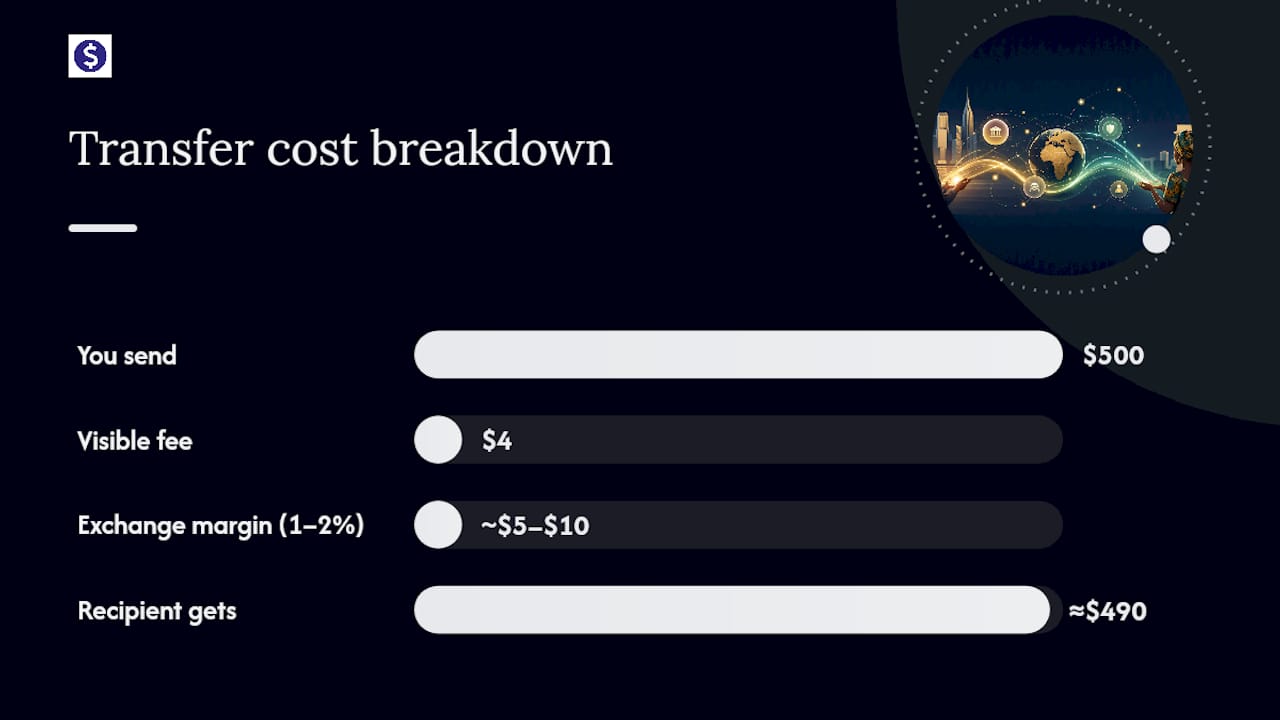
Here's what a realistic $500 transfer might look like once both costs are accounted for:
| Item | Amount |
|---|---|
| You send | $500 |
| Visible transfer fee | $4 |
| Amount converted | $496 |
| Exchange rate applied (illustrative) | Slightly below mid-market |
| Exchange-rate margin cost (illustrative) | Roughly 1 to 2% of the converted amount |
| Recipient gets (approximate) | Cedi equivalent of nearly $490 in value |
The exact numbers shift daily since the cedi is volatile, but the pattern holds: the fee is the cost you see, the margin is the cost you usually don't, and together they determine what actually reaches your recipient.
Pro Tip: Funding method changes your total cost more than most senders realize. ACH bank transfers are usually the cheapest way to fund a transfer but can take a day or two to clear. Debit or credit cards fund almost instantly but often carry an added processing fee. If you're not in a rush, fund by bank account and save the card fee for emergencies.
Before sending anything, run the numbers through a live comparator. Rates move throughout the day on the USD to cedi corridor, and comparison tools that track real-time pricing consistently find meaningful gaps between providers on the exact same transfer amount. Idealremit's calculator shows the "you send / recipient gets" breakdown across providers before you commit to one, which turns a guessing game into a five-minute check.
What Verification and Security Checks Should You Expect?
Sending internationally means clearing identity checks on both ends, and that's a feature, not a hassle, since it's what keeps the corridor safe from fraud.
On the U.S. side, expect to provide a government-issued photo ID, your Social Security number or last four digits in some cases, and details of your funding source (bank account or card). Larger or repeated transfers can trigger a request for source-of-funds documentation, particularly once you cross a provider's threshold for enhanced due diligence. This isn't unique to any one company; transfers can fall under U.S. anti-money-laundering reporting requirements tied to the Bank Secrecy Act, and Ghana's own payout rules require transfers to move through authorized dealers.
On the Ghana side, your recipient's verification depends on the delivery method: a Ghana Card linked to their MoMo wallet, matching account details for bank deposit, or a valid ID for cash pickup. Skipping this step or getting a name slightly wrong is the single most common reason transfers stall.
Watch for these red flags, whether you're a first-time sender or a regular one:
- Anyone asking you to share a one-time passcode (OTP) you didn't request.
- Unsolicited messages claiming you're owed a refund and need to "verify" your account.
- A recipient name on the transfer that doesn't exactly match their government ID.
- Instructions to collect cash somewhere with no tracking number or reference code attached.
Pro Tip: If a "provider" contacts you first, out of nowhere, about a transfer you didn't initiate, treat it as fraud until proven otherwise. Legitimate providers don't cold-call you about pending money. For more on spotting scams across international transfers generally, Idealremit's guide to sending money to Africa safely covers patterns that repeat across corridors.
How Do You Pick the Right Provider for Your Situation?
Start by ranking your own priorities, because "best provider" only means something once you know what you're optimizing for.
- Delivery method your recipient can actually use (does their phone support MoMo, do they have a bank account nearby, would they need to travel for cash pickup?).
- How fast you need funds there (an emergency changes your provider choice completely compared to a routine monthly transfer).
- How cost-sensitive this particular transfer is (a one-time large payment can absorb a slightly worse rate more easily than a transfer you make every month).
- What funding methods you have available (not every provider takes ACH, and not every provider takes credit cards without a surcharge).
- How much you're sending relative to that provider's limits (a $3,000 transfer might need a provider built for higher-limit sends).
- How responsive their customer support actually is when something goes wrong, not just how good their marketing looks.
If speed matters most, pick a mobile-first app with MoMo delivery and accept a lower transfer cap. If cost matters most, compare margins across two or three providers before every single transfer rather than defaulting to the same one out of habit. If convenience matters most, i.e., you want one provider you never have to think about again, a specialist online provider with broad U.S. payment method support usually threads that needle best.
Before you commit to any provider, ask these questions directly:
- Does this provider deliver to MTN MoMo, and is that delivery instant or does it take hours?
- What exchange rate will you lock in at the moment I pay, versus what rate applies if there's a delay?
- Which U.S. funding methods are actually available to me, and does using a card add a fee?
- What's the maximum I can send in a single transaction, and does that change with more verification?
What Does the Data Say About the USD to Ghana Corridor?
The Ghanaian cedi has faced real depreciation pressure over recent years, and that single fact reshapes how a lot of senders behave. When a currency is losing value against the dollar, recipients want funds converted and accessible fast, before further depreciation eats into what that money is worth locally. That's a big part of why MoMo delivery has become the default preference for so many families receiving support from the U.S., not just a convenience factor.
Price dispersion on this corridor is real and worth taking seriously. Corridor tracking from SendMoneyCompare shows the gap between the cheapest and most expensive provider on a given USD to cedi transfer can be substantial on the exact same sending amount, which means loyalty to one brand can quietly cost you money month after month.
Here's how that plays out in practice:
- A sender making a $500 monthly transfer who switches from a higher-margin provider to a cheaper one could keep a meaningfully larger share of that money reaching cedis, purely by comparing rates before sending rather than after.
- A sender choosing MoMo delivery over bank deposit for a time-sensitive transfer avoids the extra day of currency exposure that a slower bank deposit carries during a period of rapid cedi movement.
- A sender setting up mobile money delivery for recurring support builds a habit that compounds savings over a year of transfers, not just a single one.
The practical takeaway: for recurring transfers, set a rate alert and check it before each send rather than assuming last month's provider is still the cheapest this month. Rates move, and providers reprice their margins constantly.
A Practical Closing Note
I've looked at a lot of remittance corridors, and Ghana's is one where the gap between "fine" and "smart" is almost entirely about habit, not knowledge. Everyone reading this now understands MoMo delivers faster than a bank deposit and that fees don't tell the whole story. The part people skip is actually checking rates every single time instead of defaulting to whichever app they downloaded first.
That's the real lesson here. Speed and security should come first for any transfer involving family support, medical costs, or anything time-sensitive, full stop. But once those needs are met, cost comparison isn't optional homework, it's the difference between your money going as far as it should and quietly losing value to a margin you never looked at. Compare before you send. Every time, not just the first time.
Compare Rates Before You Send Money to Ghana
Idealremit is the alternative to guessing which provider is cheapest this week: instead of opening five apps to check five different rates, you see the "you send / recipient gets" breakdown for multiple providers side by side, on the exact route you need, before committing a dollar.
That matters most on a corridor like USD to Ghanaian cedi, where margins shift and the cheapest provider last month isn't guaranteed to be the cheapest one today. Idealremit's comparison tool covers transfers to Ghana and more than 100 other countries, tracks live exchange rates, and lets you set rate alerts so you're not stuck guessing when the cedi moves. Whether you're sending $50 for a phone bill or $5,000 for school fees, you get to see the real numbers, fees and rate margin included, instead of trusting a provider's homepage to tell you the truth about cost.
Check current rates for sending to Ghana and compare providers for your next transfer before you send a single dollar.
Where to Verify Rates and Requirements
Check these sources directly for the exact rate and delivery timing on the day you send, since both change constantly:
- Wise's Ghana transfer page for upfront pricing and current speed estimates on bank deposits.
- Western Union's Ghana corridor page for agent locations and total cost shown before confirming.
- Remitly's Ghana help page for delivery method options and express card-funding details.
- SendMoneyCompare's USA to Ghana corridor analysis for independent pricing comparisons across providers.
- Idealremit's blog for broader safety guidance and corridor-specific tips beyond Ghana.
This article is general information, not a substitute for advice from a qualified financial advisor. Consult a qualified financial professional about your own circumstances before acting on anything here.
Sources
- Send money to Ghana | Wise
- Send Money to Ghana - Western Union
- Send Money to Ghana - Remitly
- Cheapest Way to Send Money USA to Ghana - SendMoneyCompare
FAQ
What is the easiest way to send money from the USA to Ghana?
The easiest method for most senders is a mobile-first app or specialist online provider offering MoMo or bank deposit, since signup and setup usually take a short time and delivery can happen within minutes to hours.
Can Zelle send money to Ghana?
No, Zelle is built for domestic U.S. bank-to-bank transfers only and does not support international transfers to Ghana; you'll need a dedicated remittance provider like the ones covered above.
How much is $100 US in Ghana?
The cedi value of $100 changes daily with exchange-rate movement and varies by provider margin, so check a live comparator like Idealremit right before sending rather than relying on a fixed figure.
What is the best app to send money to Ghana?
There's no single best app for everyone: mobile-first apps tend to win on MoMo speed and cost, while specialist online providers offer broader payment method support, so the right choice depends on your recipient's delivery method and how much you're sending.
How long does a money transfer to Ghana take?
MoMo deliveries often complete within minutes, bank deposits typically take a few hours to one business day, and cash pickup is usually available within minutes to a few hours once the transfer is confirmed.