
TL;DR:
- Using specialist online transfer services can reduce international remittance costs by up to 90 percent compared to traditional banks. They pass the mid-market exchange rate with minimal markup and have transparent fees, enabling family savings. Consistent habits like funding via bank transfer and timing transfers during market hours further lower total costs.
An international remittance savings guide is a practical framework for reducing what you pay every time you send money across borders. The average global cost of sending remittances sits at 6.36% of the amount sent, meaning a $1,000 transfer costs $63 before your family sees a cent. That figure is not fixed. Specialist online transfer services, smart timing, and a clear understanding of fee structures can cut that cost by 70-90%. This guide covers every major cost component, explains where banks overcharge, and gives you a step-by-step plan to keep more money in your family's hands.
What fees and costs should you look out for in international remittances?
Every international money transfer carries at least two layers of cost, and most people only notice one. The first layer is the upfront transfer fee. This is either a flat charge (say, $5 per transfer) or a percentage of the amount sent. The second layer, and the more expensive one, is the exchange rate markup.
The exchange rate markup is the hidden cost
Banks add a 2-5% markup on top of the mid-market rate before quoting you an exchange rate. That mid-market rate is the real rate you see on Google or Reuters. The gap between that rate and what the bank gives you is pure profit for the bank. On a $1,000 transfer, a 3% markup costs $30 before any flat fee is added.
Intermediary and receiving bank fees
When a transfer passes through one or more correspondent banks on its way to the destination, each one can deduct a fee. These intermediary charges are unpredictable and rarely disclosed upfront. The recipient can also face a receiving bank fee on their end. Both charges reduce the final amount your family receives.
How you fund the transfer matters
Funding with a credit card adds 2-3% in surcharges compared to funding with a bank transfer. That surcharge is on top of every other fee. Bank-to-bank transfers (ACH or direct debit) are the most cost-effective funding method by a wide margin.
| Fee type | Typical range | Who charges it |
|---|---|---|
| Flat transfer fee | $0-$15 | Transfer provider |
| Exchange rate markup | 0%-5% | Bank or provider |
| Credit card surcharge | 2%-3% | Card network/provider |
| Intermediary bank fee | $5-$30 | Correspondent banks |
| Receiving bank fee | $0-$20 | Recipient's bank |
Pro Tip: Always calculate the "all-in" cost by comparing how much the recipient actually receives, not just the advertised fee. Two providers with the same flat fee can differ by $40 on a $1,000 transfer because of exchange rate markups.
How do specialist online transfer services save you money compared to banks?
Specialist online transfer services charge a fraction of what banks charge. Total costs for banks can exceed $75-$135 for a $1,000 transfer, while top specialist providers charge under $10 for the same amount. That gap exists because specialists use the mid-market exchange rate with little to no markup, while banks treat the exchange rate as a profit center.
The cost difference is not marginal. Online specialist services can reduce transfer costs by 70-90% compared to traditional banks. For a family sending $500 every month, that translates to more than $1,000 saved annually.
What makes specialist providers different
- Mid-market exchange rates: Specialist providers pass the real rate to you, or add only a minimal margin.
- Transparent fee structures: Fees are shown upfront before you confirm the transfer, not buried in fine print.
- Faster delivery: Many specialist transfers arrive within 24 hours, compared to 3-5 business days for international bank wires.
- Regulatory oversight: Reputable online providers are licensed by financial regulators in their operating countries, giving you the same legal protections as a bank transfer.
- Lower fixed fees: Flat fees from specialist providers are typically under $5, versus $25-$45 for a standard international wire from a bank.
Pro Tip: Use a comparison platform like Idealremit to view real-time rates and fees side by side across multiple providers. A two-minute comparison can save you more than an hour of bank paperwork.
For a deeper look at how exchange rate differences drive total transfer costs, the role of exchange rates in money transfers explains the mechanics clearly.
What are the best practices to save money on your international remittances?
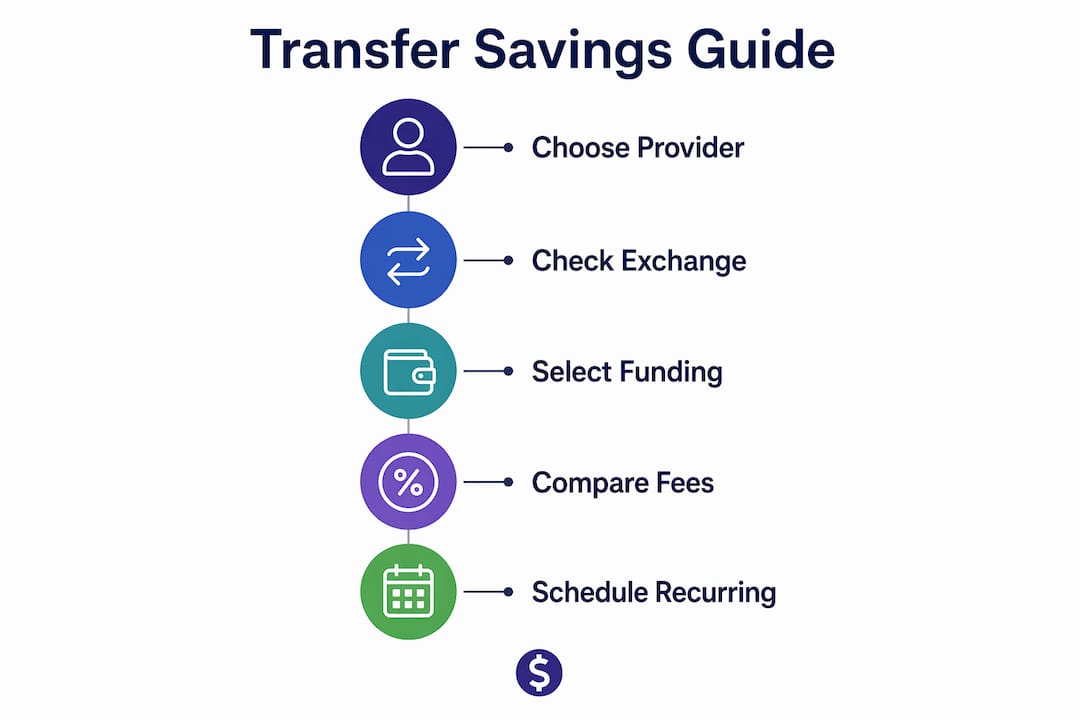
Cutting transfer costs is not about finding one magic provider. It is about applying a consistent set of habits that compound over time. The following steps work regardless of which corridor you send to.
-
Fund with a bank transfer, not a card. Credit and debit card funding adds 2-3% to every transfer. Switch to ACH or direct debit and that surcharge disappears immediately.
-
Consolidate smaller transfers into larger ones. Sending $3,000 quarterly instead of $1,000 monthly drops the fee impact from 0.50% to 0.17%. Fixed fees hurt more on small amounts, so batching transfers reduces their percentage impact significantly.
-
Transfer during weekday market hours. Timing transfers during weekday trading hours saves 1-3% on exchange rate costs. Currency markets are most liquid from Monday through Friday during business hours in major financial centers. Rates on weekends are often less favorable because providers hedge against closed markets.
-
Set rate alerts and wait for favorable rates. Rate alerts notify you when the exchange rate hits a target you set. Setting rate alerts can save an additional 2-5% for non-urgent transfers. That is a meaningful gain for families sending money regularly. Idealremit offers personalized rate alerts so you never miss a favorable window.
-
Skip express delivery unless it is urgent. Express delivery costs 30-50% more but only reduces transfer times by 1-2 days. Standard delivery is the right choice for routine transfers. Reserve the premium speed option for genuine emergencies.
-
Compare the total payout, not just the fee. Evaluating the recipient's received amount rather than the advertised fee is the single most reliable way to identify the cheapest transfer. Two providers can show the same flat fee but deliver very different amounts because of exchange rate differences.
Pro Tip: Check the 2026 money transfer savings guide on Idealremit's blog for updated strategies specific to popular corridors, including Africa, Asia, and the Americas.
How can you ensure the safety of your international money transfers while saving?
Lower cost does not mean lower security. The safest international money transfer is not the most expensive one. It is the one from a regulated provider with transparent fees and strong encryption. Regulated online platforms meet the same legal standards as banks in the countries where they operate.
"Safety is not a function of cost but of trusted, regulated platforms with transparent pricing. Top-tier digital providers use multi-layer encryption and regulatory oversight equal to traditional banks."
The most common security mistake is confusing low cost with low trust. A licensed specialist provider with published fees and strong encryption is more trustworthy than an unregulated cash agent with no paper trail.
Security best practices for every transfer
- Verify the provider holds a valid license from a recognized financial regulator (such as the CFPB in the US, FCA in the UK, or equivalent).
- Check that the website uses HTTPS and that the provider offers two-factor authentication on your account.
- Avoid providers that advertise "zero fees" without explaining their exchange rate. Providers advertising zero fees often offset costs through worse exchange rates, meaning you pay more without realizing it.
- Never send money through an unverified contact or an unsolicited offer, regardless of the promised rate.
- Use a comparison platform to confirm the provider's legitimacy before your first transfer.
For additional guidance on secure international transfers, Prominence Bank's 2026 safety guide covers the key protocols to verify before sending.
What should you consider about transfer speed versus cost?

Transfer speed is a real variable, but most families overestimate how often they need it. Standard delivery from a reputable specialist provider takes 1-3 business days for most corridors. Express delivery cuts that to same-day or next-day, but the price premium is steep.
Express options add fees that are disproportionate to the time saved. A transfer that costs $8 on standard delivery might cost $12-$15 on express. That 50-90% fee increase for one day of difference rarely makes financial sense for routine transfers.
When speed is worth paying for
- A family member faces a medical emergency and needs funds within hours.
- A payment deadline is fixed and missing it carries a financial penalty.
- The recipient has no access to alternative funds and the situation is urgent.
Outside those scenarios, standard delivery is the right call. Payout method also affects both speed and cost. Bank account deposits are typically the cheapest and most reliable option. Mobile wallet payouts are fast and increasingly available across Africa and Asia. Cash pickup is the most expensive payout method and should be reserved for recipients without bank access.
Pro Tip: If you send to the same recipient regularly, set up a recurring transfer schedule with standard delivery. You will avoid express fees automatically and build a predictable savings habit.
Key Takeaways
Families who apply a consistent set of transfer habits, including using specialist providers, funding by bank transfer, and comparing total payouts, can cut remittance costs by 70-90% compared to sending through a traditional bank.
| Point | Details |
|---|---|
| Average cost is 6.36% | The global average remittance cost is 6.36%, but specialist providers can bring this well below 1%. |
| Exchange rate markup is the biggest hidden cost | Banks add 2-5% on top of the mid-market rate, costing more than any flat fee. |
| Fund transfers by bank transfer | Credit card funding adds 2-3% in surcharges; ACH or direct debit eliminates that cost. |
| Consolidate and time your transfers | Batching transfers and sending during weekday hours reduces both fixed fees and rate costs. |
| Compare total payout, not advertised fees | The recipient's received amount is the only number that tells you the true cost of a transfer. |
What I've learned after years of watching families lose money on remittances
The most expensive mistake I see families make is trusting the bank by default. Banks have built a reputation for safety, and that reputation is well-earned. But safety and cost efficiency are separate things entirely. A regulated online specialist provider offers the same legal protections as a bank wire at a fraction of the price.
The second mistake is chasing "zero fee" offers. That phrase is almost always misleading. The cost is hidden inside a worse exchange rate, and most senders never notice because they are not comparing the recipient's final amount. Once you start measuring what your family actually receives, the math becomes obvious.
The third thing I have observed is that timing matters more than most people realize. Sending on a Friday afternoon or over a weekend often means accepting a rate set by the provider to cover their weekend risk. Sending on a Tuesday or Wednesday morning, when currency markets are fully active, consistently produces better rates. Combine that with a rate alert and you have a system that works without requiring constant attention.
The families who save the most are not the ones who obsess over every transfer. They are the ones who set up a repeatable process: bank-funded transfers, a comparison check before each send, and rate alerts for non-urgent amounts. That process takes five minutes to set up and pays off every single month.
- Brahim
How Idealremit helps you find the cheapest transfer every time
Idealremit is a comparison platform built specifically for families and individuals who send money internationally. It aggregates real-time rates and fees from a wide network of trusted transfer providers, so you can see the total cost of each option before you commit.

You can filter by destination country, transfer amount, and payout method to find the option that fits your exact situation. Idealremit also offers personalized rate alerts, so you get notified the moment a favorable rate appears for your corridor. The platform covers transfers to over 100 countries, with strong coverage across Africa, Asia, Europe, and the Americas. Compare transfer rates now and see how much your family could save on the next transfer.
FAQ
What is the average cost of an international remittance?
The global average cost of sending a remittance is 6.36% of the transfer amount. Specialist online providers can reduce that cost to well under 1% for many corridors.
Why do banks charge more than specialist transfer services?
Banks add a 2-5% markup on the exchange rate on top of flat wire fees, which can push total costs to $75-$135 per $1,000 sent. Specialist providers use the mid-market rate with minimal markup and lower flat fees.
Is it safe to use an online money transfer service?
Yes, provided the service is licensed by a recognized financial regulator. Regulated online providers use multi-layer encryption and meet the same legal standards as traditional banks.
How do I find the cheapest way to send money internationally?
Compare the total payout (the amount the recipient receives) across multiple providers, not just the advertised fee. A comparison platform like Idealremit shows real-time rates and fees side by side for your specific corridor and amount.
Does the funding method affect how much I pay?
Funding a transfer with a credit card adds 2-3% in surcharges. Using a bank transfer (ACH or direct debit) eliminates that surcharge and is the most cost-effective funding method available.