Transparent Pricing in Remittance: What You Need to Know

TL;DR:
- Transparent remittance pricing discloses all costs upfront, including fees, FX markup, and taxes, enabling fair comparisons. The foreign exchange margin often constitutes the largest hidden expense, making total cost comparison essential. Regulatory efforts push providers toward full transparency, improving affordability and fairness for senders and recipients.
Transparent pricing in remittance is defined as the full, upfront disclosure of every cost involved in sending money abroad, including the transfer fee, foreign exchange markup, and any applicable taxes, before you confirm the transaction. The industry term for this is "all-in cost disclosure," and it is the standard that regulators like the UK's Financial Conduct Authority now require under Consumer Duty rules. Without it, you cannot know what your recipient will actually receive. Specialist providers average $24.33 per $1,000 sent, compared to $34.91 at banks. That $10.58 gap exists largely because hidden fees go unnoticed when pricing is unclear.
What is transparent pricing in remittance, and why does it matter?
Transparent remittance pricing means one number tells the whole story. You see the total cost before you click "confirm," not after. That total must include the transfer fee, the FX markup, taxes, and any other charges the provider applies.
The FX markup is the part most senders miss. Average remittance costs run at 6.36%, and FX margins often represent 50% or more of that total cost. On a small $200 transfer, the FX margin alone can account for one-third of what you pay. That means the advertised transfer fee is rarely the biggest line item.

Regulators have taken notice. The FCA's Consumer Duty initiative requires providers to disclose all fees, including FX markups, before a customer accepts a payment. This is not optional guidance. It is a legal obligation for regulated firms in the UK, and similar frameworks are spreading globally.
For individuals and small businesses, the practical benefit is simple. You can compare providers on equal terms when every cost is visible. Without that visibility, you are comparing apples to oranges, and the cheaper-looking option often costs more in total.
What components make up the total cost in remittance?
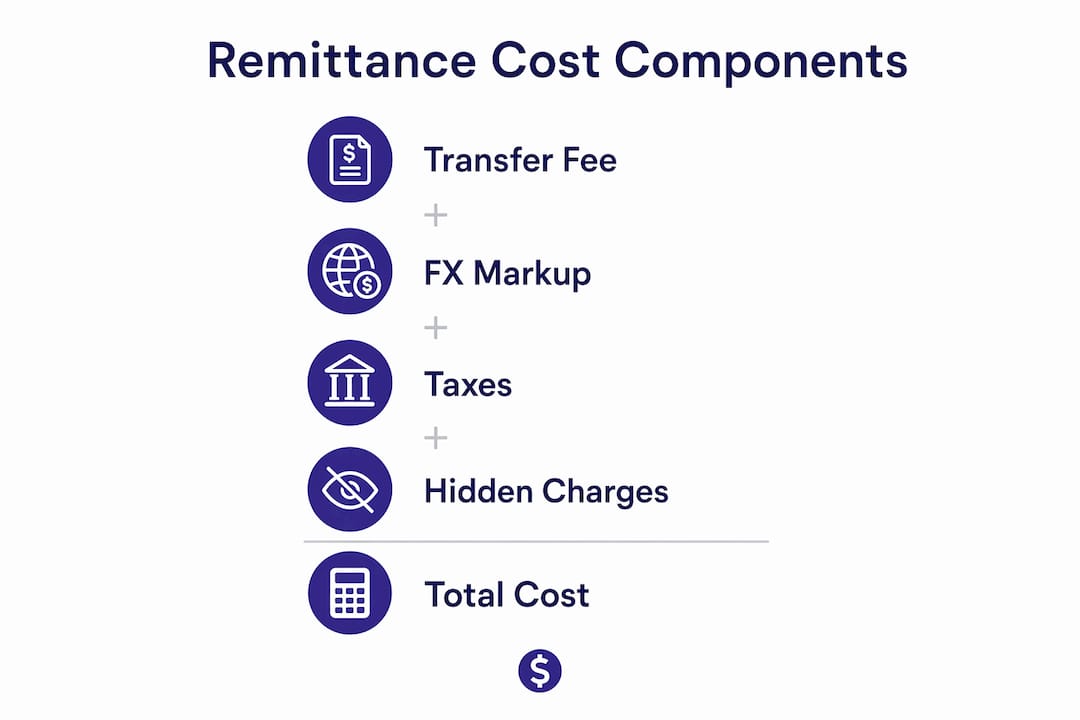
Understanding remittance pricing means knowing every layer of cost that sits between what you send and what your recipient receives.
The main components are:
- Transfer fee: The flat or percentage charge the provider advertises. This is the most visible cost, but often not the largest.
- Foreign exchange markup: The spread between the mid-market rate and the rate the provider offers you. Displayed fees frequently mislead consumers because the real cost hides in this spread.
- Taxes: VAT or local taxes applied in some corridors, which vary by destination country.
- Intermediary bank fees: Correspondent banking charges that can reduce the recipient's amount without appearing in the provider's quoted fee.
- Beneficiary deductions: Some providers allow the receiving bank to deduct a fee from the recipient's end. Transparent schemes explicitly prohibit beneficiary deductions to guarantee the recipient gets the full agreed amount.
- Funding method surcharges: Using a credit card to fund a transfer triggers cash advance fees and potentially high interest rates, adding costs that have nothing to do with the provider's pricing.
Providers can manipulate the ratio between the transfer fee and the FX spread while keeping the total cost identical. One provider charges $5 and a tight FX margin. Another charges $0 and a wide FX margin. The total cost to you is the same, but the "$0 fee" looks cheaper at a glance. This is why comparing only the advertised fee is a trap.
Pro Tip: Always ask for the recipient amount in local currency before confirming. If a provider will not show you that number upfront, treat it as a red flag.
How can you identify a truly transparent remittance provider?
Recognizing genuine remittance fee transparency takes more than reading the headline fee. Follow these steps to evaluate any provider before you send:
- Check for a single total cost figure. A transparent provider shows one number that covers everything: fees, FX markup, and taxes. If you have to add up separate line items yourself, the pricing is not fully transparent.
- Confirm the recipient amount before payment. The provider should display exactly how much your recipient will receive in their local currency, locked in at the moment you confirm. Rate lock-in at confirmation removes uncertainty for both sender and recipient.
- Identify the FX benchmark rate. Transparent providers disclose the benchmark rate they use to calculate the FX cost, such as a central bank rate or Reuters mid-market rate. If no benchmark is mentioned, the markup is invisible.
- Ignore "$0 fee" marketing. A zero transfer fee almost always means a wider FX spread. The economic reality lies in the total cost, not the advertised fee. Compare the all-in cost, not the fee in isolation.
- Check the beneficiary deduction policy. Ask whether the provider guarantees the recipient receives the full quoted amount. Providers committed to transparency prohibit any deduction at the receiving end.
- Review the funding method options. Paying by bank transfer or debit card typically avoids the extra charges that credit card funding triggers. Factor this into your total cost calculation.
The Level One Project's standardized disclosure framework and the FCA's Consumer Duty guidelines both push providers toward showing the all-in cost upfront. When you find a provider that meets these standards, you have found a genuinely transparent pricing model. Idealremit's comparison of transparent providers can help you cross-reference options quickly.
Pro Tip: Compare the recipient amount, not the fee. Two providers charging the same fee can deliver very different amounts to your recipient if their FX margins differ.
What are the benefits and challenges of transparent remittance pricing?
Transparent pricing delivers real, measurable advantages. The most striking evidence comes from the UK: after total cost pricing was introduced, the share of first-time remittance users choosing the best-cost option rose from 34% to 68%. That is a doubling of informed decision-making driven purely by clearer information.
"Transparency does not guarantee the lowest price. It guarantees you know the real price. That distinction matters because a provider with a slightly higher all-in cost may still be the right choice for speed, reliability, or destination coverage. But you cannot make that trade-off if you cannot see the full cost."
The benefits extend beyond individual savings. Transparent pricing drives competition. When providers cannot hide costs in opaque FX spreads, they compete on actual value. That pressure pushes prices down across the industry over time.
The challenges are real, though. Legacy correspondent banking fees and slow settlement infrastructure remain bottlenecks. Even a provider with perfect fee disclosure cannot eliminate costs baked into the underlying payment rails. Market volatility also complicates things. Exchange rates move, and providers that do not lock in rates at confirmation leave recipients exposed to last-minute changes.
The industry is moving in the right direction. Standardized disclosures are replacing "zero fee" marketing in more corridors. Regulatory scrutiny is increasing. But full transparency across every provider and every corridor is still a work in progress. Understanding this gap helps you evaluate providers with realistic expectations.
How does transparent pricing affect individuals and small businesses?
The financial stakes differ between individual senders and small businesses, but the core need is the same: knowing the true cost before committing.
For individuals sending money to family abroad, hidden costs directly reduce what a recipient receives. A $500 transfer with a 3% hidden FX markup delivers $15 less than expected. That may seem small, but across 12 monthly transfers it adds up to $180 a year in invisible losses. Transparent pricing eliminates that uncertainty.
Small businesses face a different set of pressures:
- Cash flow predictability: A business paying overseas suppliers needs to know the exact cost of each transfer to manage its books accurately. Hidden FX markups make budgeting unreliable.
- Volume sensitivity: Multiple transfers per month amplify the impact of even small cost differences. A 0.5% FX margin difference on $10,000 in monthly transfers costs $600 a year.
- Funding method discipline: Businesses sometimes use corporate credit cards for convenience. Credit card funding triggers cash advance fees that can significantly increase the total cost of each transfer.
- Rate timing: Locking in exchange rates at confirmation protects against adverse market moves between the time you initiate and the time the transfer settles.
Pro Tip: If your business sends money regularly, look for providers that offer rate alerts or forward contracts. These tools let you lock in favorable rates in advance, removing FX risk from your cash flow planning.
Choosing a provider based on all-in cost rather than advertised fees is the single most effective habit for both individuals and small businesses. Idealremit's guide to international transfer best practices covers this in detail, including how to time transfers and choose funding methods wisely. For a broader view of how FX margins affect your bottom line, the role of exchange rates in remittance costs is worth understanding before your next transfer.
Key Takeaways
Transparent remittance pricing means knowing the exact all-in cost before you confirm, including fees, FX markup, and taxes, so you can compare providers on equal terms.
| Point | Details |
|---|---|
| All-in cost is what matters | Compare the total cost including FX markup, not just the advertised transfer fee. |
| FX markup is often the largest cost | FX margins can represent 50% or more of the total cost of a remittance transfer. |
| Rate lock-in protects recipients | Providers that lock in the recipient amount at confirmation remove last-minute FX risk. |
| Transparent schemes ban beneficiary deductions | Reputable providers guarantee the recipient receives the full quoted amount with no end-deductions. |
| Credit card funding adds hidden costs | Use bank transfer or debit card to avoid cash advance fees that inflate your total cost. |
Why I think most senders are still paying more than they should
I have spent years watching people send money abroad and assume the fee they saw was the fee they paid. The gap between that assumption and reality is where billions of dollars disappear every year.
The shift toward transparent pricing is genuinely exciting, but the industry still has a long way to go. Too many providers still lead with a "$0 fee" headline and bury the real cost in the exchange rate. Regulators are catching up, but enforcement is uneven across markets.
What I find most encouraging is the data on consumer behavior. When people can see the full cost, they make better choices. That is not a complicated insight, but it has profound implications for financial inclusion. Migrants and small business owners sending money to lower-income countries are often the most price-sensitive senders and the least equipped to decode opaque pricing. Clear pricing is not just a convenience. It is a fairness issue.
My advice: treat any provider that will not show you the recipient amount before confirmation as one that has something to hide. The technology to display that number exists. Choosing not to show it is a business decision, not a technical limitation. Demand better, and use tools like Idealremit to find providers that already meet that standard.
- Brahim
Find transparent remittance pricing with Idealremit
Knowing what transparent pricing looks like is only half the work. Finding a provider that actually delivers it is the other half.

Idealremit aggregates real-time rates and fees from a wide network of trusted transfer services, so you can compare the all-in cost across providers in seconds. Every comparison shows the recipient amount, the exchange rate applied, and the total fee, giving you the complete picture before you commit. Whether you are an individual sending money home or a small business managing regular overseas payments, Idealremit helps you find the best transfer rates without having to decode each provider's pricing structure yourself. Transparent pricing starts with having the right information. Idealremit puts it all in one place.
FAQ
What is transparent pricing in remittance?
Transparent pricing in remittance is the upfront disclosure of the total cost of a money transfer, including the transfer fee, foreign exchange markup, and taxes, before the sender confirms the transaction. It means the recipient amount is shown clearly so there are no surprises after payment.
What is the difference between a transfer fee and an FX markup?
A transfer fee is the flat or percentage charge a provider advertises, while an FX markup is the spread between the mid-market exchange rate and the rate the provider offers you. FX markups often represent 50% or more of the total cost of a remittance, making them the larger and less visible charge.
How do I find a transparent fee remittance provider?
Look for providers that display a single all-in cost figure, lock in the recipient amount at confirmation, disclose the benchmark exchange rate they use, and explicitly prohibit beneficiary deductions. Comparison platforms like Idealremit show these figures side by side so you can evaluate providers on equal terms.
Does transparent pricing mean the cheapest price?
Transparent pricing means you know the real price, not necessarily the lowest one. A provider with a slightly higher all-in cost may still be the right choice based on speed, reliability, or destination coverage. Transparency gives you the information to make that trade-off consciously.
Why do some providers advertise a $0 transfer fee?
A $0 transfer fee almost always means the provider earns its revenue through a wider foreign exchange spread instead. The total cost to the sender remains similar or higher than providers that charge an explicit fee with a tighter FX margin. Always compare the all-in cost, not the advertised fee alone.