Cheapest Way to Send Money to India from the UK (2026 Data)

In short: the UK–India corridor is extraordinarily competitive. Four providers — Profee, TapTapSend, PandaRemit and LemFi — deliver rupees at or marginally above the mid-market rate. On a £1,000 transfer their total cost is effectively nil.
At the other end, OFX costs 2.92% and Xoom 1.25%. For someone sending £500 a month, that difference is worth £180 a year.
And three providers cut a much better deal on your first transfer than on every one after it.
In a hurry? Compare live GBP to INR rates — updated every two hours.
India is the largest recipient of money sent from the UK. £3.30 billion flowed from Britain to India in 2024, more than a third of all UK remittances, and around 1.5 million people of Indian origin live in the UK.
The World Bank puts the UK's average remittance cost at 4.61% in Q3 2025 — second best in the G20, behind Germany, and well under the 6.36% global average. That figure covers all corridors and all channels, banks included. On the specific UK–India route, using digital providers, the real numbers are dramatically lower.
We tracked every two hours, between 22 April and 27 September 2026, the rates and fees published by fifteen providers on the GBP/INR corridor. That is 26,354 observations across 147 days, each compared against the mid-market rate on the same day.
The full ranking
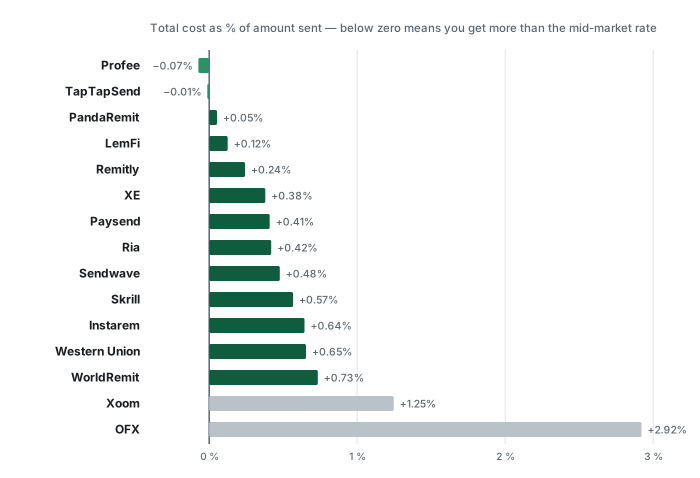
Total cost as a percentage of the amount sent, including both fees and exchange-rate margin. Negative values mean the provider delivered more rupees than the mid-market rate would. Averages over 147 days.
Total cost of sending £1,000 to India, average over the period
| Rank | Provider | Total cost | On £1,000 | Fee |
|---|---|---|---|---|
| 1 | Profee | −0.07% | −£0.73 | £0 |
| 2 | TapTapSend | −0.01% | −£0.13 | £0 |
| 3 | PandaRemit | 0.05% | £0.53 | £0 |
| 4 | LemFi | 0.13% | £1.25 | £0 |
| 5 | Remitly | 0.24% | £2.42 | £0 |
| 6 | XE | 0.38% | £3.79 | £0 |
| 7 | Paysend | 0.41% | £4.09 | £3.20 |
| 8 | Ria | 0.42% | £4.19 | £2.45 |
| 9 | Sendwave | 0.48% | £4.77 | £0 |
| 10 | Skrill | 0.57% | £5.67 | £0 |
| 11 | Instarem | 0.64% | £6.44 | £0 |
| 12 | Western Union | 0.65% | £6.54 | £0 |
| 13 | WorldRemit | 0.73% | £7.34 | £0 |
| 14 | Xoom | 1.25% | £12.47 | £0 |
| 15 | OFX | 2.92% | £29.21 | £0 |
The negative figures are not errors. Profee and TapTapSend consistently delivered slightly more rupees than the mid-market reference rate. On a corridor this competitive, some providers price at or below cost to win volume.
Note also that fees are almost irrelevant here. Thirteen of the fifteen providers charge nothing, and the two that do — Paysend at £3.20 and Ria at £2.45 — still rank mid-table, because their exchange rate is good. The margin built into the rate matters far more than the fee.
Your first transfer is not the price you will pay
Three providers quote a materially better rate on a first transfer, then revert.
First transfer compared with every transfer after it
| Provider | First transfer | Thereafter | Difference |
|---|---|---|---|
| Western Union | −1.13% | 0.65% | 1.78 pts |
| Ria | −1.23% | 0.42% | 1.65 pts |
| Remitly | −0.97% | 0.24% | 1.21 pts |
| PandaRemit | −0.29% | 0.05% | 0.34 pts |
| Instarem | 0.39% | 0.64% | 0.25 pts |
| Profee, TapTapSend, LemFi, XE, Paysend, Sendwave, WorldRemit, Xoom, OFX | Same rate every time | none | |
Western Union is the cheapest provider in the sample on a first transfer — it pays you above the mid-market rate to try it — and twelfth of fifteen on every transfer after. Ria and Remitly follow the same pattern.
For someone sending £500 a month, that step-up is worth £107 a year with Western Union, £99 with Ria and £73 with Remitly, compared with what the first transfer suggested.
This matters more here than on most corridors, because remittances to India are typically recurring. The welcome rate applies once in twelve transfers a year.
Paying by card costs more with four providers
Cost by payment method
| Provider | Bank transfer | Debit card | Extra |
|---|---|---|---|
| Western Union | 0.65% | 1.14% | +0.49 pts |
| XE | 0.38% | 0.69% | +0.32 pts |
| Xoom | 1.25% | 1.46% | +0.21 pts |
| Ria | 0.42% | 0.57% | +0.15 pts |
The other eleven providers charge the same regardless of how you pay. Where a gap exists, bank transfer is always the cheaper option.
The cheapest provider changes constantly
Profee offered the best deal on 72 of 147 days. TapTapSend led on 54, PandaRemit on 10, LemFi on 8, XE on 2 and Sendwave on 1.
So on 49% of days, the market leader was somebody else. The average daily gap between best and worst was 3.07 percentage points, or £30.72 per £1,000 sent. On 29 August, the widest day, it reached 3.87 points.
Loyalty to one provider has a cost, even a provider that is generally competitive. Check today's rates before you send →
What to do
Ignore the fee, look at the rupees. Thirteen of fifteen providers charge no fee. The entire difference sits in the exchange rate. The only number that matters is how many rupees land in the recipient's account.
Do not judge a provider on your first transfer. If you opened with Western Union, Ria or Remitly, the rate you saw is not the rate you will keep getting.
Pay by bank transfer where the option exists, unless speed is the priority.
Check before each transfer, not once a year. The leader changed on roughly half of the days we tracked.
Sending elsewhere from the UK? We track the same data on transfers to Pakistan, Bangladesh and the Philippines.
Method and limitations
Rates and fees were collected automatically every two hours between 22 April and 27 September 2026 from fifteen providers on the GBP/INR corridor: Instarem, LemFi, OFX, PandaRemit, Paysend, Profee, Remitly, Ria, Sendwave, Skrill, TapTapSend, Western Union, WorldRemit, XE and Xoom. Total: 26,354 observations across 147 days.
Total cost is the gap between the rupees actually received — after fees and at the rate actually applied — and the rupees that the mid-market rate would deliver on the same day. Calculations use a £1,000 reference transfer. Over the period the mid-market GBP/INR rate moved between 124.52 and 130.61, averaging 128.07.
Two rates are recorded per provider: the promotional rate offered on a first transfer, and the standard rate applied afterwards.
Limitations. The window starts on 22 April because that is when all fifteen providers were being tracked; aligning the period means every provider is measured on the same days. Wise is not included — our collection for it covers 98 days and is too sparse to rank fairly alongside providers with 147. MoneyGram is excluded for the same reason. AtlanticMoney was excluded after its recorded rate was found frozen at a single value, indicating a collection fault, and 116 Paysend observations were discarded as outliers deviating more than 5% from the market rate. Skrill publishes no separate first-transfer rate.
The mid-market reference is a published market rate rather than an interbank fix. Because several providers price at or slightly above it, small negative values should be read as "effectively at market", not as a guaranteed profit.
Frequently asked questions
What is the cheapest way to send money to India from the UK?
Across 147 days, Profee had the lowest average cost at −0.07%, followed by TapTapSend, PandaRemit and LemFi — all effectively at the mid-market rate. The leader changed on 49% of days, so check before each transfer.
How much does it cost to send £1,000 to India?
Between roughly nothing with the cheapest providers and £29.21 with OFX. The average daily gap between best and worst was £30.72 per £1,000.
Why was my first transfer cheaper?
Western Union, Ria and Remitly apply a promotional rate to first transfers only. With Western Union the gap is 1.78 percentage points — worth £107 a year on £500 sent monthly.
Bank transfer or debit card?
Bank transfer, where it makes a difference. Western Union charges 0.65% by transfer against 1.14% by card. Eleven of fifteen providers charge the same either way.
Are fees or exchange rates more important?
Exchange rates, decisively. Thirteen of the fifteen providers charge no fee at all, yet their total costs range from −0.07% to 2.92%. The entire difference is the margin built into the rate.
IdealRemit study — UK to India corridor. Raw data available on request.