See Delivered KES Before You Send to Kenya From the U.S.
For most U.S. senders, the fastest route sends cash straight to a recipient’s M-PESA wallet, while ACH bank transfers cost less but take a day or two longer. Either way, check the delivered KES amount (after fees and exchange-rate margin) before you confirm, not just the advertised fee, and keep your receipt for tracking.
TL;DR:
- Mobile wallet transfers via M-PESA provide instant cash delivery, but the total amount received depends on the provider’s fee and exchange-rate margin.
- ACH bank transfers are the cheapest option but can take one to three business days to complete, making them unsuitable for urgent needs.
- To maximize value, compare the actual net amount received after fees and exchange margins across providers, not just the advertised fee.
- Funding with a debit or credit card speeds up delivery but often incurs higher costs due to worse exchange rates, while bank transfers are slower but cheaper overall.
- Checking live rates and setting rate alerts before sending can save more money in the long run than choosing a provider based solely on fee.
Table of Contents
- How to Send Money to Kenya From the USA: Comparing Your Options
- How Do I Send Money to Kenya From the USA Step by Step?
- How Do Recipients in Kenya Actually Receive the Money?
- How Do I Compare Money Transfer Services for the USA to Kenya Corridor?
- How Fees and Exchange Rates Change What Your Recipient Gets
- What I’ve Learned Comparing This Corridor
- Compare Live Quotes Before You Send
- Sources
- FAQ
How to Send Money to Kenya From the USA: Comparing Your Options
Four ways to move money exist, and each fits a different situation. Here’s how they stack up.
- Mobile wallet (M-PESA payout): Funds usually land in a very short time. Cost depends on the provider’s fee plus the exchange-rate margin, not a flat rate. Best when the recipient needs cash today for rent, school fees, or an emergency.
- Bank transfer (ACH funding): Cheapest funding option for the sender, but delivery can take one to three business days depending on the provider and route, according to corridor pages tracked by Xe. Best for planned transfers where speed isn’t critical.
- Cash pickup: The recipient collects physical cash at a partner location. Useful when someone doesn’t have a bank account or mobile wallet, though it usually costs more than a digital payout.
- In-person agent (sender side): You pay with cash at a physical U.S. location instead of online. Convenient if you don’t want to link a card or bank account, but it’s the slowest way to initiate a transfer and often the priciest.
M-PESA remains the backbone of the receiving side in Kenya. Its reach across rural and urban areas alike is why most providers push mobile-wallet payouts as the default, and why routing directly through M-PESA rather than a third-party wallet tends to avoid extra handling fees. Funding with a debit or credit card speeds things up but usually adds a card-processing cost; ACH is slower to clear but keeps your sending cost lowest.
How Do I Send Money to Kenya From the USA Step by Step?
The process is nearly identical across providers, which makes it easy to learn once and repeat.
- Create an account with a government-issued ID. Most U.S. providers accept a driver’s license or passport for identity verification before you can send.
- Enter recipient details. For an M-PESA payout, you need the recipient’s phone number registered with Safaricom. For a bank deposit, you need the account number and the bank’s name and branch.
- Choose your funding method. ACH from a checking account is cheapest but slower; a debit or credit card clears faster but usually costs more.
- Review the quote before confirming. Reputable providers show the fee, the exchange rate, and the exact KES amount your recipient will get, a step WorldRemit’s send flow and similar platforms build into checkout by design.
- Send, then save your receipt and tracking number. You’ll need it if the recipient reports a delay or if the transfer needs troubleshooting later.
Pro Tip: Text or call your recipient the tracking number and expected arrival window right after you send. If a transfer stalls, having that number ready cuts resolution time significantly when you contact support.
How Do Recipients in Kenya Actually Receive the Money?
Where the money lands matters as much as how fast it gets there, and the right choice depends on what your recipient already uses day to day.
- M-PESA: The most common payout method. Funds typically appear within minutes and the recipient withdraws cash at any M-PESA agent or spends directly from the wallet. Standard mobile-money transaction limits apply per Safaricom’s tiers.
- Bank deposit: Useful for larger amounts or when a recipient prefers keeping funds in a traditional account. Requires the exact bank name, branch, and account number. Slower to post than mobile wallet.
- Cash pickup: The recipient brings ID to a physical location and collects cash. Good for people without a bank account or smartphone, though it requires a trip and sometimes a wait in line.
Before you pick a method, just ask the recipient which one they’d rather use. It sounds obvious, but plenty of senders default to bank deposit because it feels “official,” when the person on the other end would rather have instant M-PESA access.
How Do I Compare Money Transfer Services for the USA to Kenya Corridor?
Every provider’s landing page shows a fee. Almost none of them shows the full picture unless you dig one layer deeper.
Here’s what actually determines value on a quote screen:
- Total cost, not headline fee. A $0 fee with a padded exchange rate can cost more than a $4 fee with a fair rate. Live comparisons ranking net KES delivered consistently show this gap between specialist apps and larger legacy brands.
- Delivery time. Minutes for mobile wallet, up to three business days for some bank routes. Confirm the estimate matches your funding method, not just the provider’s average.
- Payout options available. Not every provider supports M-PESA directly. Confirm before you commit if your recipient’s wallet is the whole point.
- Sending limits. Daily and monthly caps vary by provider and by your account verification level.
- Support and refund policy. Check how a failed or delayed transfer gets resolved, and whether that’s a phone line, chat, or a form buried three pages deep.
Red flags worth walking away from: no visible exchange rate before you confirm, no tracking number issued, or a support page with no live contact option.
Pro Tip: Before you send, ask three questions on the quote screen: How long will this take? How will my recipient get it? What ID do I need? If any answer is unclear, get a quote from a different provider.
Is Western Union available in Kenya? Yes. Western Union’s U.S. corridor page lists cash pickup, bank deposit, and mobile wallet as payout options, with ID verification required for the sender at signup.
How Fees and Exchange Rates Change What Your Recipient Gets
Two numbers determine your recipient’s final amount: the transfer fee and the exchange-rate margin. The fee is visible upfront. The margin, the gap between the mid-market rate and the rate a provider actually gives you, is often buried, and it usually costs more than the fee itself.
Here’s how to calculate the real number:
- Start with your send amount, say $100.
- Subtract the provider’s fee (if charged separately).
- Apply the provider’s exchange rate, not the mid-market rate you’d see on Google.
- That result is the net KES your recipient actually gets.
Funding with a card instead of a bank account can shrink that number further, since card-funded transfers often carry a slightly worse rate to offset processing costs. Comparison sites tracking net delivered KES have found this margin difference between competing apps can be larger than the advertised fee gap, which is the whole reason comparing “delivered amount” beats comparing “fee” every time. Understanding why exchange-rate margins matter for remittances is worth five minutes before you send anything sizable. Get a live quote right before you confirm. Rates move throughout the day, sometimes enough to matter on larger transfers.
What I’ve Learned Comparing This Corridor
Most people shopping for a way to send money to Kenya fixate on the fee line and skip the exchange rate entirely. That’s backwards. The fee is the smallest lever in the whole transaction. The rate margin is where providers actually make their money, and it’s the part most senders never think to check.
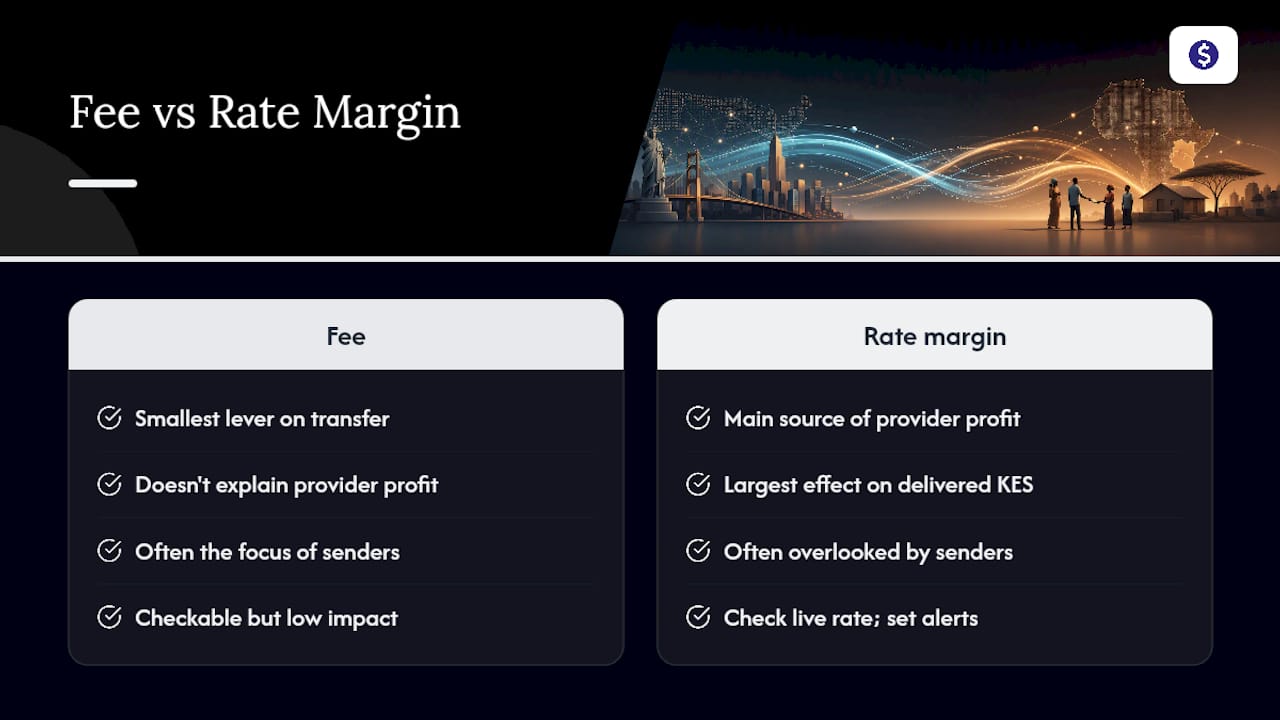
The senders who do best on this corridor treat it like a habit, not a one-time decision. They check the live rate on the day they send, not the day before, and they set a rate alert when they’re moving a larger amount so they’re not guessing. Ideal Remit’s comparison tools exist for exactly this reason: pulling live rates and fees side by side so you can see the delivered KES number before committing, instead of finding out after the fact.
If you send to Kenya more than once a year, that habit alone will save you more than switching providers ever will.
— Brahim
Compare Live Quotes Before You Send
Every provider’s fee page tells you half the story. Idealremit shows you the other half: the actual delivered KES after fees and exchange-rate margin, side by side across providers, so you’re not choosing blind.

For a corridor where the exchange-rate margin often costs more than the fee itself, that comparison matters more than brand loyalty. Rate alerts also let you set a target rate and get notified when it hits, useful if you’re sending a larger amount and want to avoid overpaying by a few cents per shilling. If you send regularly, that adds up fast. Head to the Idealremit blog and comparison tools and enter your exact send amount to see what different providers would actually deliver to your recipient’s M-PESA wallet or bank account today.
Sources
FAQ
Does Kenya Have Zelle?
No. Zelle only works between U.S. bank accounts, so it can’t be used to send money to Kenya. You’ll need a dedicated international transfer provider instead.
How Much Is $100 USD Worth in Kenya?
The exact KES amount depends on the day’s exchange rate and which provider’s margin applies, which is why comparing live quotes before sending matters more than checking a fixed conversion number.
What Is the Best App to Send Money to Kenya?
There’s no single best app for everyone. Compare live delivered-KES quotes across providers for your exact amount using a tool like Ideal Remit before you decide, since the best option shifts based on your send amount and funding method.
What Is the Safest International Money Transfer?
Look for a provider that’s licensed in the U.S., verifiable through NMLS Consumer Access, and shows the exchange rate and delivered amount before you confirm. Always save your tracking number in case of a delay.