
TL;DR:
- Transfer speed measures how quickly data or money moves from one point to another, in units like Mbps or hours. It is crucial because delays can affect cash flow and emergency support, making speed a key factor in choosing transfer methods. Comparing actual transfer times, provider routes, and real-world speeds helps optimize for both cost and urgency.
Transfer speed is the measurable rate at which data or money moves from one point to another, calculated as the amount transferred divided by time. For digital data, that rate appears in megabits per second (Mbps) or megabytes per second (MB/s). For international money transfers, it shows up as hours or business days until the recipient receives funds. Whether you are a business sending payroll abroad or an individual supporting family overseas, understanding transfer speed helps you choose the right provider, avoid surprise delays, and plan around real delivery times.
What is transfer speed and why does it matter?
Transfer speed is defined as the ratio of data or money transferred divided by the time taken to complete that transfer. In networking, throughput is measured in bits per second, with common units including Mbps (megabits per second) and MB/s (megabytes per second). In financial transactions, speed is measured as time to recipient, ranging from under 30 minutes to five business days depending on the provider and route.

Transfer speed matters because delays cost real money. A business waiting three days for a supplier payment in another country faces cash flow pressure. An individual sending emergency funds to a family member in Morocco or the Philippines cannot afford a four-day window. Speed is not just a convenience metric. It is a financial planning variable.
Transfer speed is also distinct from two related concepts: latency and throughput. Latency is the delay before a response begins, while throughput is the actual volume of data delivered over time. Both affect user experience differently. A connection can have high bandwidth but poor latency, making it feel slow for real-time tasks even when large file transfers complete quickly.
What factors influence transfer speed in data and money transfers?
Transfer speed in both digital and financial contexts depends on multiple variables, not just the technology used.
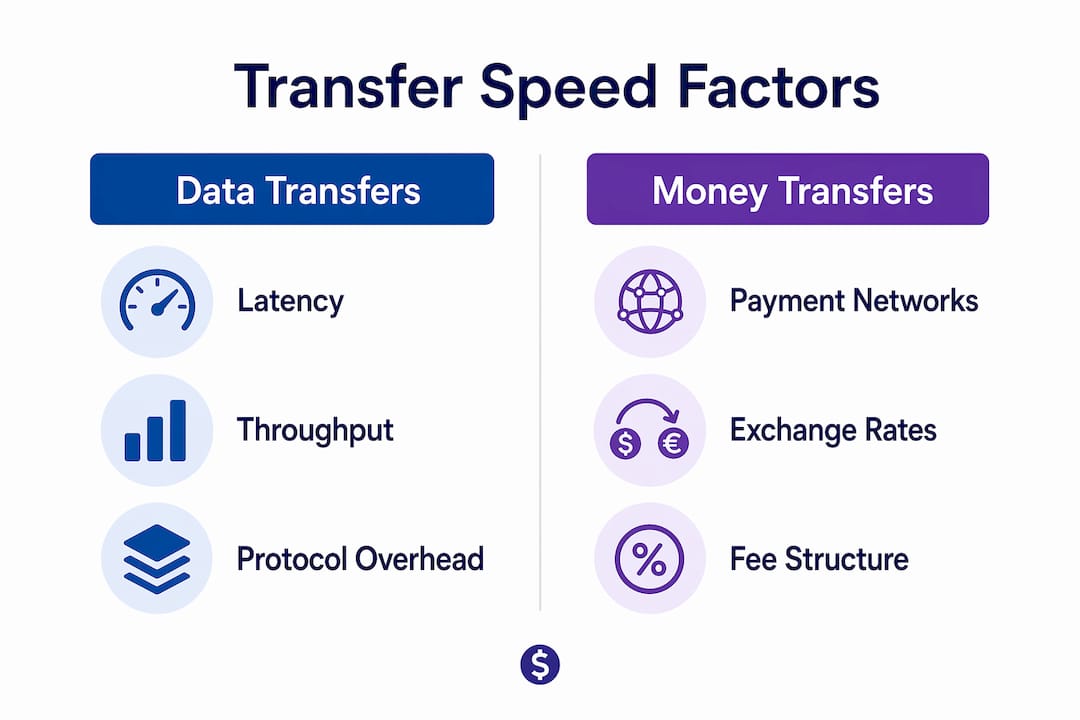
Data transfer factors
For digital transfers, the main factors are:
- Bandwidth: The maximum capacity of a connection. Higher bandwidth allows more data to move simultaneously, but it does not guarantee fast delivery.
- Network congestion: Heavy traffic on shared networks reduces available bandwidth for any single transfer.
- Protocol overhead: Every data packet carries header information. That overhead reduces the share of bandwidth available for actual payload.
- Encryption: Securing data in transit consumes CPU resources. SMB file transfers with encryption can drop to under 1 MB/s on underpowered hardware.
- Latency: High latency slows transfers even on fast connections, because each acknowledgment packet takes longer to return.
- File size and count: Transferring thousands of small files is far slower than moving one large file of the same total size, because each file requires its own handshake cycle.
Money transfer factors
For international payments, the variables are different but equally significant:
- Banking intermediaries: Most cross-border payments pass through one or more correspondent banks. Each adds processing time and fees.
- Compliance checks: Anti-money laundering (AML) and know-your-customer (KYC) reviews can pause a transfer for hours or days.
- Cut-off times: Banks and transfer services process batches at set times. Missing a cut-off by minutes can add a full business day to delivery.
- Payment rails: Settlement times depend on compliance and currency routes beyond any single provider's control. SWIFT gpi is faster than legacy SWIFT, but both still rely on correspondent banking chains.
- Currency routes: Some currency pairs have direct exchange markets. Others require conversion through a third currency, adding steps and time.
Pro Tip: When sending money internationally, check whether your provider uses SWIFT gpi or a direct payment rail. The difference can be hours versus days.
How to calculate and interpret transfer speed for digital data
The core formula for data transfer speed is: Speed (S) = Amount (A) ÷ Time (T). Rearranged, you get Time = Amount ÷ Speed. These two formulas cover most practical calculations.
Understanding bits vs. bytes
The most common source of confusion in transfer speed is the difference between bits and bytes. 1 byte equals 8 bits. Internet providers advertise speeds in Mbps (megabits per second). File sizes appear in MB (megabytes). That gap causes most people to overestimate download speeds.
The correct conversion formula is: Time (seconds) = File size (MB) × 8 ÷ Speed (Mbps)
| File size | Connection speed | Estimated transfer time |
|---|---|---|
| 100 MB | 100 Mbps | 8 seconds |
| 1,000 MB (1 GB) | 100 Mbps | 80 seconds |
| 1,000 MB (1 GB) | 500 Mbps | 16 seconds |
| 10,000 MB (10 GB) | 1,000 Mbps | 80 seconds |
These figures represent theoretical maximums. Real-world transfers run slower because of protocol overhead, retransmissions, and congestion.
Goodput vs. theoretical speed
Effective throughput, or goodput, excludes retransmissions and overhead and reflects what actually reaches the application. A 1 Gbps link rarely delivers 1 Gbps of usable data. Goodput is the number that matters for planning backup windows, video streaming quality, or large file sync times.
To measure actual transfer speed accurately, use a dedicated tool rather than timing a file copy manually. iperf3 isolates network performance by removing disk I/O from the equation, giving a clean read on what the network itself can deliver.
- Install iperf3 on both the sending and receiving machines.
- Start the server on the receiving machine with the command
iperf3 -s. - Run the client on the sending machine pointing to the server's IP address.
- Review the reported throughput and compare it to your advertised link speed.
- Repeat the test at different times of day to account for congestion patterns.
What affects transfer speed and timing for international money transfers?
Most international money transfers take 1-5 business days. That range is wide because the actual time depends on factors that vary by provider, corridor, and even the day of the week.
Modern payment systems have compressed that window significantly. Stripe reports that 60% of SWIFT gpi payments reach recipients in under 30 minutes. That figure applies to payments on supported corridors between banks enrolled in the gpi network. Transfers outside that network still follow the traditional 2-4 business day timeline.
Banks and specialist remittance companies perform very differently on speed. Banks route payments through correspondent networks, adding intermediaries and processing delays. Remittance companies like Wise, Remitly, and Western Union often use local payment rails in the destination country, bypassing correspondent chains entirely. That structural difference is why a Wise transfer to Europe can arrive in minutes while a bank wire to the same account takes two days.
Understanding why remittance delays happen helps you plan around them rather than be surprised by them. The most common causes are missed cut-off times, compliance holds on first-time transfers, and currency routes that require an intermediate conversion step.
Pro Tip: Schedule transfers early in the business day, early in the week. A transfer submitted after a bank's cut-off on Friday afternoon may not begin processing until Monday morning.
Key factors to check before choosing a provider:
- Stated delivery time vs. guaranteed delivery time: Many providers list best-case times. Look for guaranteed or typical delivery windows instead.
- Transfer rails used: Direct local payment networks are faster than SWIFT correspondent chains.
- Compliance requirements: First-time transfers and large amounts trigger additional checks. Build extra time into your first transfer with any new provider.
- Cut-off times: These vary by provider and destination country. Missing one by an hour adds a full business day.
How to evaluate and compare transfer speeds across providers
Evaluating transfer speed requires looking past advertised numbers. For data connections, bandwidth is maximum capacity while throughput is actual delivery. For money transfers, the advertised speed is often the best-case scenario on the fastest corridor.
What to measure in data transfers
Focus on three metrics: throughput, latency, and packet loss. Throughput tells you how much data moves per second. Latency tells you how quickly the connection responds. Packet loss tells you how reliable the connection is under load. A connection with high throughput but high packet loss will feel unreliable for video calls and real-time applications even if large file transfers complete quickly.
What to measure in money transfers
For financial transfers, the relevant metrics are delivery time, fee structure, and exchange rate margin. A provider advertising zero fees may apply a wide exchange rate spread that costs more than a flat fee would. Compare the total cost and the total time together, not separately.
Idealremit makes this comparison straightforward by aggregating real-time rates, fees, and delivery times from providers including Wise, Remitly, Western Union, and MoneyGram. You can see the full cost and expected delivery window side by side before committing to a transfer. The platform supports mobile money transfers to over 100 countries, which is particularly useful for corridors where mobile wallets deliver funds faster than bank accounts.
Pro Tip: Run the same transfer amount through two or three comparison tools before sending. Exchange rate margins shift daily, and the fastest provider is not always the cheapest.
When speed matters most depends on the situation. Urgent remittances, emergency payments, and time-sensitive supplier invoices demand the fastest available rail. Regular monthly transfers to family or routine payroll runs can prioritize cost over speed. Matching the transfer type to the right provider is the most practical way to manage both variables.
Key takeaways
Transfer speed is the amount of data or money moved divided by the time taken, and understanding both the theoretical maximum and the real-world effective rate is the only way to make reliable decisions.
| Point | Details |
|---|---|
| Transfer speed definition | Speed equals amount divided by time; units are Mbps or MB/s for data, hours or days for money. |
| Bits vs. bytes confusion | ISPs advertise in Mbps; file sizes appear in MB. Multiply MB by 8 before dividing by Mbps. |
| Goodput vs. advertised speed | Real throughput is always lower than the link maximum due to overhead and retransmissions. |
| Money transfer timing | SWIFT gpi delivers 60% of payments in under 30 minutes; traditional bank wires take 2-4 business days. |
| Provider selection | Compare delivery time and total cost together. Exchange rate margins often cost more than visible fees. |
Transfer speed in practice: what the numbers don't tell you
I have spent years watching people make the same mistake: they pick a provider based on the advertised speed and then feel blindsided when the money takes three days to arrive. The advertised number is almost always the best-case scenario on the most favorable corridor. It is not a promise.
The same problem exists in networking. A 1 Gbps fiber connection sounds fast until you realize that goodput on a real network rarely exceeds 70-80% of that figure, and latency can make a 1 Gbps connection feel sluggish for interactive tasks. The number on the marketing page and the number you experience are two different things.
What I have found actually works is testing before you commit. For data transfers, run iperf3 between your actual endpoints at the times you plan to transfer. For money transfers, send a small test amount to a new provider before routing a large payment through them. Both approaches take ten minutes and save hours of frustration.
The other thing most guides skip is the cut-off time problem. I have seen businesses lose a full business day on a payment because they submitted it at 3:00 PM on a Friday. The provider's cut-off was 2:00 PM. The payment sat until Monday. That is not a technology failure. It is an operational one. Knowing your provider's cut-off schedule is as important as knowing their fees.
— Brahim
Compare money transfer speeds and rates with Idealremit
Knowing what affects transfer speed is only useful if you can act on it quickly.

Idealremit aggregates live rates, fees, and delivery times from providers including Wise, Remitly, Western Union, and MoneyGram, so you can compare transfer services side by side in seconds. The platform covers transfers to over 100 countries and shows you the real cost, including exchange rate margins, not just the headline fee. For anyone sending money regularly or urgently, that transparency removes the guesswork from choosing between providers. Visit Idealremit to find the fastest and most affordable option for your next transfer.
FAQ
What is the transfer speed definition in simple terms?
Transfer speed is the amount of data or money moved from one point to another divided by the time it takes. For digital data, it is measured in Mbps or MB/s. For money transfers, it is measured in hours or business days.
How do I convert Mbps to MB/s for download time estimates?
Divide the Mbps figure by 8 to get MB/s, since 1 byte equals 8 bits. To estimate download time, multiply the file size in MB by 8, then divide by your connection speed in Mbps.
Why is my actual transfer speed slower than advertised?
Effective throughput is lower than theoretical link speed because of protocol overhead, retransmissions, and network congestion. The advertised figure is the maximum possible, not the typical delivered rate.
How long does an international money transfer take?
Most international transfers take 1-5 business days. Transfers using SWIFT gpi can arrive in under 30 minutes on supported corridors. Specialist remittance providers using local payment rails are typically faster than traditional bank wires.
What is the fastest way to send money internationally?
Providers using direct local payment rails, such as Wise or Remitly, are generally faster than bank wires routed through correspondent networks. For the fastest international transfer options in 2026, compare delivery times and fees on a platform like Idealremit before sending.