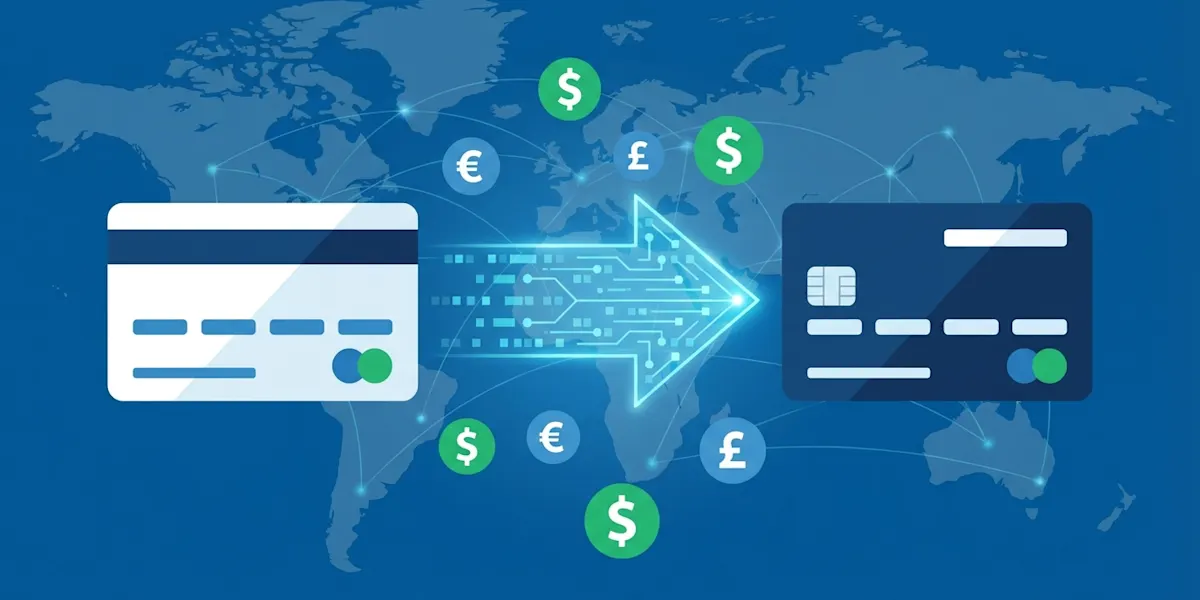
If you want to send money abroad without the paperwork of a bank wire, a card-to-card international money transfer might be exactly what you need.
This guide covers which providers support international card-to-card money transfers, the use cases and benefits in both domestic and international contexts, what transfers cost across providers, how fast they arrive, transfer limits, safety standards, and when to use them versus alternatives.
Unlike vendor pages promoting a single service, this guide compares providers neutrally so you can choose based on facts.
What Is a Card-to-Card International Money Transfer?
A card-to-card international money transfer is a cross-border payment that pushes funds directly from a sender's card to a recipient's card using card network infrastructure.
It uses push payment technology through Visa Direct or Mastercard Move. Senders and recipients use it to move money internationally without needing to exchange bank account details.
Traditional remittance methods require an IBAN, a SWIFT code, and sometimes a bank branch address. Card-to-card transfers remove that friction entirely. Funds are pushed directly to a card account, making it one of the simplest cross-border options available today.
The underlying infrastructure matters here. Visa Direct uses Original Credit Transactions (OCTs) to push funds to any eligible Visa card across its global network. Mastercard Move does the same across the Mastercard network, reaching nearly 10 billion endpoints worldwide. Both operate at speeds that traditional correspondent banking simply cannot match.
Card eligibility is straightforward. Visa and Mastercard debit, credit, and some prepaid cards are supported. American Express is generally not accepted by card-to-card providers.
Card-to-Card Transfer vs Alternatives
Not every international payment method suits every situation. Understanding the differences helps you pick the right tool for your transfer.
| Feature | Card-to-Card | Bank Wire Transfer | Digital Wallet | Cash Pickup |
|---|---|---|---|---|
| Recipient info needed | 16-digit card number | IBAN, SWIFT/BIC, bank name | App account / email | Name + ID |
| Typical speed | Minutes | 1 to 5 business days | Minutes | Minutes to hours |
| Typical fee range | Low to moderate | Moderate to high | Low to moderate | Moderate to high |
| Transfer limits | Up to USD 1M (verified) | Very high | Varies by platform | Varies by agent |
| Best for | Speed, no bank details | Large amounts | Same-platform users | Unbanked recipients |
Card-to-card is the strongest choice when the recipient has an eligible card and you want speed without sharing bank details. Bank wire is better for large institutional transfers. Digital wallets require both parties on the same platform. Cash pickup is the right call when the recipient has no card or bank account at all.
Use Cases and Benefits of Card-to-Card Money Transfers: Domestic and International
Understanding where card-to-card transfers genuinely excel, and where they fall short, is the starting point for choosing the right method. The use cases split cleanly between domestic and international contexts, and the benefits differ in each.
Domestic Use Cases and Benefits
In domestic settings, card-to-card transfers are the backbone of the P2P payment economy. When someone on Venmo, Cash App, or PayPal sends money to a friend for splitting dinner, that transaction typically runs on card network rails under the hood.
The primary benefit domestically is speed. Funds arrive on the recipient's card within minutes, sometimes seconds, compared to the 1 to 3 business days that ACH bank transfers take. For rent splits, group expenses, or any situation where immediacy matters, that speed advantage is significant.
The secondary benefit is accessibility. The sender and recipient need only a debit or credit card, not a bank account with the same institution, not an established account relationship, and not a routing number. This removes friction from everyday payments between people who may bank at different institutions.
Cost in domestic card-to-card transfers is typically low or zero for debit card funding. Funding from a credit card usually attracts a cash advance fee of 3 to 5% from the card issuer, which is a real cost many users overlook.
International Use Cases and Benefits of Card-to-Card Money Transfers
The international use cases for card-to-card money transfers are where this method becomes genuinely valuable in ways that bank wires cannot match.
Sending to unbanked recipients. A recipient without a bank account can still hold a prepaid debit card. A Visa or Mastercard prepaid card can be loaded remotely via a card-to-card transfer, giving the recipient immediate purchasing power and ATM access without ever needing a bank account. In markets across Sub-Saharan Africa, Latin America, and Southeast Asia, this is a practical solution to a real infrastructure gap.
Emergency and time-sensitive transfers. International card-to-card transfers through platforms like Visa Direct can credit the recipient's card within 30 minutes. Compare that to a 3-day international bank wire, and the case for card-to-card in emergencies is obvious. When a family member needs money for a medical bill today, 30 minutes beats 72 hours.
Freelancer and gig worker payments. Platforms paying international contractors increasingly use card-to-card rails because they eliminate the need to collect IBAN, SWIFT codes, and bank account details from recipients in dozens of countries. The recipient provides a card number, and the payment arrives on their card the same day.
Supporting family abroad. For recurring remittances to a specific person, loading a prepaid card remotely via card transfer simplifies the process to a single step rather than repeated cash pickups or mobile wallet transfers.
The card-to-card money transfer benefits internationally can be summarized in four categories: speed (minutes rather than days), accessibility (reaches cardholders without bank accounts), simplicity (no banking details required beyond the card number), and flexibility (the recipient can spend or withdraw immediately).
How Card-to-Card International Transfers Work
It's important to know what exactly happens inside the transaction, because that determines the transfer's speed, cost, and risk.
Here is the real transaction flow, step by step:
- You initiate the transfer through a provider platform and enter the recipient's 16-digit card number and the send amount.
- The provider authenticates you using 3D Secure or Strong Customer Authentication (SCA), verifying your identity with your card issuer before anything moves.
- Your card is debited and the funds are collected by the provider, who also applies the exchange rate at that moment.
- The provider submits a push payment instruction, called an Original Credit Transaction (OCT), to the card network: Visa Direct or Mastercard Move.
- The card network routes the instruction to the recipient's issuing bank in the destination country.
- The recipient's card is credited in local currency, typically within minutes. Visa Direct requires fast-funds-enabled banks to credit recipients within 30 minutes.
The entire process bypasses the correspondent banking chain that traditional wire transfers depend on. That chain adds fees and delays at every hop. Card-to-card cuts straight through it, which is the core speed advantage.
The Role of Visa Direct and Mastercard Move
Visa Direct is Visa's real-time push payment platform, reaching eligible Visa cards across 195 or more countries via approximately 12 billion endpoints. It uses OCTs to credit funds directly to cards, and it requires fast-funds issuers to make money available within 30 minutes of the transaction.
Mastercard Move, formerly known as Mastercard Send, is Mastercard's equivalent. It reaches nearly 10 billion endpoints and supports delivery to cards, bank accounts, and mobile wallets. Which network processes your transfer depends entirely on the recipient's card brand. Your provider handles the routing automatically.
Types of Card-to-Card International Transfers
Card-to-card transfers vary depending on the funding and receiving card types, and the distinction matters significantly for fees and eligibility.
Debit-to-Debit is the most common type and the cheapest. You fund the transfer from your debit card, and the recipient receives funds on their debit card. There is no cash advance risk, and most providers treat this as their default option. This is the type we recommend for most senders.
Credit-to-Debit is convenient but carries a hidden risk. Many card issuers classify money transfers funded by a credit card as a cash advance, not a purchase. That means a 3 to 5% fee on top of the transfer amount, plus immediate interest with no grace period. Always check with your issuer before funding a transfer this way.
Credit-to-Credit is rarely supported by providers and generally carries the highest fees. It is not recommended for most use cases.
Prepaid-to-Debit is a useful option for travelers or senders without a standard bank account. Some providers support Visa and Mastercard prepaid cards as a funding source. Check your specific provider's eligibility rules before sending.
Which Providers Support International Card-to-Card Money Transfers?
This is the question most guides on this topic fail to answer clearly. The honest answer is that true card-to-card international transfers, where funds move directly from one card to another across borders, are supported by fewer providers than the domestic equivalent. Here is a breakdown of which providers support international card-to-card money transfers and how each works.
Visa Direct
Visa Direct is Visa's real-time push payment platform and the infrastructure layer that powers many card-to-card transfer services. It enables funds to be pushed to any Visa debit card globally, with credits typically appearing within 30 minutes.
Visa Direct does not offer a consumer-facing product directly. It is a network capability that payment platforms, banks, and fintechs build on top of. If a transfer service advertises "instant card delivery" to a Visa card, Visa Direct is almost certainly the underlying rail. Coverage is strong across the US, EU, UK, and many markets in Asia and Latin America, with more limited reach in some African markets and smaller economies.
Mastercard Move
Mastercard Move is Mastercard's equivalent, enabling real-time push payments to Mastercard debit cards globally. Funds are pushed to the recipient's card rather than pulled, the credit appears within minutes, and availability depends on the recipient's card-issuing bank participating in the network.
Together, Visa Direct and Mastercard Move cover the vast majority of global card-to-card infrastructure. The consumer-facing services below use one or both of these networks.
Paysend
Paysend specifically markets itself as a card-to-card international transfer service, operating in 170 countries with a flat fee structure of approximately USD 2 per transfer. It is one of the most straightforward options for pure card-to-card international transfers, with fees that are transparent upfront regardless of the corridor.
Wise
Wise does not offer traditional card-to-card delivery in the sense of pushing funds to a recipient's card number. However, the Wise card allows recipients to hold and spend in multiple currencies once a transfer arrives in their Wise account. For senders using a debit card to fund and recipients who have a Wise card, the end-to-end experience can resemble a card-to-card flow, though it technically routes through Wise's account infrastructure. Wise's mid-market exchange rate makes it particularly strong for rate transparency on larger amounts.
Remitly
Remitly supports card delivery as a delivery method on selected corridors. The sender can fund via debit or credit card, and the recipient receives funds on their debit card via Visa Direct or Mastercard Move rails. Remitly's Express tier (minutes delivery) typically uses card or mobile wallet rails. Their Economy tier (3 to 5 days) routes via bank deposit. If card-to-card delivery is available for your corridor, it will appear as a delivery option during transfer setup.
WorldRemit
WorldRemit supports card delivery on selected corridors, routing via Visa Direct. The sender can use a card to fund the transfer online, and the recipient receives funds on their debit card. WorldRemit's broad destination coverage makes it useful for less common corridors where other providers may not offer card delivery.
Western Union
Western Union supports card-to-card international transfers as one of its delivery options on many corridors. The sender funds via debit or credit card, and the recipient receives funds on their Visa or Mastercard debit card, typically within 30 minutes on supported corridors. Western Union's global agent network of 500,000 locations means they also cover corridors where card delivery is not available, making them a versatile option when card-to-card reach runs out.
MoneyGram
MoneyGram supports debit card delivery on selected corridors, routing via Visa Direct. Like Western Union, MoneyGram also maintains a large cash pickup network for corridors where card delivery is not available, providing a built-in fallback if the card credit fails.
Regional and Emerging Providers
Skrill and Neteller support card-funded international transfers with card delivery in some markets. Instarem covers Asia-Pacific corridors with card delivery options. For the specific corridors these regional providers cover best, they can undercut larger platforms on cost while matching them on speed.
Best Services for Sending Money from Card to Card Internationally
The best service for a card-to-card international transfer depends on three variables: your corridor, your amount, and whether card delivery is actually available at the destination.
| Provider | Fee Structure | Exchange Rate | Typical Speed | Transfer Limits | Best For |
|---|---|---|---|---|---|
| Paysend | Flat fee (USD 2 / GBP 1 / EUR 1.50) | Competitive with margin | Instant to minutes | Up to USD 10K/month (basic) | Flat-fee simplicity |
| Wise | Variable 0.5 to 1.5% | Mid-market rate | Minutes to 2 days | Up to USD 1M (verified) | Rate transparency, large transfers |
| Remitly | Corridor-dependent | Competitive with margin | Minutes to 5 days | Up to USD 100K | Speed vs cost flexibility |
| WorldRemit | Varies | Includes FX margin | Minutes | USD 5K per card transaction | Wide destination coverage |
| Western Union | Higher fees | Wider margin | Minutes | Varies by corridor | Brand trust, cash pickup fallback |
Paysend is best for flat-fee simplicity and strong coverage in emerging market corridors. You always know what you are paying upfront.
Wise is best for exchange rate transparency and larger transfers. The mid-market rate means you get a fair conversion without hidden markups.
Remitly is best for senders who want to trade speed for savings. The Express tier delivers in minutes; the Economy tier costs less and takes longer.
WorldRemit is best for wide destination coverage, particularly useful for less common corridors.
Western Union is best for recipients who may also need a cash pickup option, giving you a built-in fallback if the card credit fails.
This comparison is based on publicly available information and standard corridors. Fees and features vary by corridor. Always verify on the provider's site before sending.
How Much Does a Card-to-Card International Transfer Cost?
Every card-to-card transfer involves three potential cost layers: the provider's transfer fee, the exchange rate markup above the mid-market rate, and any fees your own card issuer charges. Most people only look at the first one and miss the other two entirely.
| Provider | Transfer Fee | Exchange Rate | Credit Card Surcharge | Example: USD 500 to India |
|---|---|---|---|---|
| Paysend | Flat USD 2 | Competitive with margin | No surcharge | Low total cost |
| Wise | Variable 0.5 to 1.5% | Mid-market rate | Higher fee for credit | Low to moderate |
| Remitly | Varies by corridor and speed | Competitive with margin | May apply | Varies |
| WorldRemit | Varies | Includes FX margin | May apply | Moderate |
| Western Union | Higher fees | Wider margin | May apply | Higher total cost |
The most important number is not the fee. It is the total amount the recipient receives. A provider advertising "no fee" may still charge you through a wide exchange rate markup. A USD 0 fee with a 2% FX markup on USD 1,000 costs you USD 20. A USD 5 fee at the mid-market rate costs you USD 5. Always compare what actually arrives, not what is advertised.
The Cash Advance Trap: Hidden Credit Card Fees
The biggest hidden cost of card-to-card transfers is not the provider's fee. It is your credit card issuer's cash advance charge.
When you fund a money transfer with a credit card, many issuers classify it as a cash advance rather than a purchase. That triggers three separate penalties: an immediate fee of 3 to 5% of the transfer amount, a higher interest rate of typically 25 to 30% APR, and no grace period, meaning interest begins accruing the same day the transfer goes through.
A concrete example: sending USD 1,000 with a credit card could cost you an extra USD 30 to 50 in cash advance fees alone, before the provider charges a single cent. To avoid this entirely, fund your transfer with a debit card. If you must use a credit card, call your issuer before sending and ask directly how they code money transfer transactions.
How Fast Is a Card-to-Card International Transfer?
Most card-to-card international transfers arrive within minutes. Visa Direct requires fast-funds-enabled banks to credit recipients within 30 minutes. But delivery times are not uniform across providers, corridors, or recipient banks.
| Provider | Typical Speed | Fastest | Slowest |
|---|---|---|---|
| Paysend | Instant to minutes | Seconds | 2 to 3 business days |
| Wise | Minutes to 2 business days | Seconds | 5 business days |
| Remitly Express | Minutes | Minutes | Same day |
| WorldRemit | Minutes | Minutes | Varies by corridor |
Three factors determine where your transfer lands on that range.
Fast-funds support at the recipient's bank. Not every bank globally has enrolled in Visa Direct's or Mastercard Move's fast-funds programme. If they have not, the credit may take 1 to 3 business days even if the network processed it instantly.
The currency corridor. Some countries have slower domestic banking settlement infrastructure. A transfer to Germany processes faster than one to a smaller market with legacy rails.
Time of day. Transfers that hit during the recipient country's banking hours tend to settle faster. Late-night or weekend transfers sometimes queue until the next business day.
Transfer Limits and Card Eligibility
Transfer limits vary dramatically between providers, from under USD 1,000 per day for unverified accounts to over USD 1,000,000 per transfer for fully verified users. Knowing your limit before you send avoids frustrating holds or rejected transactions.
| Provider | Per Transaction | Daily Limit | Monthly Limit | Notes |
|---|---|---|---|---|
| Paysend | Varies | Up to USD 999 (basic) | Up to USD 10,000 | Higher with verified account |
| Wise | Up to USD 1,000,000 | Varies | Varies | Full KYC required for high limits |
| Remitly | Up to USD 10,000 | Varies by tier | Up to USD 100,000 | Tier unlocked via KYC |
| WorldRemit | Up to USD 5,000 per card | Varies | Varies | Check corridor-specific limits |
Card eligibility checklist: the card must be Visa or Mastercard (AmEx is generally not supported), must be 3D Secure enabled, must be issued in the sender's name, must not be expired or flagged as blocked, and some providers accept prepaid Visa and Mastercard cards while others do not.
Completing full KYC identity verification with your provider is the single most effective way to unlock higher limits. Do this before you need to send a large amount, not during the transaction itself.
Is Card-to-Card International Transfer Safe?
Yes. Card-to-card international transfers are protected by multiple layers of security, including the same standards that protect everyday card purchases.
The four core protections every reputable provider applies: 3D Secure authentication verifies your identity directly with your card issuer before each transfer is authorized; PCI DSS v4.0 compliance meets the current Payment Card Industry Data Security Standard for encryption, access controls, and security auditing; Strong Customer Authentication (SCA) is mandated under PSD2 in the UK and EU and requires two-factor authentication for every transaction; and AML/KYC screening verifies your identity and screens every transfer against sanctions lists and anti-money laundering databases before processing.
Legitimate providers are licensed by financial regulators: the FCA in the UK, FinCEN in the US, and relevant EU financial authorities. That licensing requires them to hold your funds separately from their own. For US senders, the CFPB provides additional protections, including the right to cancel a remittance transfer within 30 minutes of payment at no cost and a 180-day window to raise error disputes.
What to Do If a Transfer Fails
Transfers can fail for several reasons. Knowing the cause saves time and reduces anxiety.
Card not enabled for international transactions. Many banks block international use by default. Call your issuer to activate it before attempting the transfer again.
Fraud detection block. Your bank flagged the transfer as unusual activity. Call them directly to confirm the transaction is genuine and ask them to authorize it.
Insufficient funds or limit exceeded. Check your account balance and your provider's per-transaction or daily limit. Upgrade your verification tier if you need to send more.
Incorrect recipient card number. Double-check every digit of the 16-digit card number and the recipient's name. Unlike bank transfers, there is often no name-matching verification. A wrong number sends your money to the wrong person.
Recipient's bank does not support fast funds. The transfer has not failed; it is in transit. It may arrive in 1 to 3 business days through standard settlement.
AML/KYC verification incomplete. Log into your provider account and complete any outstanding identity verification steps before retrying.
If a transfer fails, funds are typically returned to your card within 1 to 5 business days. Contact the provider's support team for a real-time status update.
When to Use Card-to-Card Transfers (and When Not To)
Card-to-card works best when:
- You are sending money to family or friends who do not want to share their bank account details
- The transfer is urgent and cannot wait for bank wire processing timelines
- You are sending to a country where card networks are more accessible than formal banking infrastructure
- The transfer is a one-off personal payment under your provider's limits
- The recipient has a Visa or Mastercard but limited or no access to a full bank account
Consider an alternative when:
- You are sending over USD 10,000. A bank wire or Wise balance transfer often has higher limits and lower percentage costs at scale.
- You send to the same person every month. A standing bank transfer eliminates per-transaction fees and reduces friction over time.
- Your only funding option is a credit card. Cash advance fees will likely cancel out any savings the provider's low fee offers.
- The recipient has no card at all. Cash pickup through Western Union or MoneyGram, or a mobile wallet like M-Pesa for relevant corridors, is the better fit.
Common Mistakes When Sending Money Card to Card Internationally
1. Using a credit card without checking for cash advance fees. Your provider may charge USD 2. Your card issuer may charge USD 40. Always verify how your issuer codes money transfers, or simply use a debit card to avoid the risk entirely.
2. Assuming all transfers are instant. Provider quotes reflect network speed, not your recipient's bank speed. Check the estimated delivery time for your specific corridor before sending, especially if timing matters.
3. Not comparing exchange rates. "No fee" does not mean no cost. A provider can offer zero fees while embedding a 2 to 3% markup into the exchange rate. Always compare the total amount the recipient receives across providers, not just the headline fee.
4. Entering the wrong recipient card number. Unlike bank transfers, most card-to-card providers do not verify the recipient's name against the card number. One wrong digit can send money to a complete stranger with no guaranteed way to recover it. Triple-check all 16 digits before confirming.
5. Ignoring transfer limits before sending. Attempting to send above your verification tier triggers holds, rejections, and delays. Complete your KYC verification in advance, especially before time-sensitive transfers.
Frequently Asked Questions About Card-to-Card International Transfers
Which providers support international card-to-card money transfers? The main providers that support international card-to-card money transfers are Paysend, Wise, Remitly, WorldRemit, Western Union, and MoneyGram. Regional providers including Skrill, Neteller, and Instarem cover selected corridors. The underlying network infrastructure is provided by Visa Direct and Mastercard Move. Availability depends on whether the recipient's card-issuing bank participates in push payment networks in their country.
What are the use cases and benefits of card-to-card money transfers in domestic and international contexts? Domestically, card-to-card transfers offer speed and accessibility for everyday P2P payments like splitting expenses or sending money between individuals at different banks. Internationally, the main benefits are speed (funds arrive in minutes), accessibility (no bank account required for the recipient), simplicity (only a card number is needed, no IBAN or SWIFT code), and flexibility (recipients can spend or withdraw immediately). Key international use cases include emergency family support, payments to unbanked recipients, freelancer payments, and recurring remittances.
How do I transfer money from one card to another internationally? Fund a transfer through a card-to-card provider like Paysend, Wise, Remitly, or WorldRemit. Enter the recipient's 16-digit Visa or Mastercard number, choose the amount, and confirm. The provider routes funds through Visa Direct or Mastercard Move to credit the recipient's card, usually within minutes. No IBAN or SWIFT code is needed.
What is the best service for sending money from card to card internationally? Paysend offers a dedicated card-to-card model with flat fees and coverage in 170 countries, making it one of the most straightforward options. Wise is best for exchange rate transparency on larger amounts. Remitly suits senders balancing speed against cost. The best choice depends on your corridor, amount, and whether card delivery is available at the destination.
Can I send money internationally with a credit card? Yes, most card-to-card providers accept Visa and Mastercard credit cards as a funding source. However, your card issuer may classify the transaction as a cash advance, which adds a 3 to 5% fee and immediate interest with no grace period. Using a debit card avoids this risk and is usually cheaper.
How long does a card-to-card international transfer take? Most card-to-card international transfers arrive within minutes. Visa Direct requires fast-funds-enabled banks to credit recipients within 30 minutes. However, delivery can take 1 to 3 business days if the recipient's bank does not support real-time processing or the corridor has slower infrastructure.
What is the cheapest way to send money internationally card to card? For small to medium transfers, Wise (mid-market rate) and Paysend (flat fee) are often the cheapest. Always compare the total amount the recipient receives, not just the stated fee, because exchange rate markups can cost more than the provider's headline charge.
Is it safe to transfer money using card-to-card services? Yes. Licensed card-to-card providers use 3D Secure authentication, PCI DSS-compliant encryption, and AML/KYC screening. Transfers are processed through Visa and Mastercard networks with the same security infrastructure as everyday card payments. In the US, the CFPB grants senders the right to cancel within 30 minutes and a 180-day error resolution window.
Can I cancel a card-to-card international transfer? In most cases, yes, if the funds have not yet been deposited to the recipient's card. Under US CFPB rules, senders have the right to cancel a remittance transfer within 30 minutes of payment at no cost. After that window, cancellation depends on the provider's policy and whether the recipient's bank has already credited the funds.
Conclusion
Sending money internationally through card networks offers a fast, low-friction alternative to traditional bank wires. Knowing which providers support international card-to-card money transfers, and understanding the use cases and benefits of card-to-card transfers in both domestic and international contexts, puts you in a position to match the right method to the right situation.
Three things to keep in mind before every transfer. First, debit-to-debit is the safest and cheapest funding method. Use it unless you have a specific reason not to. Second, always compare the total amount the recipient receives, not just the provider's advertised fee. Third, if you plan to use a credit card, check your issuer's cash advance policy first.
Regulated providers using Visa Direct and Mastercard Move apply the same security standards as everyday card transactions. Your money is protected when you use a licensed, reputable service.
Written by
Brahim Oubrik
Brahim Oubrik, a senior data engineer who experienced firsthand the challenges of sending money internationally. Living in France while supporting his family in Morocco, Brahim regularly needed to transfer funds across borders. Drawing on his background in data engineering, Brahim decided to solve this problem not just for himself, but for the millions of others navigating the same difficulties. He built Ideal Remit to bring clarity to the international money transfer market.