International Money Transfer Fees and Rates: Complete Guide
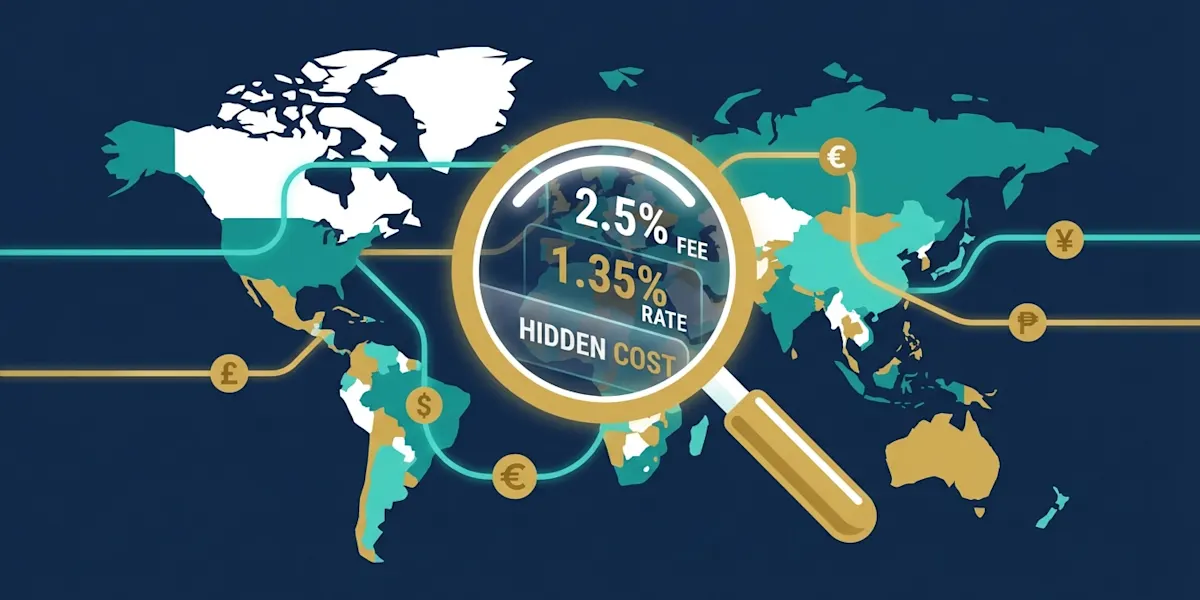
Every year, over $650 billion flows to low- and middle-income countries through international money transfers.
The World Bank estimates the global average cost of sending $200 sits at approximately 6.2%, meaning billions of dollars are absorbed by fees and exchange rate margins before reaching recipients. For migrant workers supporting families back home, for small businesses paying overseas suppliers, and for anyone sending money across borders, these costs represent real money lost.
The true cost of a transfer is never just the stated fee. Exchange rate markups, intermediary bank deductions, and receiving-end charges quietly inflate the price, often doubling the visible cost. This is why the UN's Sustainable Development Goal 10.c targets reducing remittance costs below 3% by 2030.
Progress is happening, driven by fintech competition and regulatory pressure, but the gap between what senders pay and what they should pay remains wide.
This guide breaks down every component of international money transfer costs, compares providers and methods, and provides strategies to minimize what you pay.
What Are International Money Transfer Fees?
International money transfer fees are the total cost structure incurred when sending money across national borders, encompassing explicit charges like transaction and service fees as well as implicit costs like exchange rate markups and intermediary deductions. They apply to every transfer method, from bank wires to mobile wallets, and affect both senders and recipients.
The critical distinction most senders miss is the difference between explicit fees and implicit fees. Explicit fees are the charges stated upfront: the $4.99 transfer fee, the $2 delivery charge.
Implicit fees are buried in the numbers, primarily the exchange rate markup, where the provider offers a worse rate than the real mid-market rate and pockets the difference.
A provider advertising a $5 fee on a $500 transfer to India may also apply a 2% exchange rate markup, adding $10 in hidden cost and making the true fee $15, or 3%. Evaluating only the stated fee gives a dangerously incomplete picture.
Explicit Fees vs. Implicit Costs
The total cost of any international transfer has two layers: explicit costs that providers disclose and implicit costs embedded in the transaction mechanics. Understanding both is essential for accurate comparison.
| Cost Type | What It Is | Visibility | Typical Range | Example |
|---|---|---|---|---|
| Transfer/Service Fee | Upfront charge by the provider | Fully visible | $0-$50 or 0-5% | $4.99 flat fee to send $500 |
| Delivery Fee | Charge based on how recipient gets funds | Visible | $0-$15 | $3 for cash pickup |
| Exchange Rate Markup | Spread between mid-market and offered rate | Hidden in the rate | 0.3%-4% | 1.5% margin on $1,000 = $15 loss |
| Intermediary Bank Fee | Deductions by SWIFT network banks | Partially hidden | $10-$30 per bank | Two intermediaries deduct $25 each |
| Receiving Bank Fee | Charge by the recipient's bank | Often hidden | $5-$20 | $15 incoming wire fee |
For transfers above $300, the exchange rate markup is almost always the largest cost component. For small-value transfers under $100, flat fees dominate the total cost percentage.
How the Total Cost of a Transfer Is Calculated
Follow these four steps to determine the true cost of any international money transfer:
-
Find the mid-market rate for your currency pair. Check Google, xe.com, or any financial data provider for the current interbank exchange rate between the two currencies.
-
Compare the provider's offered rate against the mid-market rate. The difference between these two rates is the exchange rate margin, which represents a hidden cost.
-
Add the provider's stated transfer fee. This is the explicit charge shown during checkout or on the fee schedule.
-
Divide total cost by the send amount and multiply by 100. This gives you the total cost as a percentage, the most useful metric for comparison.
Worked example: Sending $1,000 USD to PHP. The mid-market rate is 55.50, and the provider offers 54.80 with a $5 fee. The exchange rate loss equals $1,000 x (55.50 - 54.80) / 55.50 = approximately $12.61. Total cost = $5 + $12.61 = $17.61, or 1.76% of the send amount.
Types of International Money Transfer Fees
International transfers can incur up to seven distinct fee types depending on the transfer method, corridor, and providers involved. Some apply to every transaction, while others surface only in specific situations.
Transfer and Service Fees
Transfer fees are the most visible charge, applied by the sending provider for processing the transaction. Providers use three main pricing models:
| Pricing Model | How It Works | Best For | Example |
|---|---|---|---|
| Flat Fee | Same charge regardless of amount | Large transfers | $4.99 per transfer |
| Percentage-Based | Proportional to the send amount | Small transfers | 1.5% of amount |
| Tiered/Hybrid | Changes by amount band or combines flat + percentage | Varies | $2.99 under $500, $4.99 over $500 |
Some providers advertise zero transfer fees but compensate through wider exchange rate margins. The pricing model alone does not determine cost; it must be evaluated alongside the exchange rate markup to calculate total cost.
Exchange Rate Markups and Currency Conversion Costs
An exchange rate markup is the difference between the mid-market exchange rate and the rate a money transfer provider offers customers. This spread, often 1% to 4%, represents a hidden profit margin that increases the total cost of the transfer beyond any stated fee.
The mid-market rate (also called the interbank rate) is the midpoint between the buy and sell prices of a currency pair on the global foreign exchange market. It represents the "real" exchange rate at any given moment. You can check it on Google or xe.com. Every money transfer provider offers a rate less favorable than the mid-market rate, and the gap is their margin.
On a $1,000 transfer, a 2% exchange rate markup costs you $20, even if the provider advertises "zero fees." A provider charging a $5 fee with a 0.5% markup ($5 in margin) costs $10 total, half of what the "free" provider charges.
Some providers, such as Wise, have built their model around offering the mid-market rate with a transparent, separately stated fee. This approach makes the total cost visible and comparable, which is why exchange rate transparency has become a competitive differentiator in the industry.
Intermediary and Correspondent Bank Fees
When you send a bank wire transfer through the SWIFT network, your sending bank may not have a direct relationship with the recipient's bank. In that case, the transfer routes through one to three intermediary (correspondent) banks, each of which may deduct a fee of $10-$30 from the transfer amount before passing it along.
The SWIFT system uses three charge options: BEN (beneficiary pays all fees), SHA (shared, each party pays their own bank's fees), and OUR (sender pays all fees, including intermediary charges). Choosing OUR is the only way to guarantee the full amount arrives, but it is also the most expensive option for the sender.
This layered deduction model is a key limitation of traditional bank wires and a primary reason many senders have shifted to digital-first providers. Fintech platforms that maintain direct payout networks or local bank partnerships can bypass the correspondent banking chain entirely, eliminating these unpredictable intermediary costs.
Receiving and Delivery Fees
Fees on the receiving end vary based on who handles the last mile of delivery:
- Receiving bank fees: Many banks charge $5-$25 for incoming international wire transfers, deducted from the received amount.
- Cash pickup fees: Agent networks like Western Union or MoneyGram may embed costs in the exchange rate or charge recipients a small collection fee at certain locations.
- Mobile wallet delivery: Transfers to wallets like M-Pesa, bKash, or GCash are often the lowest cost option, with delivery fees frequently waived.
- Door-to-door/home delivery: Available in select corridors, this premium service carries the highest delivery fees, sometimes $10-$20 or more.
What Determines International Money Transfer Rates?
Seven key factors drive the variation in transfer costs:
-
Transfer Amount. Larger transfers benefit from economies of scale. A $5 flat fee represents 1% on a $500 transfer but only 0.1% on a $5,000 transfer. Percentage-based costs scale proportionally, but many providers reduce their percentage for higher amounts.
-
Currency Pair. Major pairs like USD/EUR or USD/GBP have tight spreads because of high trading volume and liquidity. Exotic pairs involving smaller currencies carry wider exchange rate margins due to lower liquidity and higher volatility.
-
Remittance Corridor. High-volume corridors like US-to-Mexico or US-to-India attract more providers and intense competition, driving costs lower. Low-volume corridors, particularly those serving Sub-Saharan Africa or small Pacific island nations, have fewer providers and higher costs.
-
Payment Method. How you fund the transfer affects cost. Bank transfers and ACH are typically the cheapest funding methods. Credit cards are the most expensive, often adding a 1-3% surcharge plus potential cash advance fees from the card issuer.
-
Delivery Speed. Instant or same-day transfers carry premium pricing. Standard delivery (1-3 business days) costs less. Economy options (3-5 days) offer the lowest fees on platforms that provide speed tiers.
-
Provider Type. Banks are consistently the most expensive option for personal transfers. Traditional money transfer operators (Western Union, MoneyGram) fall in the middle. Fintech and digital-first platforms (Wise, Remitly, Revolut) typically offer the lowest total cost.
-
Regulatory and Compliance Costs. KYC (Know Your Customer) and AML (Anti-Money Laundering) compliance requires significant operational investment from providers. These costs are passed on to customers through fees, and they are proportionally higher in corridors with elevated risk profiles or stricter regulatory regimes.
How Remittance Corridors Affect Pricing
Remittance costs vary dramatically by geographic corridor, from under 3% in competitive regions to over 8% in underserved markets.
| Corridor Region | Avg. Cost (% of $200 sent) | Key Reason |
|---|---|---|
| South Asia | ~4.5% | High competition, large diaspora volumes |
| Latin America & Caribbean | ~5.5% | Mix of digital and cash-dependent markets |
| Middle East | ~6% | Moderate competition, regulatory variation |
| East Asia & Pacific | ~6.5% | Regulatory barriers, island nation access |
| Sub-Saharan Africa | ~7.5-8% | Limited infrastructure, exclusivity agreements |
Source: World Bank Remittance Prices Worldwide (RPW) database.
The UN Sustainable Development Goal 10.c targets reducing the global average cost of remittances below 3% by 2030. While costs have declined from roughly 10% a decade ago, progress toward the 3% target remains slow, particularly in the highest-cost corridors where structural barriers persist.
Payment Method Impact on Fees
| Payment Method | Typical Added Cost | Speed | Availability |
|---|---|---|---|
| Bank Transfer / ACH | $0-$1 | 1-2 days to fund | Widely available |
| Debit Card | $0-$3 | Instant funding | Widely available |
| Credit Card | 1-3% surcharge | Instant funding | Limited; fewer providers accept |
| Cash at Agent Location | $0-$5 | Same day | Requires physical visit |
| Apple Pay / Google Pay | $0-$2 | Instant funding | Limited availability |
Bank transfer or ACH is the most cost-effective funding method for non-urgent transfers. Debit card is the best balance of speed and cost when you need funds sent quickly. Avoid funding with a credit card unless no other option exists. Beyond the provider's surcharge, your card issuer may classify the transaction as a cash advance, triggering additional fees and immediate interest charges.
International Money Transfer Fees by Provider: Comparison
| Provider | Type | Typical Fee Range | Exchange Rate Markup | Transfer Speed | Best For |
|---|---|---|---|---|---|
| Wise | Fintech | $0.50-$15 (varies by corridor) | 0.3%-0.6% (mid-market rate) | Minutes to 2 days | Transparent, low-cost transfers |
| Remitly | Fintech | $0-$4.99 | 0.5%-1.5% | Minutes to 3 days | Remittances to developing countries |
| Revolut | Neobank | $0-$5 | 0.3%-1.5% | Minutes to 2 days | Frequent small transfers |
| WorldRemit | Fintech | $0-$4.99 | 0.5%-2% | Minutes to 3 days | Mobile wallet delivery |
| OFX | Fintech | $0 (min. transfer applies) | 0.4%-1% | 1-3 days | Large transfers ($10k+) |
| Western Union | MTO | $0-$10+ | 1%-4% | Minutes to 5 days | Cash pickup worldwide |
| MoneyGram | MTO | $0-$10+ | 1%-3.5% | Minutes to 3 days | Cash pickup, Walmart access |
| PayPal/Xoom | Fintech/MTO | $0-$4.99 | 2%-4% | Minutes to 5 days | PayPal users, convenience |
| Chase (Bank Wire) | Bank | $30-$50 send | 2%-4% | 2-5 days | Existing banking customers |
| Bank of America | Bank | $30-$45 send | 2%-4% | 2-5 days | Large/business wires |
Note: Fees vary by corridor, transfer amount, and payment method. Verify current rates on each provider's website before sending.
Fintech providers generally deliver the lowest total cost for mid-to-large personal transfers on major corridors. Traditional MTOs remain competitive, and sometimes the only option, for cash pickup delivery in regions with limited banking infrastructure. Banks are typically the most expensive choice for personal remittances but may be necessary for large business-to-business transfers or when the recipient requires a direct SWIFT wire. The only reliable way to compare is to evaluate total cost, including the exchange rate margin, not just the stated fee.
Bank Wire Transfer Fees vs. Online Money Transfer Services
| Dimension | Bank Wire Transfer | Online Transfer Service |
|---|---|---|
| Typical Fee | $25-$65 send + $10-$25 receive | $0-$10 |
| Exchange Rate Markup | 1-4% | 0.3-2% |
| Speed | 1-5 business days | Minutes to 2 days |
| Delivery Options | Bank deposit only | Bank, cash pickup, mobile wallet |
| Transparency | Low (intermediary deductions unknown upfront) | High (total cost shown before confirming) |
| Maximum Amount | High limits ($50k+) | Varies ($10k-$50k per transaction) |
| Regulation | Bank-regulated | Licensed money transmitter |
Banks cost more but serve a purpose for large transfers, business payments, and situations where an existing banking relationship provides convenience. Online services dominate for personal remittances under $10,000 due to substantially lower costs and faster delivery. Regulatory protections are comparable in most jurisdictions, as licensed money transmitters are subject to the same AML/KYC requirements as banks.
Cheapest Ways to Send Money Internationally
-
Use a fintech provider offering mid-market or near-mid-market rates. Platforms like Wise and Revolut (for supported corridors) build their pricing around exchange rate transparency, resulting in total costs often below 1% on major currency pairs.
-
Fund transfers via bank account or ACH rather than credit card. This eliminates the 1-3% credit card surcharge and avoids potential cash advance fees from your card issuer. The tradeoff is slightly slower funding.
-
Take advantage of first-transfer-free promotions. Providers like Remitly, WorldRemit, and others regularly offer fee-free or discounted first transfers. These promotions provide a genuine saving on your initial transaction.
-
Compare total cost, not just stated fees. Use comparison tools or manually calculate the exchange rate margin plus the stated fee. A "free" transfer with a 3% exchange rate markup is more expensive than a $5 transfer with a 0.5% markup on any amount over $250.
-
Send larger amounts less frequently. If you regularly send $200 per month, consolidating into a $600 quarterly transfer reduces the impact of per-transaction flat fees.
-
Choose standard delivery speed instead of express. Same-day or instant delivery often carries a premium. If the recipient does not need the money within hours, selecting 1-3 day delivery can save $2-$10 per transfer.
The cheapest option depends on your specific corridor, amount, and delivery preference. No single provider is cheapest for every scenario. The consistent principle is to evaluate total cost before committing.
How to Compare International Money Transfer Rates Effectively
Step 1: Determine Your Transfer Details
Specify the exact amount you want to send, the currency pair (e.g., USD to PHP), your preferred delivery method (bank deposit, cash pickup, or mobile wallet), and how urgently the recipient needs the funds. These four variables directly affect pricing.
Step 2: Check the Mid-Market Rate
Before looking at any provider, note the current mid-market rate for your currency pair. Use Google (search "USD to PHP"), xe.com, or any financial data provider. This is your baseline for evaluating every quote.
Step 3: Get Quotes from 3-5 Providers
For each provider, note two things: the exchange rate they offer and any stated fees. Many providers have online calculators that show both. Record the total amount the recipient will receive for each.
Step 4: Calculate Total Cost for Each
Use the formula: Total Cost = Stated Fee + (Send Amount x (Mid-Market Rate - Offered Rate) / Mid-Market Rate). Convert this to a percentage by dividing by the send amount and multiplying by 100. This gives a like-for-like comparison across providers with different pricing models.
Step 5: Factor in Non-Price Variables
Cost is not the only consideration. Evaluate delivery speed, provider reliability and reviews, customer support quality, transfer limits, and recipient convenience. A provider that saves $2 but takes five days longer or requires the recipient to travel to a distant pickup point may not be the best choice.
Key Metrics: Total Cost Percentage and Cost Per $200
Total cost percentage is the sum of all fees and exchange rate margins divided by the send amount, expressed as a percentage. The World Bank uses cost per $200 sent as the standard benchmark for comparing remittance providers globally.
The $200 benchmark was chosen because it represents a common remittance amount for low-income senders in developing countries, the population most affected by high transfer costs. The SDG 10.c goal targets reducing average costs below 3% of a $200 transfer. The G20's "5x5" objective previously aimed to reduce costs to 5% within five years. The current global average of approximately 6.2% shows that neither target has been fully met, though the trajectory is downward from roughly 10% a decade ago.
Hidden Fees in International Money Transfers
Hidden fees in international money transfers are costs not clearly disclosed upfront, including exchange rate markups, intermediary bank deductions, and receiving-end charges. These hidden costs can add 1-4% to the stated price, significantly increasing the true cost of sending money abroad.
The five most common hidden fees:
-
Exchange rate markup disguised as "no fee" transfers. Many providers advertise zero fees but apply a 2-4% exchange rate margin. The cost is real but invisible unless you compare the offered rate to the mid-market rate. This is the most widespread hidden cost in the industry.
-
Correspondent/intermediary bank deductions on SWIFT transfers. When a bank wire passes through intermediary banks, each one may deduct $10-$30. The total deduction is often unknown until the money arrives, and senders have no control over the routing or the charges applied.
-
Receiving bank incoming wire fees. The recipient's bank may charge $5-$25 for processing an incoming international transfer. This fee is deducted from the received amount and is rarely mentioned by the sending provider.
-
Currency conversion at destination (double conversion). If you send USD to a country that uses a different currency and the transfer is first converted to an intermediary currency (such as EUR) before reaching the destination currency, two conversions occur. Each conversion carries a markup, compounding the cost.
-
Credit card cash advance fees when funding a transfer. Some credit card issuers classify money transfers as cash advances, triggering fees of 3-5% plus immediate interest accrual at a higher rate than standard purchases. This applies even if the transfer provider does not charge a credit card surcharge.
How to Spot and Avoid Hidden Transfer Charges
-
Always compare the offered rate to the mid-market rate before sending. Check Google or xe.com for the current rate and calculate the percentage difference with the provider's rate. Any difference over 0.5% is worth questioning.
-
Confirm whether the quoted received amount is guaranteed or estimated. Some providers show an estimated amount that can change due to intermediary deductions. Look for "guaranteed amount received" or "locked rate" confirmations.
-
Choose providers that show total cost upfront before you confirm. Reputable providers display the fee, exchange rate, and exact amount the recipient will receive on a single screen before you authorize the transfer.
-
Avoid funding with a credit card. Use bank transfer, ACH, or debit card to prevent potential cash advance fees from your card issuer.
-
For bank wires, select the OUR charge option. This means the sender pays all intermediary fees, ensuring the full amount arrives. It costs more upfront but eliminates surprise deductions.
-
Use providers with direct payout networks. Fintech platforms that partner directly with local banks or mobile wallet operators bypass the SWIFT correspondent chain, removing the risk of intermediary deductions entirely.
International Money Transfer Fee Regulations and Consumer Protections
Three regulatory layers shape the fee landscape:
United States: The Dodd-Frank Act Section 1073 and the CFPB Remittance Transfer Rule require providers to disclose exact fees, the exchange rate, and the amount to be received before the transfer is authorized. Senders receive a pre-payment disclosure showing the total cost. The rule also provides a 30-minute cancellation window after payment, allowing senders to reverse a transfer if they find a better deal or made an error. These protections apply to transfers over $15 to foreign countries.
European Union: The Payment Services Directive (PSD2) mandates transparent pricing for cross-border payments within and outside the EU. Providers must disclose all charges upfront, and fee limits apply to intra-EU transfers. PSD2 also opened the market to non-bank payment providers, increasing competition and driving costs down.
Global frameworks: The World Bank's Remittance Prices Worldwide database monitors costs across over 300 corridors, creating public accountability for high-cost providers and corridors. The SDG 10.c target and the G20 Cross-Border Payments Roadmap create political pressure for cost reduction. FATF guidelines on AML/CFT compliance are necessary for security but add operational costs that providers pass on to consumers.
There is an inherent tension in this regulatory environment. AML and KYC compliance increases provider operating costs, which get embedded in fees. Simultaneously, consumer protection regulations push providers toward lower, more transparent pricing. The net effect has been positive for consumers, as transparency requirements have forced providers to compete on total cost rather than obscuring it.
Trends in International Money Transfer Costs
Declining global average costs. The global average cost of sending $200 has fallen from roughly 10% a decade ago to approximately 6.2% today. This decline is primarily driven by fintech competition introducing lower-cost alternatives and by regulatory pressure from global bodies tracking and publishing cost data. However, the pace of decline has slowed, and costs remain well above the 3% SDG target.
Digital-first providers gaining market share. Companies like Wise and Remitly have grown at 30-40% annually, pulling volume away from traditional banks and MTOs. Their lower cost structures, built on technology rather than physical agent networks, allow them to offer consistently lower total costs. As digital adoption accelerates in receiving countries, these providers can serve more corridors cost-effectively.
Blockchain and stablecoin experiments. Distributed ledger technology and stablecoins (like USDC and USDT) have the theoretical potential to reduce costs further by eliminating intermediary banks from the settlement chain. Projects like RippleNet have gained traction with some financial institutions. However, adoption remains limited, regulatory uncertainty creates operational risk, and the "last mile" conversion from crypto to local currency often reintroduces the costs the technology was supposed to eliminate.
Mobile money integration. Platforms like M-Pesa in East Africa and bKash in Bangladesh have transformed last-mile delivery by enabling low-cost or free receipt directly to mobile wallets. This reduces agent commissions and delivery fees, particularly benefiting rural recipients who previously had to travel to cash pickup locations.
Regulatory push for improvement. The G20 Cross-Border Payments Roadmap, launched in 2020, aims to deliver faster, cheaper, and more transparent international transfers by 2027. Specific targets include reducing the global average cost below 3% and ensuring no corridor costs more than 5%.
Despite these positive trends, structural barriers persist. Costs remain stubbornly high in corridors serving Sub-Saharan Africa and small island nations. Exclusive agent agreements in some markets limit competition. And the "debanking" phenomenon, where large banks close accounts of smaller money transfer operators due to perceived compliance risk, has reduced options in certain corridors rather than expanding them.
Frequently Asked Questions About International Money Transfer Fees and Rates
How much does it cost to send money internationally?
The cost of sending money internationally typically ranges from 1% to 8% of the transfer amount, depending on the provider, corridor, and payment method. The global average is approximately 6.2% for a $200 transfer according to the World Bank. Fintech providers can deliver costs below 1% on major corridors. Total cost always includes two components: the stated transfer fee and the exchange rate markup.
Why are international transfer fees so high?
International transfer fees remain high due to compliance costs (KYC/AML), reliance on the SWIFT correspondent banking network, limited competition in certain corridors, and exclusive agent agreements that restrict market access. These factors are most pronounced in low-volume corridors like those serving Sub-Saharan Africa, where few providers operate and infrastructure is limited. Regulatory pressure and fintech competition are gradually driving costs down.
What is the cheapest way to transfer money internationally?
The cheapest way to transfer money internationally is typically through a digital-first fintech provider like Wise or Remitly, funded via bank transfer or ACH, using standard delivery speed. Wise charges a transparent fee over the mid-market rate, often resulting in total costs below 1% on major corridors. The cheapest option always depends on the specific corridor, amount, and delivery method.
Do banks charge more than money transfer services?
Banks generally charge significantly more than specialized money transfer services for international transfers, with total costs often 3-5 times higher. Banks charge $25-$65 in wire fees, add 1-4% exchange rate markups, and involve intermediary bank deductions. By contrast, fintech providers typically charge $0-$10 with markups of 0.3-1.5%. Banks may still be preferred for very large or business transfers requiring direct SWIFT wires.
What is the mid-market exchange rate?
The mid-market exchange rate is the midpoint between the buy and sell prices of two currencies on the global foreign exchange market, representing the real exchange rate before any provider markup. It is also called the interbank rate. You can check it on Google or xe.com. Money transfer providers offer rates below the mid-market rate, and the difference between their rate and the mid-market rate is their profit margin.
Are "zero fee" money transfers really free?
Zero-fee money transfers are not truly free. Providers that advertise no transfer fee typically compensate by applying a larger exchange rate markup, which is an invisible cost embedded in the conversion rate. A "zero fee" provider with a 2.5% exchange rate margin costs more than a provider charging $5 with a 0.5% margin on a $500 transfer. Always check total cost including the exchange rate.
How long does an international money transfer take?
International money transfers take anywhere from minutes to 5 business days, depending on the provider, delivery method, and destination country. Cash pickup and mobile wallet transfers are often available within minutes. Online provider bank deposits typically arrive in 1-2 business days. Traditional bank SWIFT wires take 2-5 business days due to intermediary processing. Faster options generally cost more.
Conclusion
The true cost of sending money across borders extends well beyond the stated transfer fee. Exchange rate margins, intermediary deductions, and receiving-end charges can double or triple the visible price.
Three principles should guide every transfer decision: always evaluate total cost rather than the stated fee alone; recognize that the exchange rate markup is typically the largest hidden cost component; and consider digital-first providers, which generally offer the lowest total cost for personal remittances.
For those ready to send money and wanting to find the best deal for a specific corridor, provider comparison tools that calculate total cost are the most efficient next step.
Senders focused on particular countries or regions will benefit from corridor-specific guides that account for local delivery options, currency dynamics, and provider availability.
Businesses managing regular international payments should explore dedicated business transfer services, which offer volume discounts, multi-beneficiary tools, and forward contracts that lock in exchange rates for future transfers.
The remittance industry is moving in the right direction, with costs declining and transparency improving. Informed senders who understand the full cost structure and compare on total cost rather than headline fees will consistently pay less and deliver more to their recipients.
Written by
Brahim Oubrik
Brahim Oubrik, a senior data engineer who experienced firsthand the challenges of sending money internationally. Living in France while supporting his family in Morocco, Brahim regularly needed to transfer funds across borders. Drawing on his background in data engineering, Brahim decided to solve this problem not just for himself, but for the millions of others navigating the same difficulties. He built Ideal Remit to bring clarity to the international money transfer market.